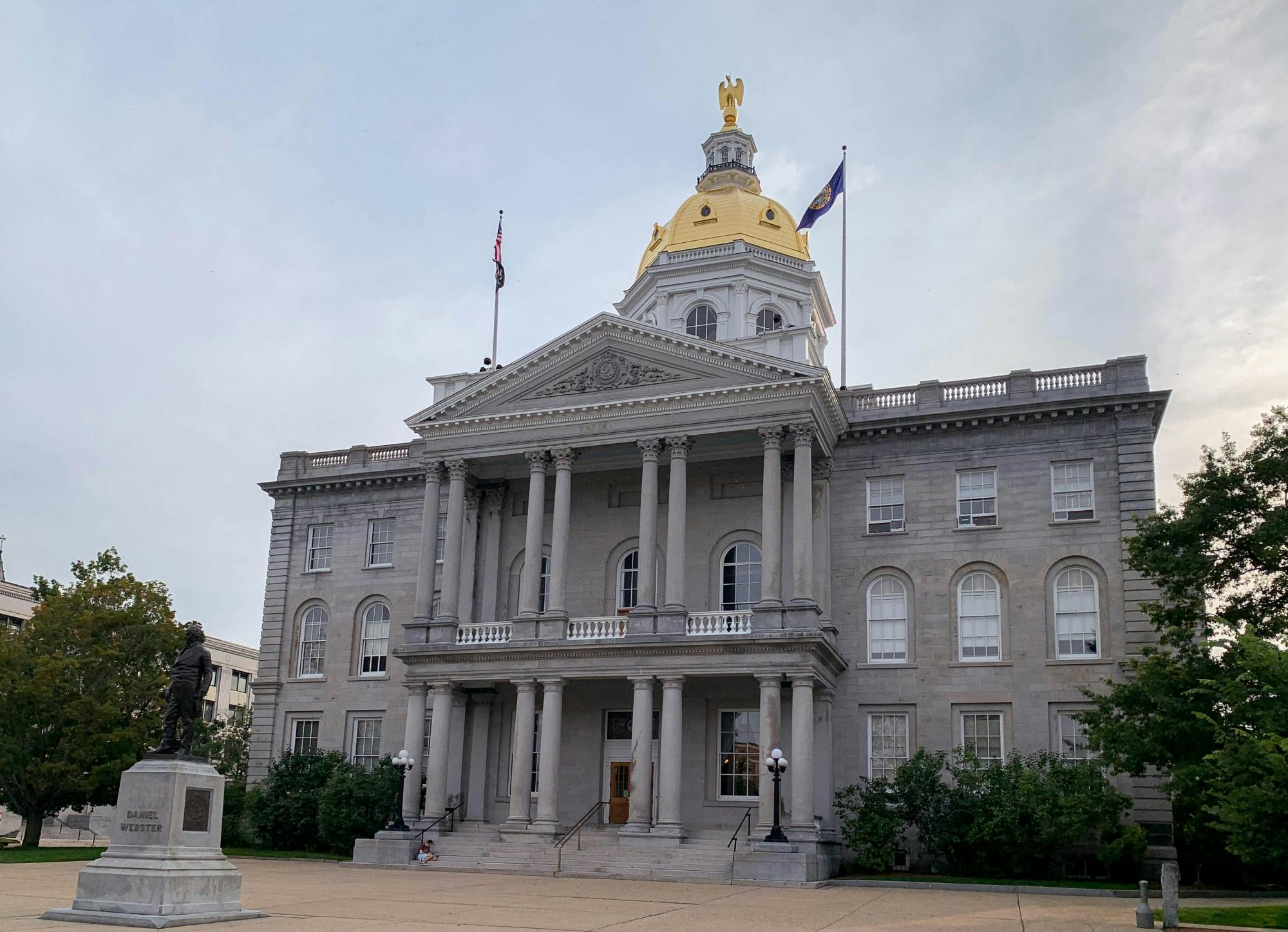
On Nov. 5, Democrats swept state elections across the east coast. In New Hampshire, however, incumbent Republicans were re-elected to municipal offices across the state, amidst rising polarization of the state legislature. How these trends will play out in New Hampshire’s upcoming midterm elections rests on the uniquely local character of the state’s politics.
With 400 representatives, the New Hampshire state legislature is the largest lower house of any American state and the third-largest in the English speaking world, according to the New Hampshire Executive Council. The next-largest lower house in the U.S., Pennsylvania’s, has only 203 members.
The New Hampshire House of Representatives also has the smallest citizen to representative ratio of any state, one representative for every 3,300 N.H. citizens, per the New Hampshire Bulletin. Massachusetts has one for every 44,000.
With each legislator presiding over a smaller community, they have the opportunity to be “intimately familiar with their constituents,” government professor and state representative Russell Muirhead, D-Hanover, said.
“This anti-federalist, ideal democracy — it’s like a fable from the past. But actually, it works in a very small state like New Hampshire,” Muirhead said.
New Hampshire’s state representatives do not work full-time for the state of New Hampshire and are paid a ceremonial salary of $100 a year. In New York, by contrast, professional state legislators make a living for $142,000 a year, according to the National Conference of State Legislatures.
The large number of citizen representatives means that the legislature continues to set “records” for bills submitted each year, according to state representative James Thibault, R-Merrimack, who is also a student at St. Anselm’s College and one of the youngest state representatives in the country.
Out of around 1,400 bills submitted each year, only a couple hundred get passed, Thibault added.
The low passage rate is a product not just of the volume of legislation submitted but also of New Hampshire’s unique requirement that every bill see floor debate.
“We’re in session [from] January to June every year. In that time frame, we have public hearings on every bill, we have a committee vote on every bill and then every bill gets a floor vote. We do that all in about six months,” Thibault explained. “I think it’s the most transparent and effective legislative system of any state.”
In 2024, House Majority Leader Jason Osborne, R-Rockingham, tried to remove the public hearing requirement from the state’s rules.
The attempt resulted in a “rebellion,” according to State Senator Suzanne Prentiss, D-Lebanon.
“This is the system we’ve always embraced,” Prentiss said.
Prentiss added that New Hampshire has also distinguished itself in “negative” ways through its “live free or die” political philosophy.
Osborne did not respond to multiple requests for comment.
In September, New Hampshire was the only New England state to abstain from a public health collaborative for the dissemination of guidelines separate from the Centers for Disease Control and Prevention following controversial vaccine guidelines from the Trump administration.
In contrast to other northeastern states whose legislatures have significant Democratic majorities, in New Hampshire both legislative chambers and the positions of governor, secretary of state and attorney general are controlled by Republicans.
Thibault said that while there is a “demand in New Hampshire for conservative policies,” the local, citizen-based aspect of the legislature allows for “bipartisan agreement” on many bills.
Federal politics don’t have “the biggest impact on the state level because people care more about what we can do for them in terms of education, state taxes and law enforcement, rather than what the federal government’s dealing with,” Thibault explained.
Muirhead, however, said that nationalized partisanship has made its way into the state house.
“Believe it or not, a lot of people care more about the party or ideology than ordinary factual conditions [such as] do people have jobs? Are the streets safe? Are the schools good? You know, everyday life is what matters, and that's what politics is supposed to deliver.” Muirhead said.
The House came under GOP majority in January 2025, with 221 Republican seats to Democrats’ 177. Legislation has followed this changing tide with nationally-aligned bills that are shifting the House’s “local” character, including a Jan. 9 bill making it easier for committee chairs to push votes through without prior notice to the public.
“There is an extremist wing of the New Hampshire Republican party that wields a lot of power in the House,” English professor and state representative Ellen Rockmore, D-Hanover, wrote in an email statement.
“They slash[ed] or eliminate[d] the types of taxes that the wealthiest residents pay, specifically the Interest and Dividends Tax and the Business Profits and Enterprise Tax,” Rockmore wrote. “New Hampshire, which is not a poor state, is now struggling to fund its public universities, its basic infrastructure needs and its services for the most vulnerable citizens.”
Thibault offered a different view of his party ’s policies.
“We’ve lowered taxes, we’ve increased education freedom, we’ve tightened our bail laws to make New Hampshire safer,” he said. “Our local communities are very important to us, so we want to see them thrive.”
These divides will come to a head in the 2026 midterm elections, when all 400 seats of the state legislature will be up for grabs. Muirhead said offering a centrist position will be an advantage in this contest, irrespective of political party.
“Democrats only win New Hampshire if they’re centrist,” Muirhead said. “They have a hard time winning against really moderate, really centrist Republicans. So if people in New Hampshire perceive the legislature to have been dominated by extremists, that will hurt Republicans. If they perceive the legislature to be dominated by centrist Republicans, that’ll make it harder for Democrats.”
Despite partisanship, legislators agree on the value of grassroots representation in the state legislature’s identity.
“We’re the people of the people,” Prentiss said.
Kay Alvito ’29 is a news reporter from Rio de Janeiro, Brazil studying comparative literature and creative writing. On campus, she is very involved with the arts as a member of the Rude Mechanicals classical theatre company and the dance group Street Soul.
Max Hubbard '29 is a reporter from Boston, Mass., and is majoring in government and minoring in French. In his free time, he enjoys listening to music, running and watching movies.