
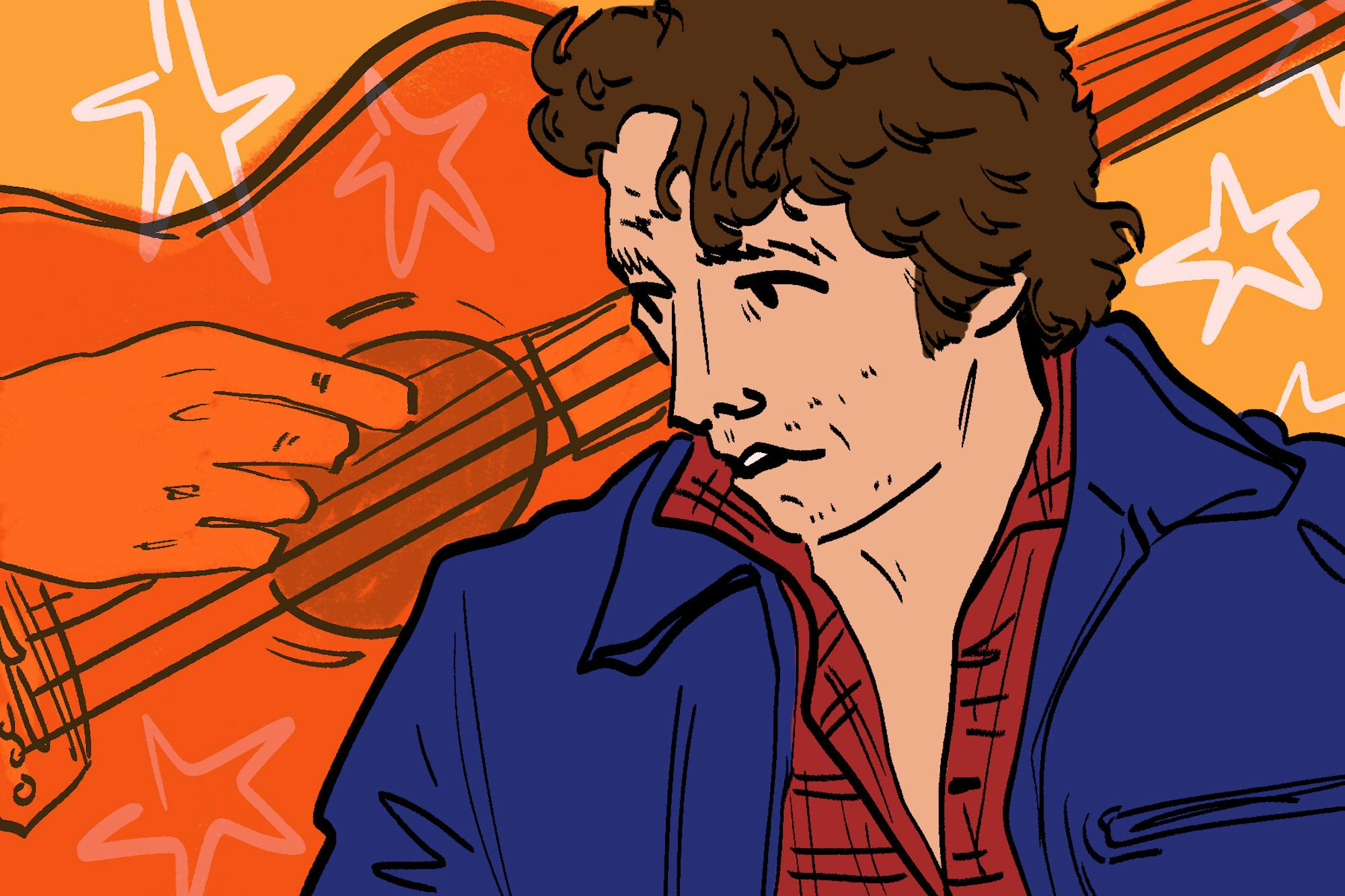
Introspective and anticlimactic, the Bruce Springsteen biopic “Springsteen: Deliver Me From Nowhere” is perhaps most accessible to viewers who are already fans of “the Boss.” This is not a traditional biopic — so viewers expecting a narration of the arc of Springsteen’s life will be disappointed. However, those interested in the craft of his songwriting and a glimpse into his emotions will be rewarded.
The film is based on Warren Zanes’ 2023 book chronicling Springsteen’s writing process for his 1982 album “Nebraska,” Springsteen’s attempt at a folk album. Famously recorded in solitude on a highly unconventional four-track cassette tape, it climbed to top three on the U.S. Billboard chart despite its release without fanfare. Unlike Springsteen’s rock albums, which promote an upbeat version of the American dream, “Nebraska” — subdued and a bit haunted — deals with dark themes like crime, heartbreak and futility. In his 2016 memoir “Born to Run,” Springsteen revealed that he wrote the 10 tracks in a deep depression while reflecting on his relationship with his abusive and mentally-ill father.
In the film, Jeremy Allen White convincingly plays a 32-year-old Springsteen — living in a rented house in the woods in his New Jersey hometown — following the end of the tour for his popular album “The River.” Struggling with growing fame and high industry expectations, while dealing with depression and also engaging in a months-long affair, he eventually produces “Nebraska” — as well as the start of his hit 1984 album “Born in the USA.”
The film alternates between scenes of Springsteen writing and black and white flashbacks, which director Scott Cooper relies on a little too much to demonstrate Springsteen’s preoccupations. In one overwrought moment of exposition, for example, a flashback shows Bruce’s father (Stephen Graham) taking him as a child to see a mansion on a hill, after which the scene cuts to him writing “Mansion on a Hill.”
Overall, the film’s struggles largely seem to be an inevitable byproduct of its structure — narrow in scope with no climax. Even Faye Romano (Odessa Young), Springsteen’s fictional love interest in the film who represents a composite of Springsteen’s girlfriends, cannot change the fact that Springsteen spent most of this period alone, writing and then recording in his bedroom. Thus, compared to 2024 Bob Dylan biopic “A Complete Unknown,” which tracks Dylan’s tumultuous and action-packed transition from acoustic to electric, this film falls flat in energy. Considering that Dylan and Springsteen occupy similarly revered places in the American canon, comparing the two films is natural. “A Complete Unknown” was electric in a way this film cannot be because it is about depression and solitude.
As a result, some of the side characters fall short. Jeremy Strong does his best to hammer depth into Springsteen’s kindly manager Jon, but the script offers him little to work with. While White and Young establish great chemistry, there’s too little screen time for it to fully play out before Springsteen abandons Romano for his career.
Nevertheless, White’s performance is the backbone of the film. He is simultaneously charismatic and weary, commanding as a musician yet clearly struggling. In one scene where he argues with Romano about his inability to open up, he adeptly portrays someone on the precipice of vulnerability. When he snaps at music technicians trying to polish the sound, his frustration is palpable. White’s acting is especially impressive in his many solo scenes: the movie is best when he is recording alone, or frantically writing lyrics.
White also particularly shines while covering the film’s featured songs, such as “I’m on Fire” and “Dancing in the Dark.” Bruce Springsteen has an incredibly distinctive voice; a ragged and raspy baritone. While White’s speaking accent is slightly inconsistent, he effectively taps into his character’s persona while singing.
From “The Promise,” this Springsteen lyric encapsulates Springsteen’s emotional struggles in the film: “All my life I fought that fight / the fight you can’t ever win. / Every day it just gets harder to live / this dream you’re believing in.”


