The College approached a student to promote Evergreen.AI — the College’s wellness artificial intelligence project — in an op-ed in The Dartmouth and edited the article before submission to the paper.
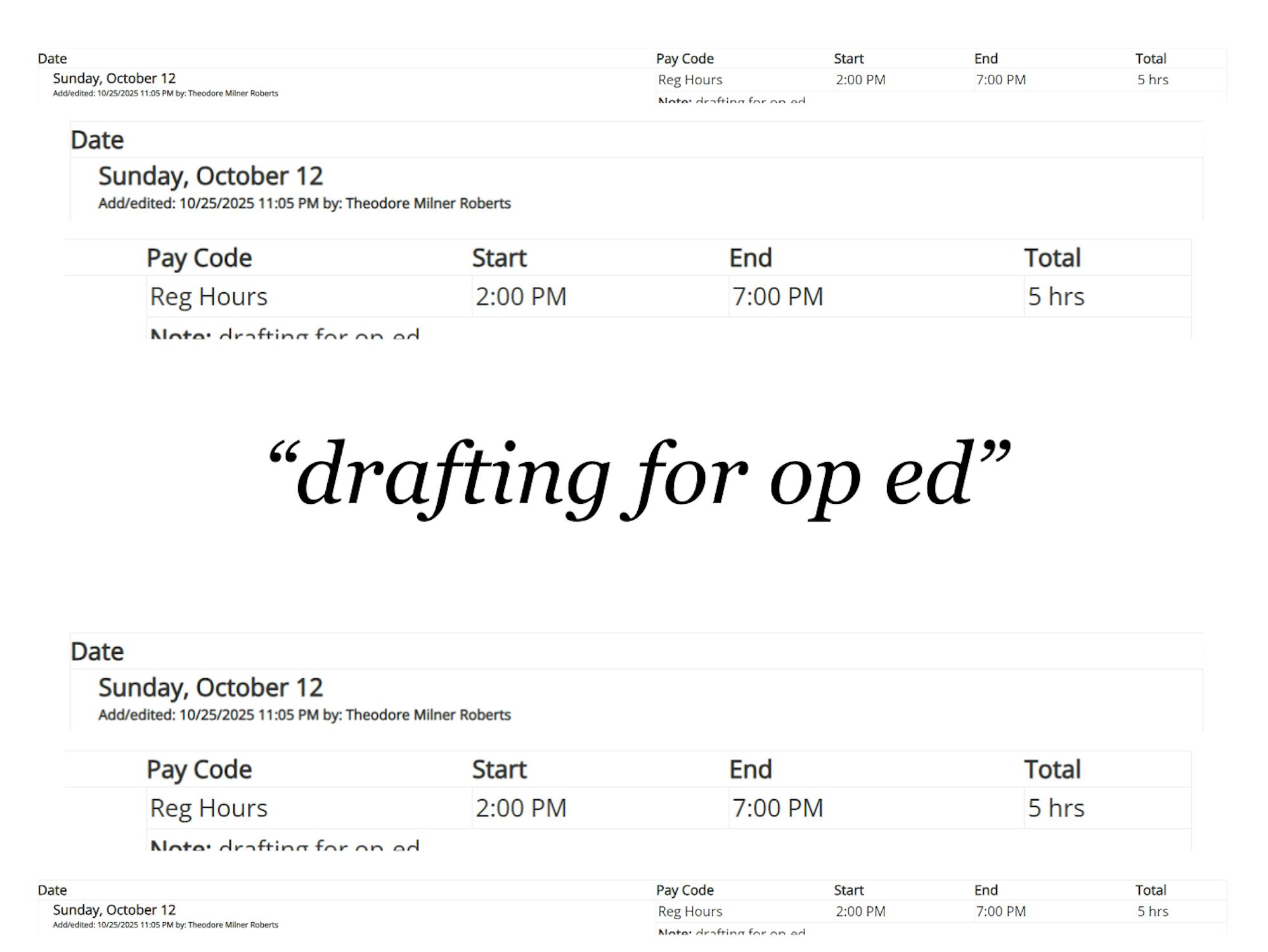
In his capacity as an Evergreen project assistant, Teddy Roberts ’26 later received $81.25 for his work on the column, according to a time slip obtained by The Dartmouth that reads “drafting for op-ed.” Roberts did not disclose to The Dartmouth that he had been compensated for and aided in writing the article until Nov. 21, 2025, four days after his initial opinion piece had been published.
Members of Dartmouth’s Office of Communications, who worked with Roberts on the piece, said they were not aware the student had billed the hours of work to the project. Roberts said that his Evergreen research coordinator — who is a non-student employee of the College — instructed him to bill the hours.
The Office of Communications team made and suggested edits to Roberts’s draft “like we were all writing it together,” Roberts told The Dartmouth in an interview. While no statements in the piece were untrue, they were not entirely aligned with “deeper things going on that I was really feeling,” he explained.
“It was very hollow and just sort of parroting what the administration or … the leadership team of Evergreen had been saying,” Roberts said.
Center of Technology and Behavioral Health at Dartmouth director Lisa Marsch, who is part of the Evergreen leadership team, wrote in an email statement to The Dartmouth that Evergreen compensates employees for work “including press engagement, conferences and related activities” to “ensure fair payment and so that financial constraints do not limit participation.”
“These opportunities are offered to student employees working on Evergreen in response to their strong interest in leadership and community engagement, and students are able to share any comments they wish during these activities,” Marsch continued.
According to emails obtained by The Dartmouth, College spokesperson Jana Barnello sent Roberts “food for thought” and “prompts” including, “Why is this project so important for Dartmouth students?” and “How and why are you involved in Evergreen?”
Office of Communications associate vice president Kathryn Kennedy wrote in an email statement that the office “offered advisory support only.”
The Office of Communications “routinely provides guidance to Dartmouth community members who are interacting with news media,” she wrote.
Roberts said that he was first approached by the Office of Communications about promoting the project in September. After he initially agreed to do so in general terms, a communications staff member reached out to propose several public-facing opportunities, including media interviews, donor panels and the opinion column. Roberts replied that he was willing to do all of them, but ultimately only wrote the opinion column and spoke in one media interview.
On Oct. 18, Barnello instructed Roberts in an email obtained and reviewed by The Dartmouth to send the draft to The Dartmouth.
“You might also want to mention that you think your op-ed is an important counterpoint to Eli’s opinion piece that ran on Friday,” Barnello wrote to Roberts, linking an Oct. 17 opinion column published by opinion editor Eli Moyse ’27 that criticized the Evergreen project.
Roberts said he “followed the instructions exactly,” sending a draft to The Dartmouth on Oct. 18 and including a mention of Moyse’s earlier column.
After his initial submission email did not receive a reply for 10 days, Barnello wrote to Roberts on Oct. 28 to “sit tight for now,” pending Marsch’s interview with The Dartmouth for a separate news article, according to an email obtained and reviewed by The Dartmouth.
“Let’s see how that goes and then reassess,” Barnello wrote.
The next day, Barnello wrote to Roberts that she had heard Marsch’s interview with the news reporter had gone “really well” and that she felt “comfortable with you following up with The D to see if they will run your piece,” which Roberts did. The article was accepted by The Dartmouth shortly after.
The Dartmouth’s ethics code, which is publicly available on its website, does not allow staff members to be compensated by external organizations for their work.
In an interview, The Dartmouth Publisher Quentin Proud ’26 said that authors receiving compensation for opinion columns is a “violation of the spirit of our ethics code” because it can lead them to “argue opinions that might not be their own.”
“It is our expectation that writers are disclosing financial incentives or conflicts … they might have in advance of publishing either a written article or an opinion piece,” he said.
“Most reputable journalism organizations” do not allow guest columnists to submit “an opinion piece for which they were paid by a third party,” Student Press Law Center executive director Gary Green wrote in an email statement to The Dartmouth.
“Many reputable publishers do allow for sponsored content, which is a form of advertising, but that is entirely different than an op-ed for which the author was paid by a third party to push a particular viewpoint,” he said.
Green said that “content marketing” — opinion pieces that are “commissioned by other organizations” — can erode readers’ trust in newspapers.
It “gives reason for your readers to question your journalism and your procedure and your ethics,” Green said.
Eli Moyse ’27, columnist and associate opinion editor for The Dartmouth, was not involved in the writing or editing of this article. Quentin Proud ’26, the publisher of The Dartmouth, was not involved in the writing or editing of this article. Charlotte Hampton ’26, the editor-in-chief of The Dartmouth, is the student representative on the Board of the Student Press Law Center.
Annabelle Zhang '27 is a reporter and editor from New Jersey. In the classroom, she studies Geography and Government modified with Philosophy and Economics. She enjoys creating recipes, solving puzzles and listening to music.