This article is featured in the 2026 Commencement special issue.
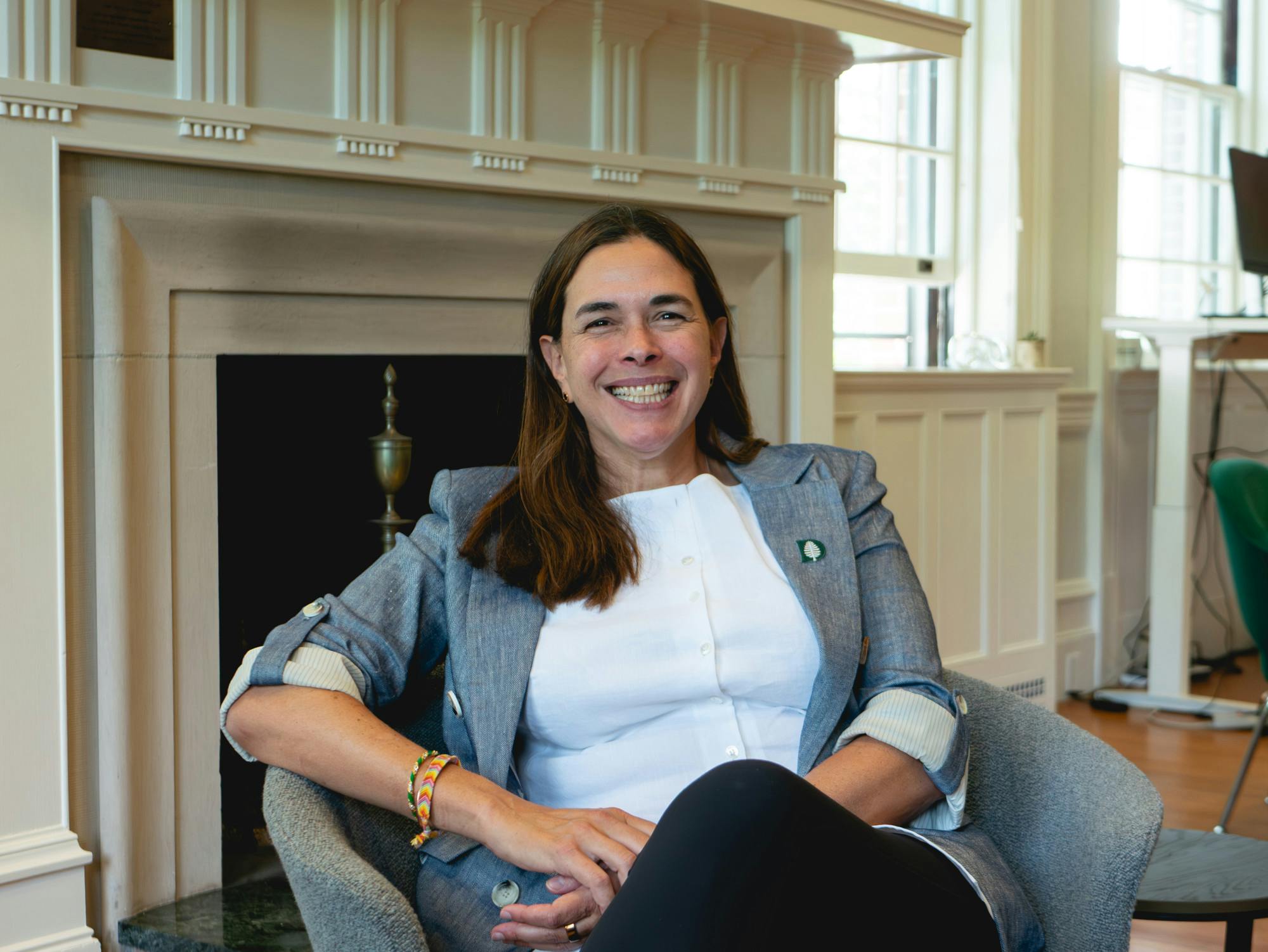
Fifty years after the first coeducational class graduated from the College, women continue to carve out a special place in Dartmouth’s history. The Dartmouth sat down with President Sian Leah Beilock, the College’s first female president, to discuss the past, present and future of women at Dartmouth.
Could you reflect on the experience of being the first female president of Dartmouth? Do you feel that there are particular issues or areas that you have been able to address from your unique vantage point?
SLB: I’m honored to be the president of Dartmouth, and I think it’s very special to be the first woman. Of course, everyone’s experience brings different sorts of insights to the job. I’ve been very focused on issues around student wellness and sexual violence prevention. As a woman, I bring that insight. It’s important to make sure women feel like they have just as much ability to be at the table as their male counterparts.
Do you feel like you faced any particular challenges, entering an office that had been male-dominated for so long?
SLB: It’s interesting as a woman, and raising a 15-year-old daughter, living on frat row. I think I maybe walked into that a little skeptical of what that was going to be like, but it’s actually been great. I’ve seen the community that Greek life brings and I’ve also seen a need to make sure that women are included. I think we need more sororities on campus, for example. I want to make sure that our female students have all of the same access to opportunities that our male students do.
What does it mean to be a “daughter of Dartmouth,” as referenced in our Alma Mater? What do you want the female graduates to leave Dartmouth knowing, feeling and doing?
SLB: I think Dartmouth is about empowering the next generation of leaders. I want our female graduates to feel they have just as much right to lead as their male counterparts. That means always making sure that they’re taking advantage of opportunities, raising their hands for recommendations, talking to people — doing whatever it takes to make sure that they have a foot in the door.
When women first arrived at Dartmouth, many reported being made to feel like intruders in a male-centered institution. Some women of the Class of 1976 described being called degrading names by their male peers, as well as being subject to deeply misogynistic banners and an offensive letter slipped under their doors. From your perspective as president, what Dartmouth-specific changes do you think have helped create a more gender-equitable campus than existed in those early years of coeducation?
SLB: I think one thing is that there were a lot less women than men at the beginning. One thing I feel really inspired by is that really old institutions — our institution is over 250 years old — can change. I think we have a responsibility to think about our traditions but also how we change. I think seeing women in leadership roles is really important — there’s a lot of research showing that’s the case. Whether it’s our alums or women leading the school, and being clear that this is the place where we need to have a culture where different ideas and perspectives can be held and that everyone who is part of our community deserves to be included and feel that they belong.
What specific things has Dartmouth changed over the years that you think have allowed women to become more included in the community over time?
SLB: Well, certainly numbers have changed, and now we have a lot of amazing female graduates who bring their perspectives back. I think women have really made a name for themselves in philanthropy, whether it’s what they did at Dartmouth Hall or the new Alumnae Hall that’s going to be on West Wheelock. We’ve also making sure that sexual violence prevention is an important part of what we do. Again, a focus on health and wellness. We have a lot of great women faculty, who lead and present as role models to our students. I think seeing all of that is important.
The Dartmouth ran a survey last year in which 91% of female respondents said that they experienced some amount of sexism on campus, and about 95% of female respondents said that Greek life has a role to play in perpetuating sexism on campus. As president, what avenues are you pursuing to address lingering sexism on campus? How does Greek life factor into that work?
SLB: Unfortunately, I don’t think sexism is limited to the Dartmouth campus. People are always going to be made to feel particular ways because of their identity or their gender, and I think we should push back against that. I do think that making sure we have spaces that women feel comfortable in, whether that’s sorority houses or clubs or others, are also really important.
I would say that I’ve seen such community in Greek life. I also know that students have to be responsible and look out for each other. I’m really proud now that all of our first-, second- and now third-year students will have training, and that our Greek leaders have that training as well. Then again, I think we need more spaces, more sororities, to support all of the women who are on campus. My understanding is we have just about the same number of men and women in Greek life but only about half the number of sororities.
Would you share more details about your desire for there to be more sororities on campus? Do you have concrete plans towards creating more sororities right now?
SLB: It’s funny you should ask. Dr. Jennifer Rosales, our chief student affairs officer, has been running a year-long residential working group, and they are talking about Greek life, house communities, living learning communities — all sorts of communities. That is where I first saw the data on the number of women and men in sororities and fraternities. My understanding — I don’t have the report yet — is that they might make some recommendations about that moving forward.
I will also say that we want to make sure that Greek life is safe. That is, point blank, the most important thing. I also see a lot of benefits that men get through their fraternities and the alums. I want those benefits for women too; those should be everywhere. I also want to make sure that those connections live for everyone on campus, whether you’re a part of Greek life or not, which is one of the reasons we’re really pushing to invigorate the new Center for Career Design, so that everyone can have those connections to alums and use the Dartmouth family.

Shifting gears, the leadership of the Women of Dartmouth alumni group — Dartmouth’s largest alumni group — wrote an opinion article in The Dartmouth and a letter to the Board of Trustees urging the College to rename the Black Family Visual Arts Center in light of three women accusing Leon Black ’73 of sexual assault, as well as Black’s longstanding financial and social relationship with convicted sex offender Jeffrey Epstein.
Dartmouth Student Government and the Student and Presidential Committee on Sexual Assault have urged the same, along with Rep. Ro Khanna, D-Calif., when he visited campus earlier this year. What is your perspective on these requests?
SLB: First of all, I understand and empathize with people who are disturbed by having the name on the building. Sexual assault, as I’ve said before, is never okay. The Board of Trustees takes this really seriously, and they have spent a lot of time talking about next steps. They announced that they’re putting together a committee on the naming process to make a decision based on principles and Dartmouth’s values. That will be in the long-term best interest of the school. I think as they started to talk about these issues, they realized that they needed better processes and procedures in place, vehicles to get input from the community and to think about the naming processes writ large.
Certainly BVAC will be a topic of conversation there. I think always our goal is to make decisions based on the evidence that’s out there, based on principles and think about how we can make a decision that is for the College now, but also works in the future. The Board is going to work carefully but in an expedited manner, and I think they take it very seriously.
What is the timeline for the formation of the Board’s naming committee and decision-making? What will your input look like on this committee?
SLB: The Board is going to announce the charge of the committee and the timeline in June. I don’t think it’s all specified now, but they want to work quickly but carefully.
Naming decisions are Board decisions. I certainly give input into this, but the Board, as fiduciaries of the institution, make that decision.
The College has previously said that it no longer maintains a financial relationship with Leon Black. Does the College maintain any other, non-financial, form of relationship with him or the Black Family Foundation?
SLB: I don’t know what you mean by that.
Does Black serve in any advisory capacity at the College?
SLB: No. We don’t have a financial relationship with Leon Black or the Black Family Foundation.
Looking forward, what do you want the next 50 years of women at Dartmouth to look like?
SLB: Sometimes this is a hard job, but my favorite thing is walking around campus and thinking, ‘One of our students is going to be the next president of this country, they’re going to be in Congress.’ I want to see a lot of women in those roles.
How does it feel that the class of 1976 is coming back for their 50th reunion very soon?
SLB: I’m actually an honorary member of that class, and it’s also the year I was born, and so it’s really special, being the first woman to have the role of College president. I think our institutions can get better but the fact that an institution like Dartmouth is able to change and push forward gives me faith that what we’re doing here is so important and it can get better.
This interview has been edited for length and clarity.
Black has faced multiple lawsuits accusing him of sexual harassment, abuse or rape. He has denied all allegations of wrongdoing, and the three lawsuits have since been dismissed.
Vidushi Sharma ’27 is an executive editor and news reporter. She is majoring in Government and minoring in International Studies and Sociology.