Boots and Rallies
“Are you going to FoCo?” This question, the most phatic bit of verbiage, is laden with history and innuendo that someone outside of Dartmouth’s cultural cell could never understand and about which someone within forgets to think.
Lately I have surveyed campus with an extra jiggle in my step. I have ignored a bit more cheerfully than usual the humming of the paper shredders in Baker-Berry as scores of readers gather to destroy every print edition of this column they can find.
59, 25 — The percent of members of the Class of 2015 and Class of 2018 respectively who have been in love at Dartmouth. \n 53 — The percent of total respondents who matriculated as virgins and are still virgins. \n 75, 63 — The percent of members of the Class of 2017 and Class of 2016 respectively who always or almost always use protection. \n 35 — The number of times people described their love life as “nonexistent” in their survey responses. \n 48 — The percent of respondents who have had a friends with benefits relationship and think sex is too casual on campus.
What’s the most romantic spot in Hanover? \n Ah, idyllic Hanover! Isolation brings its perks — our cozy campus is replete with spots for cuddling and canoodling.
When The Mirror polled campus last week, we asked, \nIf you could send an anonymous romance-related message to anyone at Dartmouth, what would you say? \nHere's how you responded.
Artists' Note: It’s usually an assumption that love at Dartmouth doesn’t exist since it isn’t really visible on campus. So when we took on this project, we thought it would be hard to find couples on campus. However, throughout the past few days when we met and photographed couples in their happiest moments, we learned that love does exist at Dartmouth, and it sometimes comes in the most unexpected ways.
Dartmouth University or Dartmouth College: a debate that is almost as old as the school itself.
Dartmouth’s departments, programs and minors have committed to a liberal arts education, evidenced by the many interdisciplinary programs and majors, cross-listed courses and the collaboration between faculty members. Though there is a limited supply of resources, and most department chairs would prefer to have more funding, this has not led to much competition between departments.
In order to market itself to prospective students each year and keep application and enrollment numbers high, the College has to appeal to and attract prospective students from around the world.
This issue began on a four-way Skype call coordinated between four time zones and three continents. Say that three times fast.
Dartmouth graduates leave Hanover with either a B.A. or B.E., both representing an education cultivated across disciplines. This approach is advantageous for those desiring to gain experience in many fields, but some prospective students who want to specialize in art may have difficulty deciding between the liberal arts and the fine arts.
Each year, The Dartmouth publishes a story reporting the College’s ranking compared to other higher education institutions as determined by the U.S. News & World Report. These rankings, however, are not without their critics.
According to a report published by the Committee on Instruction last winter, the average Dartmouth grade point average has increased by 11.48 percent across departments – from 3.05 to 3.40 since the 1970s.
Addressing the issue of how student identity affects classroom dynamics is messy and potentially controversial, yet, the conversation is one that both students and faculty at Dartmouth seem ready to have. And yes, the first step is admitting we have a problem.
Each year, around 600 students participate in research through the undergraduate advising and research office, in addition to those who work through other sources on theses and independent studies.
Extending the undergraduate emphasis on an interdisciplinary education to graduate studies, Dartmouth’s Master of Liberal Arts Studies graduate program focuses on the liberal arts rather than pre-professional training.
Following the recent Religion 65 cheating scandal, in which 64 students were charged with honor principle violations, the topic of academic honesty resurfaced in campus discussion.
Graduate students inhabit the same campus as the College’s undergraduate population, but experience different forms of academic and social life.
Advocates make a convincing case, but is the statement worth the financial hit?
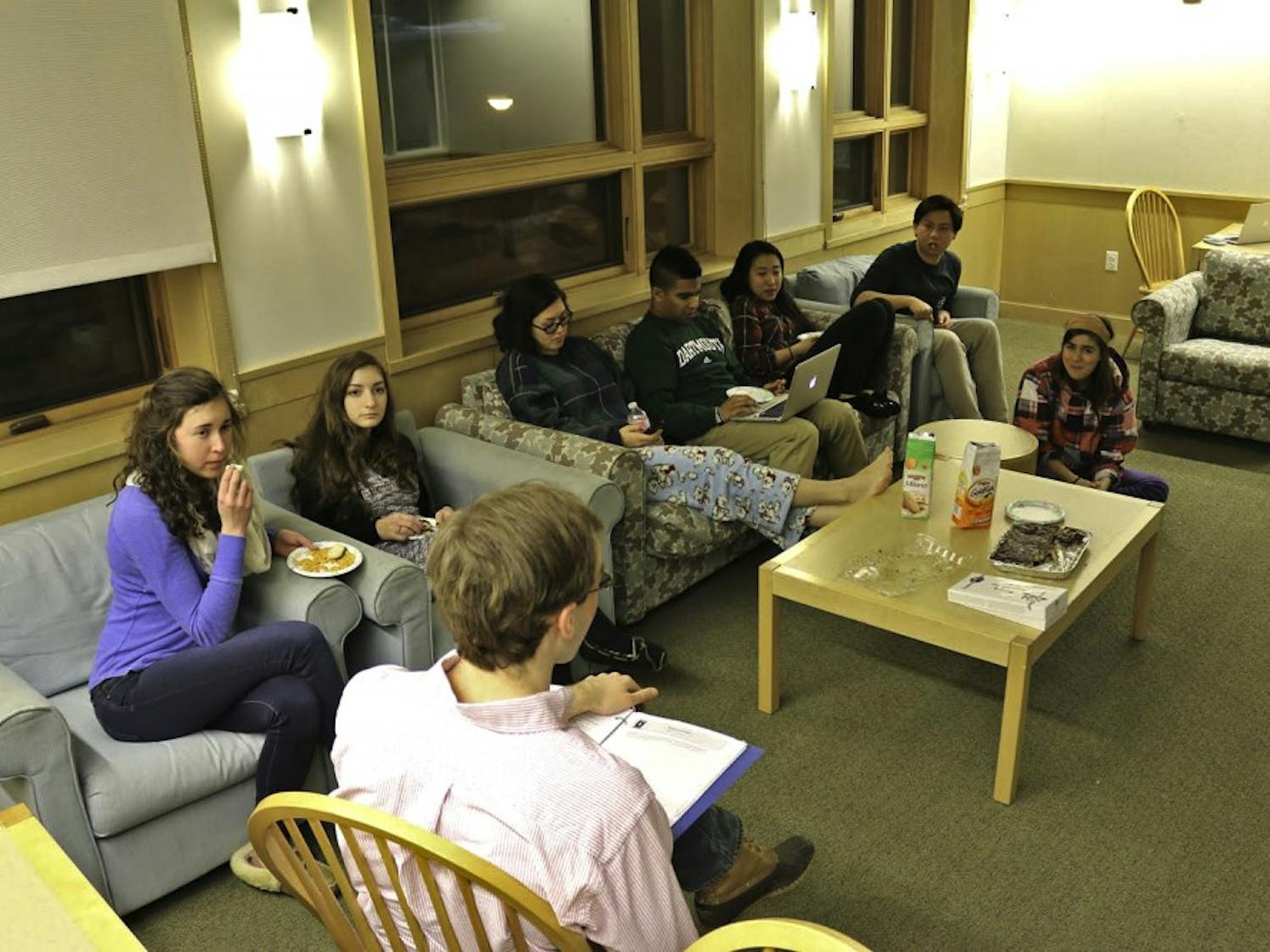
Although the windows reveal the icy, barren scene of a Hanover winter, thoughts of warmer weather and spring sunshine fill the air in the Collis second floor lounge. Six students sit together and ardently plan the extensive fruit-and-vegetable-producing garden that will be planted in a sorority’s yard this spring.