
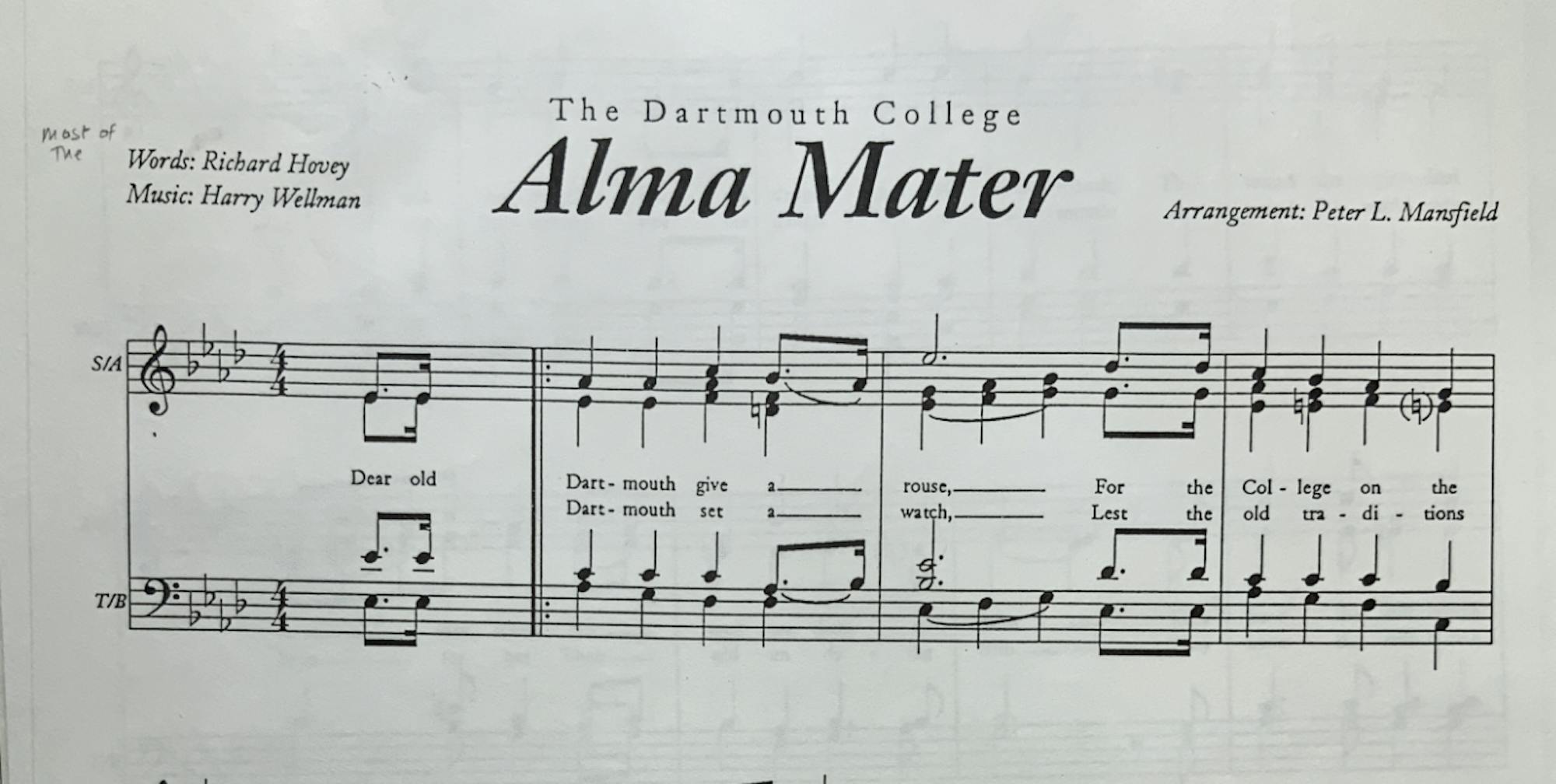
Whether you’re a member of the Class of 2030 or the Class of 1988 or even the Class of 1894, you’ve heard Dartmouth’s alma mater, or at least some version of it. The familiar chords of “Dear Old Dartmouth” echo out from the Baker Library bells every day at 6 p.m. like clockwork. Before matriculation, freshmen sing the lyrics as they hold lit candles in the woods — and often think to themselves, “Did I just join a cult?” By the time students sing it at graduation, they hardly need the lyrics on their program. Those familiar words are already seared into “their muscles and their brains.”
The history of “Dear Old Dartmouth,” however, reveals a more complicated story behind what is now a wholesome symbol of school pride.
Men of Dartmouth
On Easter Day 1894, Richard Hovey, Class of 1885, wrote a poem titled “Men Of Dartmouth,” which was later published in the Dartmouth Literary Monthly, a student-run literary magazine that operated from 1886 to 1912. The verses represent Dartmouth as a place of loyalty, tradition and fraternity. Lines such as “Men of Dartmouth, give a rouse”; “the sturdy sons of Dartmouth”; “stand as brother stands by brother”; and “their old chivalric faith” emphasize that being an all-male institution was an integral part of Dartmouth’s identity.

Months later, Henry Moore Baker, Class of 1863, wrote to the College offering to award a $100 prize for the “best poem suited to a Dartmouth song.” Hovey’s poem won. This prize did not necessarily intend to create a new alma mater. Dartmouth students writing songs about the College was tradition, and six different editions of The Dartmouth Songbook compiled these tunes over the years.
Baker subsequently offered another prize of $100 for a music composition to accompany the verses, so Hovey himself requested a score from the young English composer Mary Wurm, who had collaborated with him on other songs. Wurm’s score was rejected “because she was not ‘a Dartmouth man,’” according to a Dartmouth News article from 1986. This event reinforced the original lyrics’ association with a narrative of Dartmouth as an exclusively male community where women were unwelcome and unacknowledged.
Following many attempts at a composition — by people including then-music professor Charles Morse and Addison Andrews, Class of 1878 — the melody that became the song we know today was composed in 1908 by Harry Wellman, Class of 1907.
Though a different tune, called “The Dartmouth Song,” had been the College’s official song since 1891, “Men of Dartmouth” was sung at Commencement starting in 1910. A vote in 1914 showed that Dartmouth students preferred “Men of Dartmouth” to the previous song, and it became the official alma mater in 1926.
Men and women, sing as one
While the first coeducational class at Dartmouth matriculated in 1972, no official proposal to include women in the lyrics of the alma mater was made until 1986.
During the Class of 1976’s matriculation, the alma mater was substituted for another song, “Dartmouth Undying,” to “avoid any appearance of male chauvinism,” according to a 1972 College Office of Information Services report. At the end of matriculation, however, a group of students still insisted on singing “Men of Dartmouth.”
In fact, in response to the arrival of women, male students started emphasizing the line “lest the old traditions fail” by singing it louder than the rest of the song in what a 1988 protest flyer of unknown provenance — denouncing sexist traditions that continued despite changes to the alma mater — called a “hostile message to women.” It was a reminder that Dartmouth’s men-only identity was a tradition that some male students intended to keep untouched.
When The Dartmouth polled female students about the song in 1972, 68% out of the 94 students who answered said the lyrics of the alma mater should be kept as it is.
“If men want to sing about rocks in their heads, it’s fine with me,” one poll responder wrote. Another wrote, “Women should be proud to be Men of Dartmouth.”
In response to this poll, the Board of Trustees voted to reaffirm “Men of Dartmouth” as the College’s official song, and people returned to singing it at events the following year, according to the 1972 Office of Information Services report.
The student body culture shifted by the 1980s, with many women wanting to see institutional change. In 1980, a new verse written by Cobra — Dartmouth’s first all-female senior society — was presented from this group of women in the Class of 1980 as a “gift” to the College. The lyrics were not only an adaptation of the lyrics of the old song, as today’s “Dear Old Dartmouth” is, but a reimagining of its ideals.

In the lyrics to the new verse, Cobra added new meaning to the alma mater and the Dartmouth identity: one of equality, unity and friendship. Rather than giving a rouse and standing by each other, the new verse urges students to “sing as one” and “give a hand to one another” and calls the Dartmouth community a “family.” The verse also included the line “stand as sister stands by brother.”
As then-women’s studies department chair Marysa Navarro-Aranguren, a prominent proponent of coeducation at the College, told The Dartmouth in 1980, the new song was a “synthesis” of “what Dartmouth is about.”
“It goes beyond brotherhood and establishes fellowship,” she said at the time.
In a 1986 Valley News article titled “One More Time: ‘Men of Dartmouth,’” then-Office of Speech co-director Merelyn Reeve said people “loved” the added verse.
“It was the first time women in the faculty felt something had been done,” she said.
Soon, though, the Student Assembly voted against it, according to the same Valley News Article.
“It’s a tragedy … that we still are stuck with a song that excludes half the population,” Reeve said, reflecting on the lack of official change in lyrics.
Adding Cobra’s verse to the alma mater was never officially proposed, and there are no records of the added verse ever being sung after that Commencement in 1980.
When the old traditions fail
In May 1986, the College’s Council on Diversity proposed that the College seek more inclusive alternatives to the song — which could involve changing the lyrics, choosing a different Dartmouth song or writing a new one — and, in the meantime, not sing the song at official events, according to the 1986 Valley News article.
By the time matriculation rolled around, protests against the singing of “Men of Dartmouth” began. According to another 1986 Valley News article, two female students — Susan Jarvis, Class of 1987, and Margaret “Meg” Pappano, Class of 1986 — shredded their programs and threw them onto the platform where College officials stood singing “Men of Dartmouth.”
The two students distributed a flyer titled “For an alma mater that includes everybody; why ‘Men of Dartmouth’ does not,” urging students to remain seated and silent during the song, arguing that “diversity is now part of the Dartmouth spirit, and should be reflected in every aspect of the College.”
Pappano told the Valley News at the time that they had resorted to protest because they had “tried all legitimate approaches” to make changes to the alma mater.

According to the Valley News article cited above, though the majority of the crowd at Commencement stood up and sang, then-College President David McLaughlin “endorsed” changing the words to be more inclusive during his convocation address.
In October, a group called “womben to overthrow dartmyth” that also felt they had “exhausted” the methods of official negotiation — considering that the Council on Diversity had already advised against singing the song at official events, but it was included in programming anyway — choosing to instead take protests a step further by distributing bloodied tampons on the lawn in front of McLaughlin while he delivered a speech. In a flyer for the cause, the group condemned the patriarchy, capitalism and “phallocracy” and claimed that “wimyn have no voice, no power, no existence.”

That same year, McLaughlin created the Student Alma Mater Committee to ultimately decide whether the lyrics would change.
With the possibility of change came pushback. R. Hugh Uhlmann, Class of 1937, wrote a misogynistic parody of the new song in 1987, which began with “Its of Dartmouth give a rouse/ For the College on the Pill!”
“For the unisex at Dartmouth/The fisting ones at Dartmouth,/ Tho round the girdled earth girls roam,/At home their bra remains,” the parody continues.

According to the “Men of Dartmouth: a brief chronology” file in the Rauner archives, in 1987, the Student Alma Mater Committee poll showed that 61% of students did not want to change the alma mater. Still, the committee recommended that it be revised.
An article published by The New Hampshire Bulletin in December 1987 announced that the Dartmouth Alumni Council had approved changes to the alma mater, to be made “as soon as possible.” Another article from that issue of The Bulletin is titled, “Trustees seek closer male-female ratio.” These changes came concurrently — at a time when the College was striving to build a more diverse student body through a “vigorous recruitment policy” geared towards women.
As sister stands by brother
In 1988, then-College President James O. Freedman announced eight changes to the original lyrics. Among the changes are: “Dear old Dartmouth” replacing “Men of Dartmouth”; “undying faith” replacing “chivalric faith”; “as sister stands by brother” replacing “as brother stands by brother”; and “the loyal ones who love her” replacing “the loyal sons who love her.”
“The new version celebrates the presence of women and men as a single community on this campus,” Freedman told the Dartmouth News that May.
At Commencement in 1988, the “Dear Old Dartmouth” that students today know and love was sung for the first time, under the program simply as “the alma mater.”

Just like Dartmouth itself, the alma mater reached its present form through social, institutional and cultural change. Reinvention is a part of the Dartmouth tradition.
Kay Alvito ’29 is a news reporter from Rio de Janeiro, Brazil studying comparative literature and creative writing. On campus, she is very involved with the arts as a member of the Rude Mechanicals classical theatre company and the dance group Street Soul.
