
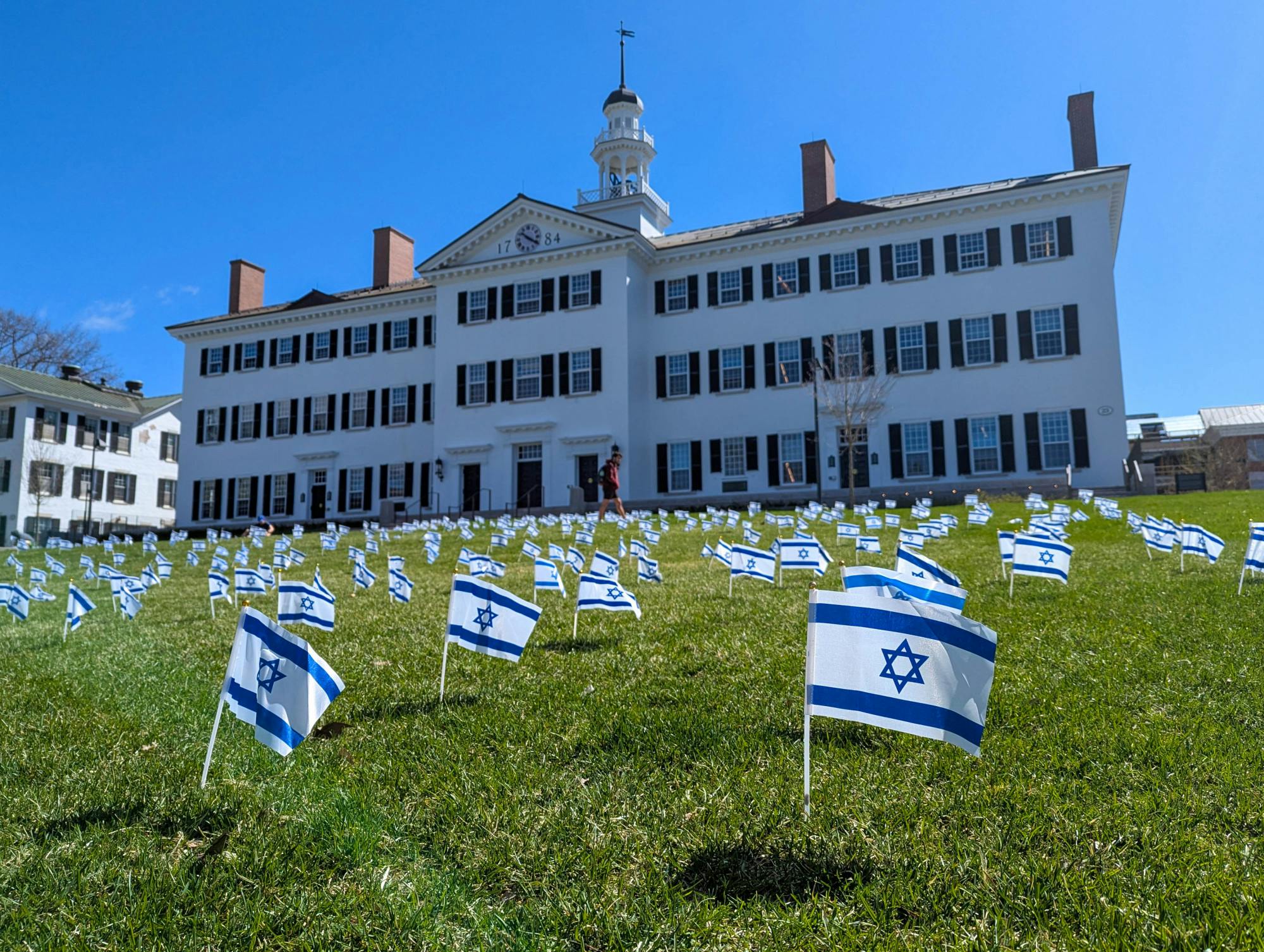
Since the start of the year, several academic initiatives have begun work on bringing Israeli scholars to campus. Dartmouth Kalaniyot has recently begun facilitating scientific research collaborations between the College and Israeli universities. Additionally, an anonymous donor is funding a new program that will bring visiting Israeli politics professors who are affiliated with Israeli universities to Dartmouth’s government department.
Computer science professor Daniel Rockmore and psychological and brain sciences professor Jeremy Manning launched Dartmouth’s Kalaniyot chapter in the fall of 2024. Kalaniyot is a faculty-led initiative for academic collaboration between Israeli and American universities that was originally founded at the Massachusetts Institute of Technology following the Oct. 7, 2023 attacks in Israel. Dartmouth’s chapter was the second after MIT, and there are currently seven active campus chapters.
Rockmore said Kalaniyot is bringing its first scholars to Dartmouth in the summer and fall of 2026.
“Israel is known for its amazing science, and Kalaniyot helps support faculty who want to benefit from the ideas that people working at Israeli institutions have,” Rockmore said.
Dartmouth-Kalaniyot Collaborative Ventures in the Sciences funds $50,000 for year-long research collaborations between Dartmouth and faculty at Israeli universities.
Rockmore said Dartmouth Kalaniyot received 26 applications for research collaborations, only five of which could be funded.
“We had to make some tough decisions,” Rockmore said.
Rockmore said the number of applications inspired the creation of the Kesher Grant Program, which provides $5,000 grants for one-week visits to Israel for Dartmouth faculty to “explore shared interests and establish pathways for collaborative research” with Israeli researchers, according to the Dartmouth Kalaniyot website.
“The intention of these grants is that if a faculty member would go over [and] give a talk in someone’s lab, they’d actually be able to have a more meaningful exchange so that after that, they could then come back to Hanover and write a stronger proposal,” Rockmore said.
According to its website, Dartmouth Kalaniyot is currently accepting applications for its 2026 Postdoctoral Fellows Program — for Ph.D. and M.D. graduates from Israeli universities to complete post-doctoral training at Dartmouth — and its 2026 Sabbatical Scholars Program, for established faculty and researchers to conduct research at Dartmouth during sabbaticals from their Israeli institution. Dartmouth Kalaniyot, which is funded by the trust of Harvey Grable ’58 and anonymous donors, does not support teaching positions, according to Rockmore.
Dartmouth Kalaniyot began its “Lunch and Learn” lecture series on Nov. 10, 2025, when Weizmann Institute of Science physics and math postdoctoral researcher Assaf Shmuel spoke about machine learning and climate science. Shmuel visited Hanover for a week to work with the math and geography departments, according to Rockmore.
On Jan. 26, University of Haifa professor Derya Akkaynak spoke on Zoom about underwater imaging in the second installment of the series. Around 30 people attended each event, according to Rockmore.
Two Palestine Solidarity Coalition members, Jamison Anderson ’26 and Ramsey Alsheikh ’26, protested the Lunch and Learn lecture on Jan. 26 with flyers that read “End Kalaniyot” and “Keep scholasticide off our campus.”
In an interview outside the event, Anderson said the collaboration with scholars from Israel “feels inappropriate” because Israeli universities are “complicit” in “both the genocide and scholasticide in Gaza.”
“There is still a genocide in Gaza,” Anderson said.
Rockmore said Kalaniyot is apolitical.
“The mission is to deepen ties and do collaborative work with Israeli institutions and their faculty, regardless of the race, origin or anything about the individual faculty member,” Rockmore said.
Separately, another program is seeking to bring professors from Israel to the College. The government department is currently seeking to hire visiting professors who are currently affiliated with an Israeli university, according to an Interfolio job posting on Jan. 12. Government professor and associate dean of social sciences Benjamin Valentino said the pilot program is funded by an anonymous donor and will bring between two and four visiting professors to Dartmouth over the next two academic years.
This pilot program will be the College’s second program that fosters relationships with institutions in a specific country. The Harris Professorship — which brings visiting professors from German universities — was founded in 1987.
Valentino said he is “excited” to bring scholars from Israeli universities to Dartmouth.
“Israel is a place where there’s quite substantial interest from our students and our faculty, so it seemed like a logical place to have a program like this, especially because we had the generous support of donors to make it possible,” he said.
Government professor William Wohlforth, who was appointed to lead the search, wrote in an email statement to The Dartmouth that the department is looking for “the best political scientist” with expertise in Israeli politics. According to the job post, a review of candidates began on Jan. 30.
“It’s a matter of student interest, plus trying to reduce any overlap with existing offerings in this area,” he wrote.
PSC member Kevin Engel ’27 said they are “very disappointed” by Kalaniyot and the new government department program and said they believes the programs “directly oppose” the College’s institutional restraint policy.
“They’re actively supporting the idea that Israel is this moral and just country,” Engel said.
Valentino said he hopes he is “not held accountable for decisions of” the U.S. government.
“Even if you don’t like what you think the policies of the Israeli government are, more contact between American and Israeli scholars is a good thing,” Valentino said. “There’s no ideological test for this position. Especially in situations when there are differences of opinion, I favor more communication rather than less.”
Elizabeth Ray ’27 contributed to reporting. Ramsey Alsheikh ’26 is an opinion editor for The Dartmouth. He was not involved in writing or editing this article.
Iris WeaverBell ’28 is a reporter and editor. She is from Portland, Ore., and is majoring in economics and minoring in public policy.


