
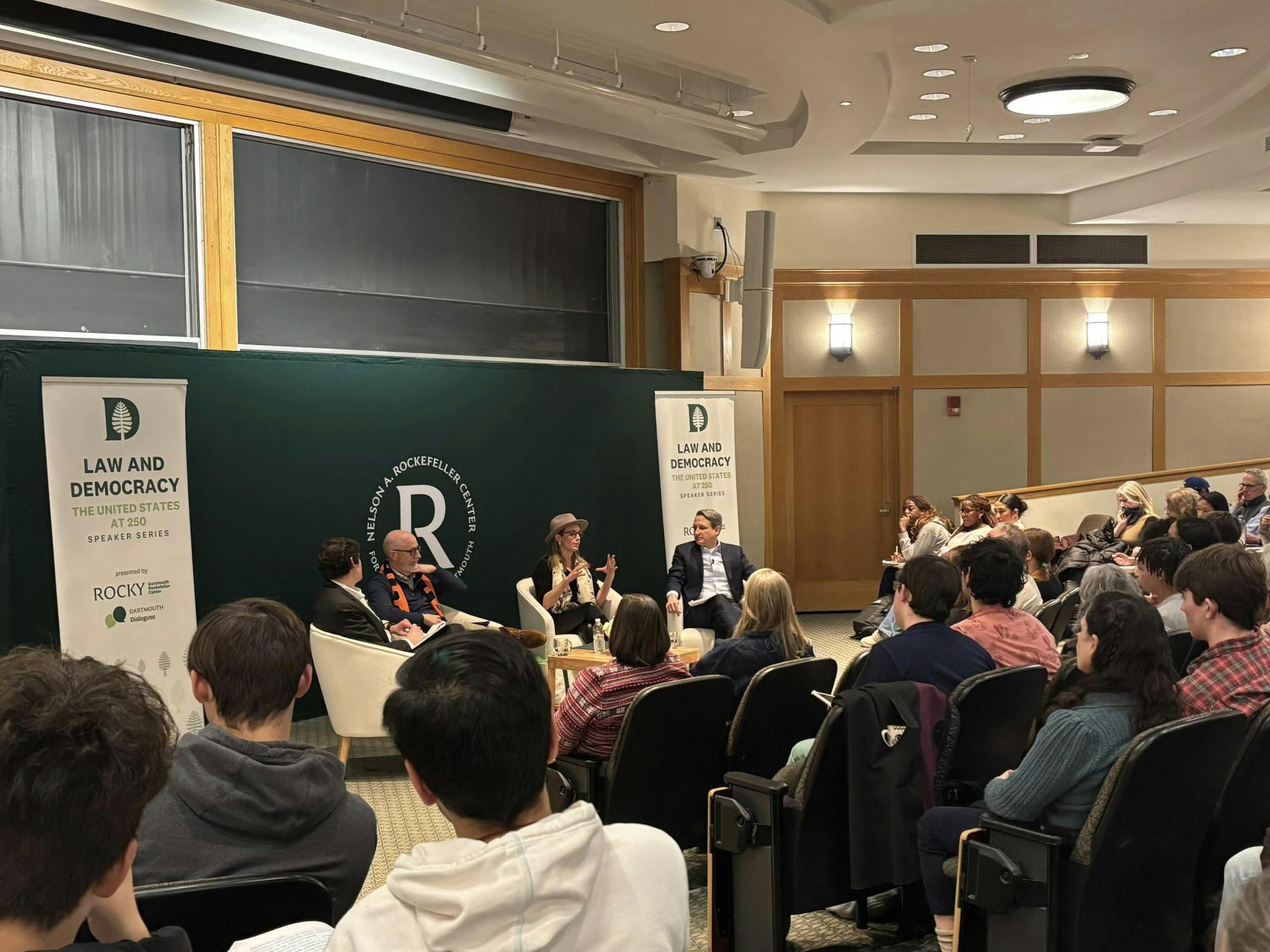
On Jan. 29, New York Times Opinion columnist and former attorney David French said the Supreme Court’s conduct has been “quite heartening” and that it has stayed “within its constitutional bounds” at a Rockefeller Center event.
At the event, titled “The Supreme Court, Law and American Democracy,” ABC News legal analyst and former Department of Justice spokesperson Sarah Isgur and French discussed the limits of executive power, the Trump administration’s alleged violations of international law and the judiciary’s role in American politics.
Two hundred people attended the event in Filene Auditorium, and another 120 people tuned in virtually, according to Rockefeller Center associate director of public programs and special events Dvora Greenberg Koelling. Government professors Herschel Nachlis and Benjamin Valentino moderated the event.
French began the event by praising the title of Isgur’s upcoming book “The Last Branch Standing.”
“I actually do believe that in our three branches of government right now, the judiciary is the last branch standing,” French said. “The presidency has broken through all of its bounds. Congress has receded into an ooze of invertebrates.”
French predicted that upcoming Supreme Court rulings could limit presidential power, resulting in a “diminished executive branch.”
“The Supreme Court is moving towards a scenario where the executive … can’t unilaterally cancel student loans, can’t unilaterally change the census [and] can’t unilaterally engage in worldwide tariffing,” French said.
French added that he did not believe that the Court was divided along ideological lines between conservative and liberal justices.
“Forty-six percent [of Supreme Court cases] were unanimous,” French said. “Fifteen percent [of cases] were decided with only conservatives in dissent and all the liberals in the majority … People are so locked into the 6-3 framework that contrary evidence just washes over them.”
Isgur argued that the Court’s “legitimacy problem” has been “driven by external actors.”
“Because of the president, [and] because of Congress, all of these questions are winding up in the Court,” Isgur said. “And so we get mad at them.”
Shifting towards international law, French criticized the Trump administration’s attempts to acquire Greenland and said there was “zero distinction” between Russia’s armed attack against Ukraine and a hypothetical United States war against Denmark.
“There is no credible legal argument that an armed attack on Denmark under these conditions meets the laws of war,” French said. “… In that circumstance, you would have an American president and senior American commanders and an American secretary of defense who
would be international war criminals.”
French and Isgur concluded the event by discussing the possibility of televising future Supreme Court debates — similar to congressional debates, which allow live video — with both agreeing that they should not be televised. Currently, the Supreme Court only provides the live audio of oral arguments.
In an interview with The Dartmouth after the event, French elaborated, saying that live video has created the conditions in which members of Congress can “market themselves” with “bite-sized comments, soundbites [and] confrontations.”
“In elected branches of government, the prevalence of the combination of video plus social media has resulted in an irresistible temptation to create moments rather than to have discussions,” French said.
In an interview, Valentino said that it is “critical” to have “informed opinions” about legal issues.
“These kinds of events are the way that we try to give the opportunity to our students to learn about the legal system, because they’ll go out and have to vote and have opinions about all these critical questions that are before our country right now,” he said.
In an interview with The Dartmouth, David Kriegsman ’29 said he “really agreed” with French, adding that he thought that the Supreme Court was the “last defense of our republic.”
“The executive and the legislative [branch] are frankly acting like clowns,” Kriegsman said.
Attendee McKinlee Williams ’29 said she “loved” the event, adding that it showed her that “this is a time to listen and be aware.”
“It’s really important that we hold our government systems accountable right now,” she said.
Kay Alvito ’29 is a news reporter from Rio de Janeiro, Brazil studying comparative literature and creative writing. On campus, she is very involved with the arts as a member of the Rude Mechanicals classical theatre company and the dance group Street Soul.


