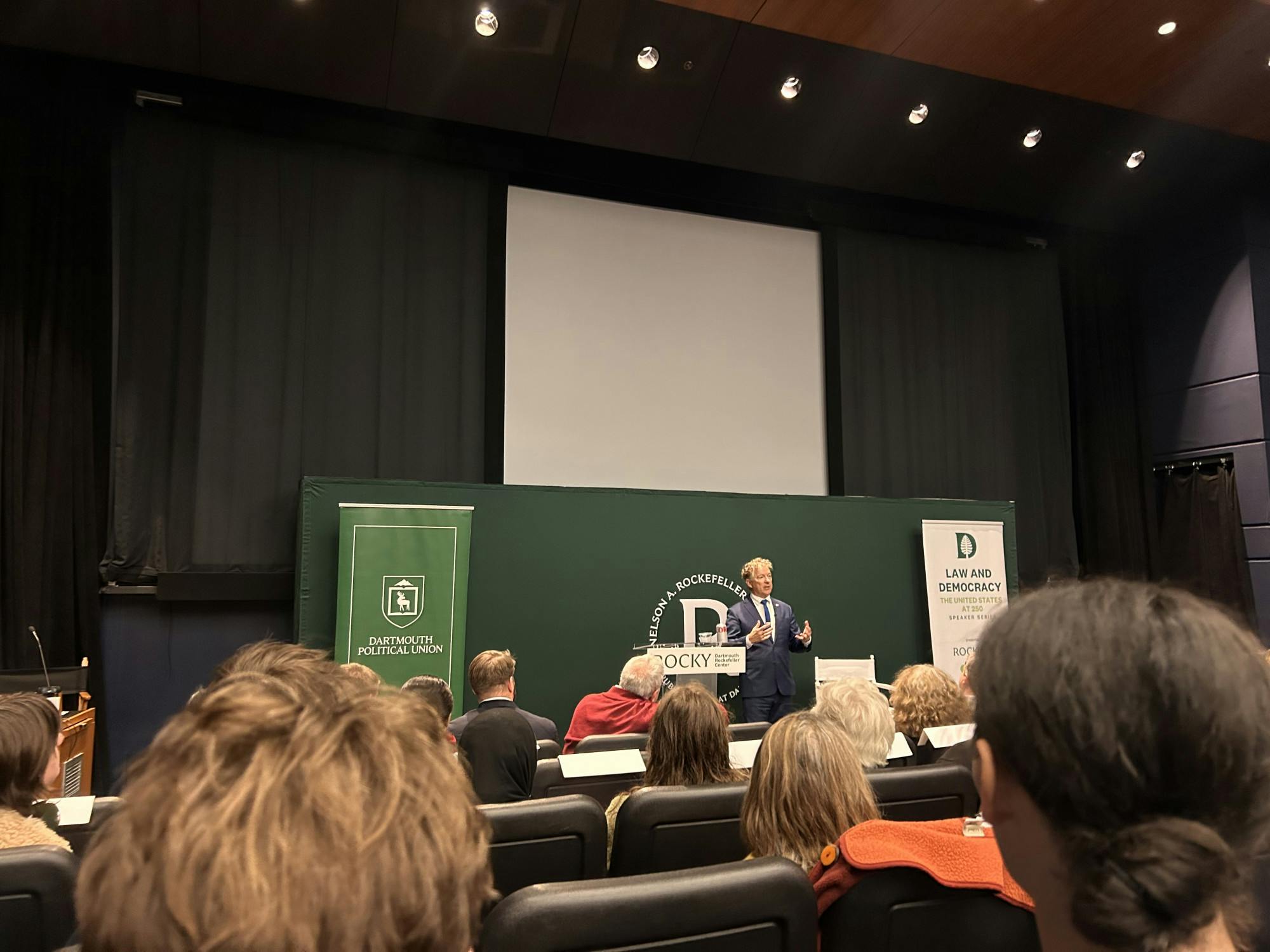
Sen. Rand Paul, R-Ky., pushed the Dartmouth community to remember that “we live in the best of times” at a Rockefeller Center for Public Policy event on Nov. 14.
Dartmouth Political Union debate director Eli Moyse ’27 moderated the Q&A section of the conversation. Approximately 220 community members attended the event, according to Rockefeller Center assistant director for public programs and special events Dvora Greenberg Koelling. The discussion was part of the speaker series “Law and Democracy: the United States at 250,” which celebrates the upcoming 250-year anniversary of the signing of the Declaration of Independence, and was co-hosted by the DPU and Dartmouth Dialogues.
Paul, an advocate for limited government, began by discussing the history of the Industrial Revolution and how we understand the best and worst of times in relation to the past. He said that Democrats, “because they’ve lost the most recent election, were unhappy and thought the best of times had passed.”
We “have to look at things with a historical perspective,” he said. “I’m not talking about the last 40 years … I’m talking about, in the last 200 years, what happened.”
Referencing increasing life expectancy and decreasing postpartum mortality rates, Paul argued we “live in the best of times with regard to health.”
Paul added that global increases in wealth are another indicator that we live in the “best of times.”
“In 1820, 98% of people in the world lived on less than $2 a day,” he said. “Now, less than 10% of the world lives on $2 a day … in every parameter there’s been a miraculous accumulation of wealth.”
Paul went on to criticize what he understands to be the two main arguments utilized by President Donald Trump to justify the imposition of tariffs.
“They tell you two things — we’re being ripped off by the Chinese and the middle class is dying,” he said. “They’re both false.”
According to Paul, tariffs “ are a way of transferring the blame to a country or person.”
In a Q&A following his talk, Paul went on to criticize Republicans who, under “pressure” from President Donald Trump, voted to pass a spending bill that expands the federal budget deficit.
“I think the [Republican] party has become more a party about loyalty to one person and I think that it is a problem,” he said.
Paul was one of three Senate Republicans to vote against Trump’s One Big Beautiful Bill Act, which the Congressional Budget Office estimated would increase the federal deficit by approximately $2.4 trillion over ten years.
“I voted ‘no’ because there has to be somebody left in the Republican party that thinks deficits are a problem and that we shouldn’t spend so much,” he said. “I do it at my own peril with regard to the president and his people, but I think it’s worth it.”
Paul also criticized Trump for authorizing a series of military strikes on vessels off the coast of Central America accused of carrying illegal drugs. Since September, the strikes have killed at least 80 people, according to The New York Times.
“We don’t just kill people,” he said. “If we find out someone’s selling drugs, we don’t go with a grenade launcher and blow their house up. It’s the dumbest thing I’ve ever heard, but I’m a distinct minority and I get vilified.”
When asked about the reduction of government assistance and the Supplemental Nutrition Assistance Program, Paul said he believes “able-bodied people” and college students should not receive food stamps.
“We just should have some tough love and [you should] go work,” he said. “Life’s not easy, college is too expensive, so work.”
Audience member and Norwich resident Mimi Simpson Tu’89 said that she was “inspired” to attend to see a “different point of view.” She disagreed with the basis of Paul’s argument that we live in the best of times, noting that she felt the timespan Paul chose was misleading.
“There’s no argument over a 200 year time period,” Simpson said. “You’re talking about health and life expectancy, of course it’s a lot better [over time].”
In an interview with The Dartmouth after the event, audience member Landon Parrish ’29 said he wanted to attend the event because Paul votes against the majority of Republicans. He said he “particularly liked” how Paul “denounced militarization” in Central America.
“The biggest thing that stuck with me was how outspoken he was against the current Republican establishment,” he said.
Eli Moyse ’27 is an opinion editor for The Dartmouth. He was not involved in the writing or editing of this article.