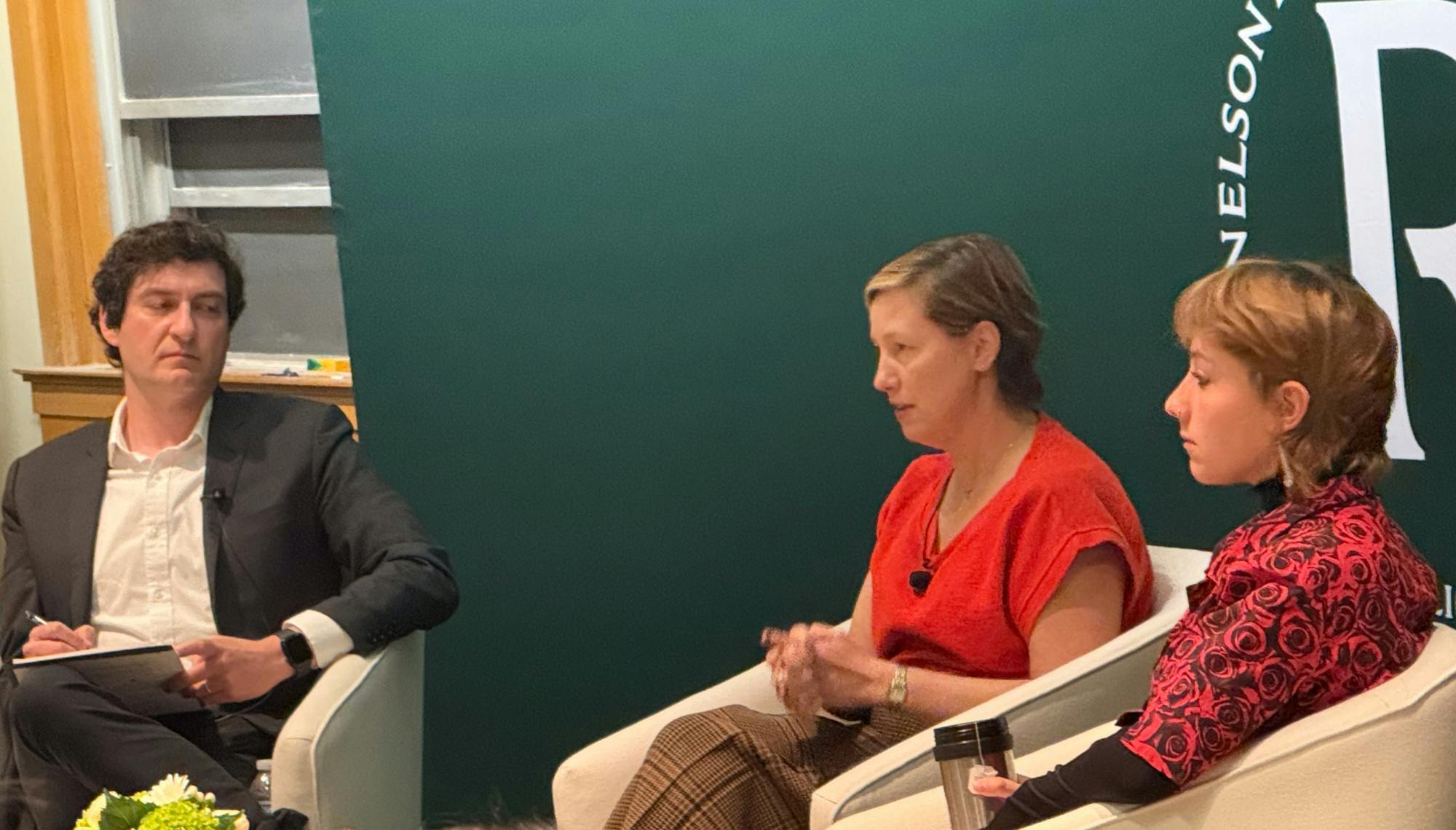
On Oct. 21, The New York Times opinion editor Kathleen Kingsbury discussed digital media in journalism, the decline of local news and the shift toward multimedia journalism in an event titled “The Power of Differing Opinions.”
Approximately 190 people attended the event in the Filene Auditorium, according to Rockefeller Center assistant director for public programs and special events Dvora Greenberg Koelling. The discussion, hosted by Dartmouth Dialogues, Rockefeller Center and The Dartmouth, was part of the “Law and Democracy: the United States at 250” speaker series and the David E. Rosenbaum ’63 Journalism Lecture Series.
The conversation was moderated by The Dartmouth’s editor-in-chief Charlotte Hampton ’26 and government professor and associate director of the Rockefeller Center Herschel Nachlis.
Kingsbury began the discussion by addressing the Times’s reputation as a left-leaning publication. She prefaced by explaining that news and opinion at the Times are kept “very separate,” noting that her section includes both left-leaning and right-leaning columnists.
However, Kingsbury said claims that the editorial board — which she called the “institutional voice of the paper” — leans left have a “certain truth.”
“We make decisions around editorials based on longstanding values that we've held as a paper,” Kingsbury said. “Many people would see those values and think that they were pretty classically liberal, and I think that that's a fair characterization.”
Nachlis asked Kingsbury about how to treat student journalists as adults creating a “paper of record” while understanding that they are young and “trying to find their way.” Kingsbury described student newspapers as “amazing training grounds.”
“You can have a lot of impact as a student journalist, and I think it's really important,” Kingsbury said. “They're often playing really important roles on campuses.”
Hampton asked Kingsbury about the Times “centering graphics, audio and video” as part of their strategy to increase trust in the media. Kingsbury, along with members of her opinion staff, was a 2025 Pulitzer Prize finalist in Editorial Writing for a graphic series on the potential effects of nuclear war.
“We find that people, when we are bringing more interactive journalism to them, are more engaged,” Kingsbury said. “We also know the realities of how people consume media are dramatically changing right now.”
Kingsbury explained that the Times brings its audience content in text, audio and video, with different target audiences for each format. She shared that this strategy grows the Times’s readership and serves as a “tool for transparency” by allowing journalists to “build a relationship with the audience.”
After a lightning round of questions, the discussion was opened to the audience for a question-and-answer session. Student body president Sabik Jawad ’26 asked Kingsbury about his perception that national media organizations lack an understanding of local events.
In response, Kingsbury explained that she sees “the value of having local journalists,” but added that local news has been “devastated.”
“In an ideal world, as far as I’m concerned, there should be a really healthy, thriving opinion journalism landscape in every community,” Kingsbury said. “There are pluses and minuses to having national organizations filling the gap where there aren’t local institutions.”
In an interview with The Dartmouth after the event, Jawad explained that he asked this question because he had noticed incomplete national coverage of local news from Dartmouth.
“I remember reading a Washington Post article that was talking about how [Dartmouth] classes started peacefully,” Jawad said. “It was published in August, a month before classes started.”
Kingsbury also responded to to a question about claims that the Times is “vastly underplaying the threat to democracy” by the current presidential administration.
“There is no one who can read the New York Times opinion section and not agree that we are consistently raising the alarms about the current administration,” Kingsbury said. “We dedicated the vast majority of 2024 [to] doing a series of pieces to explain the dangers that lied ahead if Trump was reelected.”
Hampton concluded the event by asking Kingsbury for advice she would give a young journalist entering the industry. Kingsbury said she would advise new journalists to “be flexible.”
“This industry has changed dramatically in the 25 years that I have been in it, and it’s just going to keep changing,” Kingsbury said.
Attendee Laney Woods ’29 said in an interview after the event that Kingsbury helped her realize how “complicated” journalism is.
“When she started working, [journalism] was just text. Then [news outlets] added all of the levels of pictures, audio, and video,” Woods said. “It’s just so much more to think about now.”
Charlotte Hampton ’26 is the editor-in-chief of The Dartmouth. She was not involved in the writing or editing of this article.