
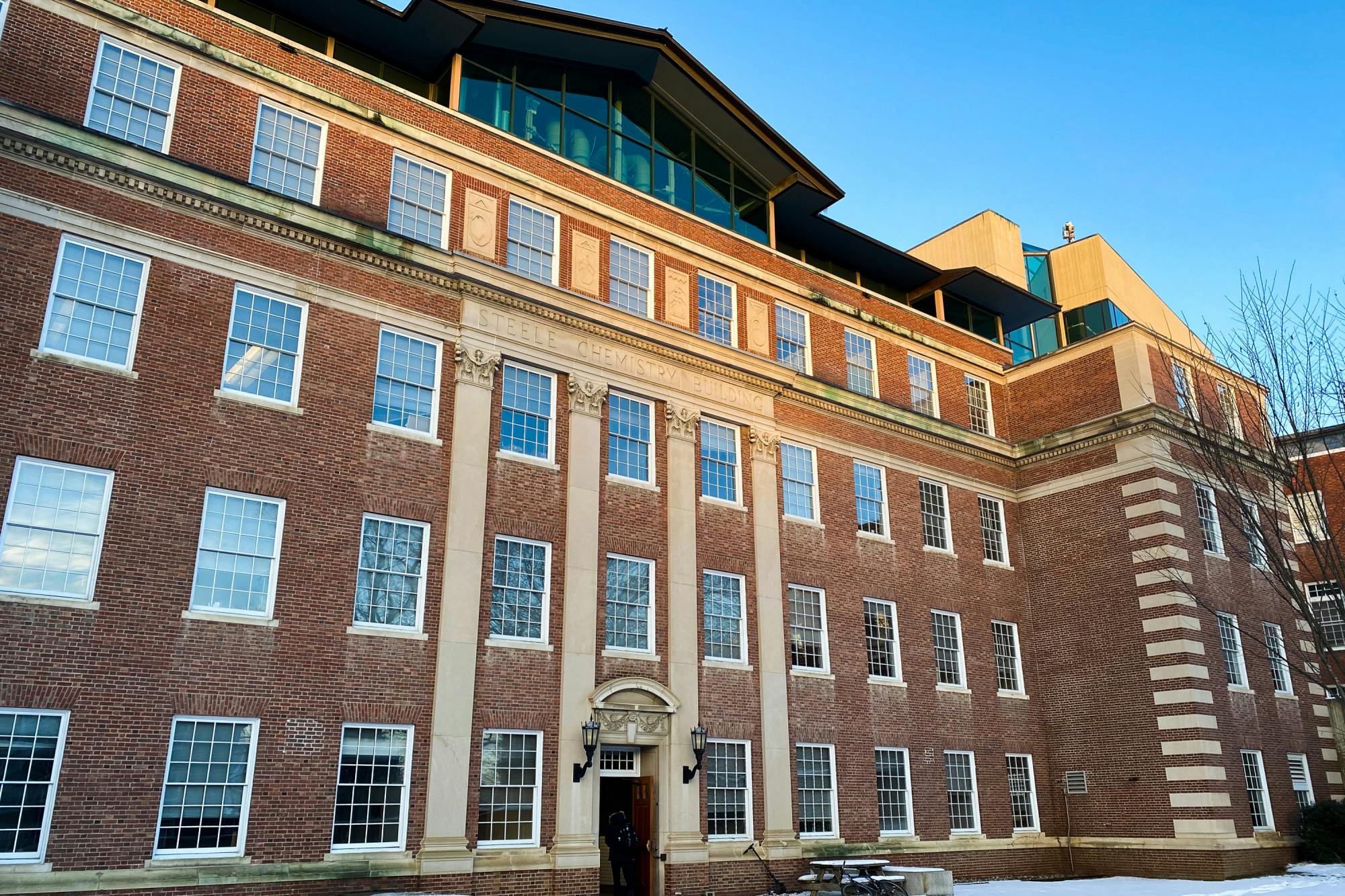
Judith Raanan, an American woman captured and held hostage by Hamas for 17 days, described her “unimaginable” experiences in captivity in an event at Steele Hall on Sept. 30.
Ranaan said she saw “horrifying things,” including dead bodies, “splashes of blood,” and fights between hostages and kidnappers. She added that she was “really afraid” throughout the experience.
“The house was bombarded with bombs,” Ranaan said. “[It was] very, very scary.”
The event, entitled “A Story of Resilience in the Face of Captivity,” was co-hosted by the Rohr Chabad Center at Dartmouth and Hillel at Dartmouth. Approximately 60 community members attended.
This came days before Hamas agreed to enter negotiations with Israel and the Trump administration on Oct. 3. The Palestinian militant group agreed to release all remaining Israeli hostages, including the bodies of those who have died in custody.
Raanan explained that she and her daughter had been visiting Israel to celebrate Raanan’s mother’s birthday before they were captured. On Oct. 7, 2023, Hamas militants took Ranaan and her daughter, along with 249 others. 48 hostages remain in Hamas custody, and around 20 of them are believed to be alive, according to the Associated Press.
In an interview before the event, Taylor Forte Tu ’26 said she was “motivated” to attend because it was a “really unique opportunity” to hear a “firsthand account” of a hostage’s experience.
“I just think it’s very brave to talk about such a sensitive topic, so I wanted to show my respect,” Forte said.
Raanan, who is from Illinois, began the event by introducing herself and the circumstances which led her to Israel. She recalled telling her daughter that it would be “a vacation you will never forget.”
The attack on Oct. 7 began right after Ranaan had awoken, she said.
“A rocket comes exactly where I was sleeping,” Ranaan said. “All the cement flying all over the glass is broken, [and] the pictures that I brought are scattered all over.”
A couple hours later, two men in “full attire” carrying rocket-powered grenades found Ranaan and her daughter. Ranaan said that as the men demanded to know her and her daughter’s names, she was reminded of the biblical story of Jacob and a divine being in which the being asked Jacob, “what is your name?”
Raanan said that similarly to Jacob, the men asked her “What is your name? What is your name?”
“Our name is the essence of who we are in the Jewish tradition,” Ranaan said. “We get a name with the Hebrew letters that [has] a meaning.”
Raanan mentioned that the men told her to “sit on the floor in the kitchen.” She said she was reminded of Holocaust movies where a Jewish family would be told to sit on the floor so “somebody can just come with a gun and shoot [the] entire family.”
While she was taken hostage, Raanan said she later learned afterward that “16 people were murdered [in her kibbutz] … [and] a bullet flew straight through the door into an 18-year-old girl.”
Ranaan said that she experienced several “miracles” during her time in captivity, including one incident in which she gestured that she was thirsty and her kidnappers gave her water to drink.
“Little did I know that this … was the head commander … and he gave an order to give me water,” Ranaan said.
While Ranaan said she felt “the light of God,” she also said she was “filled with fear and uncertainty” while being held hostage.
“If you want to take me, I’m yours, but please do it here in Israel,” Ranaan recalled telling her kidnappers. “It will be a personal insult for me to die in a foreign land.”
In an interview after the event, Raanan told The Dartmouth she hoped her story would inspire students.
“I would like all the students to … believe in a happier future and keep on doing good things and use common sense and not be afraid to protect themselves and be nice to each other — to all humanity,” she said. “In the end, we need one another.”
Anthropology and Jewish studies professor Sergei Kan said Ranaan’s story was “the most powerful thing I’ve ever heard in my life.”
“It was emotional, it was original, and the [way] she connected her experience and her daughter’s experience … with spirituality and her religion … was more powerful than dozens and dozens … of media articles and interviews,” Kan said.


