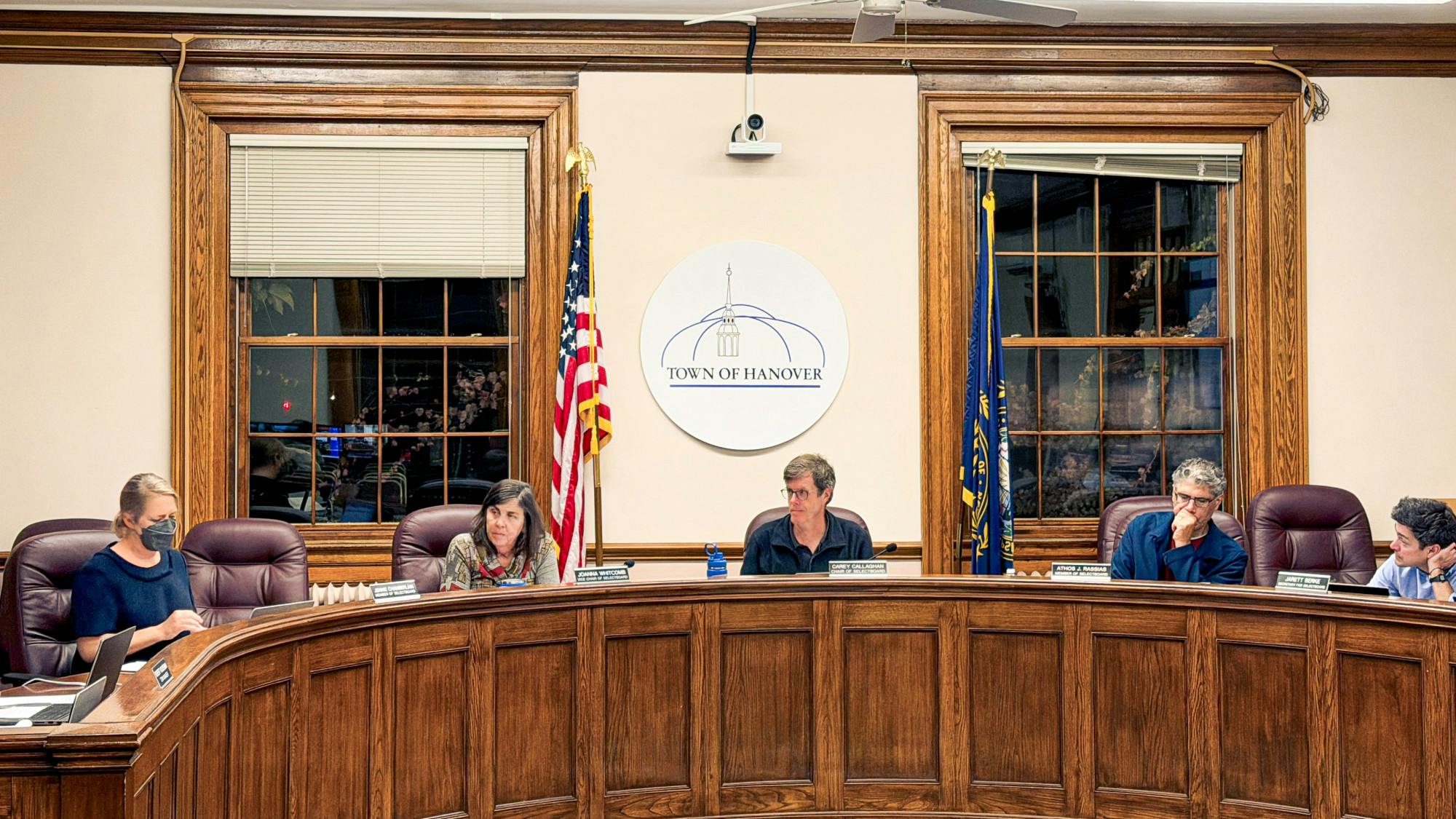
The Hanover Selectboard revised a police ordinance to comply with the New Hampshire ban on sanctuary cities at their biweekly meeting on Oct. 20. The new directive will take out any mention of Immigration and Customs Enforcement.
Hanover’s Fair and Impartial Policing Ordinance currently limits the circumstances under which Hanover police can share information with or assist ICE, which violates New Hampshire’s ban on sanctuary cities.
At a hearing on Nov. 3, the Selectboard will hear public comments on the revised ordinance before adopting it.
The Selectboard also voted to use a surplus from fiscal year 2025 to “offset” Hanover’s tax rate. Then, four Selectboard members voted to prevent Selectboard members from chairing their own advisory committees.
Town to comply with state anti-sanctuary city law
The policing ordinance was originally written in 2020. It enables the Hanover Police Department to refuse to cooperate with ICE agents to detain suspected undocumented immigrants. It must be revised by Jan. 1, 2026, in accordance with the sanctuary city ban — which was signed by Republican Gov. Kelly Ayotte on May 22, 2025. Otherwise, Hanover will face a 25% reduction in state funding — which would amount to $350,000, according to town manager Robert Houseman.
At the meeting, Selectboard chair Carey Callaghan said the town, if it did not change the ordinance, could be held “in contempt” by New Hampshire’s attorney general and sued.
“We’re trying to avoid that by taking the language out so it’s crystal clear that we have the kind of a police department that will cooperate with ICE if there are reasonable suspicions of criminal activity,” Callaghan said at the meeting.
During the discussion, Selectboard member Jennie Chamberlain said she took issue with proposed wording that “no policy of the town shall prohibit or impede” communication with ICE because that “takes away the discretion of the police.”
“I don’t think we should be discussing anything that’s beyond what the state is requiring,” Chamberlain said.
The Selectboard will present the revised ordinance at a public hearing on Nov. 3, after which it will “consider” public testimony for its final draft by Jan. 1, Houseman wrote in an email statement to The Dartmouth after the meeting.
In an interview with The Dartmouth, Selectboard member Athos Rassias called on Dartmouth students to attend the upcoming hearing and “have their say on this.”
“The Selectboard is very much aware that this issue is on the minds of many, many, many people,” Rassias said. “I would not like to have this be something that this Selectboard just approves without a lot of public input.”
Town budget “on track” for Fiscal Year 2026
Houseman and Hanover finance director Ellen Bullion said Hanover’s budgetary performance at the end of the first quarter of fiscal year 2026 was “on track” for the year. The first quarter ran from July 25 to Sept. 30.
The town spent 21% of its annual budget this quarter, and has enough money to “absorb the filling of open positions and remain within budget,” Bullion added. Currently, Hanover has seven job openings, including in the police and planning, zoning and codes departments.
The Selectboard also discussed how to appropriate a $257,000 surplus from FY 2025. Houseman said the “only two levers” for the surplus are returning this money to Hanover residents — around $60 per taxpayer — or adding it to a town “overlay fund” for potential tax returns.
The overlay fund, which is currently valued at $200,000, is used to cover abatement refunds, which taxpayers can request if they believe the town overvalued their property tax.
Houseman recommended at the meeting that the Selectboard contribute to the overlay fund. According to Houseman, the town received approximately 60 abatements in FY 2025.
“There is a risk that we will see a significant number of abatement requests in FY 2026, not unlike the last round, and we’re trying to conservatively forecast that abatement request and budget for it,” he said.
In a closed session after the meeting, the Selectboard decided to return the surplus to Hanover residents in the form of a lower tax rate, according to Houseman.
Selectboard members can no longer hold leadership positions on advisory committees
The Selectboard voted 4-1 to approve the “Selectboard Policy on the Role of Selectboard Committees,” which prohibits Selectboard members from serving in leadership positions on advisory committees — citizen-led groups that provide guidance to the Selectboard, including the Hanover Bike Walk Committee and the Sustainable Hanover Committee.
Several Selectboard members voiced support for the change at the meeting. Selectboard vice chair Joanna Whitcomb said the policy would improve governmental “transparency” by ensuring advisory committees operate independently from the Selectboard. Callaghan said he believes advisory committees led by Selectboard members are “less independent.”
Chamberlain, the chair of Hanover Bike Walk, voted against the policy.
“It’s been our long tradition that advisory committees constitute themselves,” Chamberlain said in an interview after the meeting.
After the Selectboard voted to approve the policy, Chamberlain stepped down from her role on the committee.
The Selectboard meets every other Monday at 7 p.m. in the town offices at 41 South Main St. Meetings are open to the public.
Max Hubbard '29 is a reporter from Boston, Mass., and is majoring in government and minoring in French. In his free time, he enjoys listening to music, running and watching movies.
Olivia Sapper ’29 is a reporter from Darien, Conn., and is majoring in Government.