
Long before she became President Donald Trump’s choice for United States assistant attorney general for the civil rights division, Harmeet Dhillon ’89 was a classical studies major and the editor-in-chief of The Dartmouth Review. Today, Dhillon is a Trump loyalist, the first Republican woman to hold her position within the Department of Justice and a key figure in the Trump administration’s campaign to freeze federal funding for universities on the alleged basis that they have inadequately addressed campus antisemitism.
On April 28, College President Sian Leah Beilock met with Dhillon and Dhillon’s senior counsel to “discuss combating antisemitism and encouraging free speech on college campuses,” wrote College spokesperson Jana Barnello in an email statement to The Dartmouth.
On April 29, Dhillon posted on the platform X, in support of Beilock’s response to pro-Palestinian protests. Nearly a year earlier, Beilock facilitated the arrest of 89 individuals protesting on the Green.
“My team met with Sian Beilock Monday at @JusticeDept and I was so impressed to learn how Dartmouth (my alma mater) is getting it right, after all these years,” she wrote. “Kudos to Dartmouth! I heard Jewish student applications are way up!”
**************
While a student, Dhillon was a polarizing figure. She began writing for the conservative newspaper The Dartmouth Review during her freshman year and climbed the ranks from contributor, to contributing editor, to senior editor and finally to editor-in-chief, according to archives of The Dartmouth Review.
Dhillon joined The Dartmouth Review during what was likely its heyday, as the publication’s controversial articles garnered College-wide and occasionally nationwide attention. During Dhillon’s freshman year, a group of Review writers destroyed anti-apartheid shantytown protests on the Green, later publishing a satirical advertisement for limited edition “shanty buster sledgehammers.”
Articles in this era ranged from anger towards a move away from the Indian as the College’s mascot, sneering rankings of professors, a sprinkling of anti-communist writings, denunciations of campus feminist groups, demeaning descriptions of the campus’s Gay Students Association and attacks on perceived censorship from the College.
As The Review’s editor-in-chief, Dhillon infamously approved the publication of an article entitled “Ein Reich, Ein Volk, Ein Freedmann,” by James Garrett. The title is a play on the Nazi slogan meaning “One Empire, One People, One Leader,” but substituted and misspelled then-College president James Freedman’s name and inserted it in place of “Führer.” Through analogies to Nazi Germany, Garret’s article claimed that Freedman, who was Jewish, was attempting to remove conservatives from the College’s campus. The article generated extensive criticism, and was covered in the New York Times with the headline “Satire by Dartmouth publication under heavy fire as antisemitic.”
“This episode of public breast-beating is yet another example of the liberal hypocrisy that has been practiced and institutionalized at Dartmouth over the past generation,” Dhillon wrote in a letter from the editor in response to the backlash.
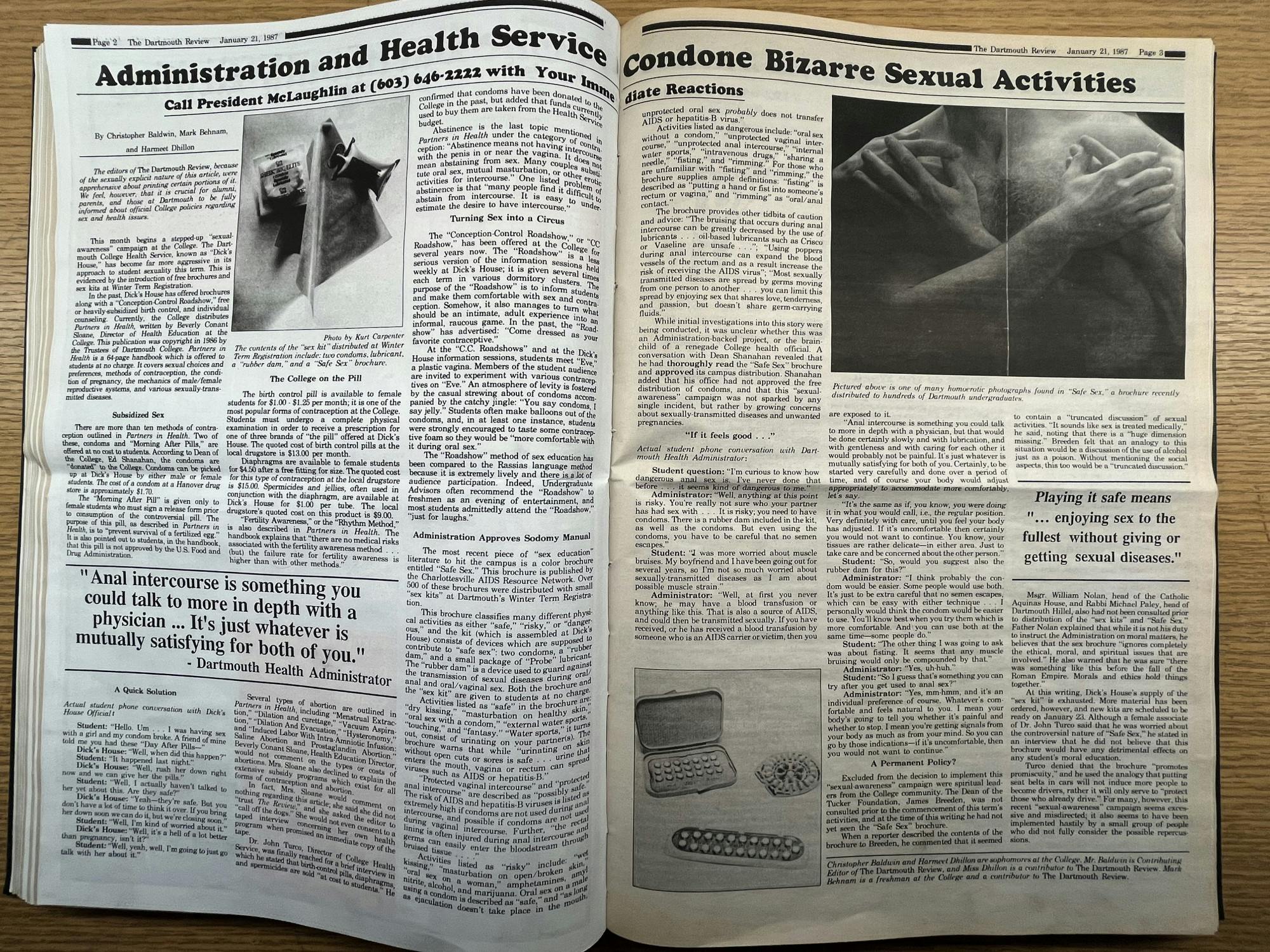
Dhillon’s own writings were also controversial. In 1987, Dhillon co-wrote an article whose title warned that the “Administration and Health Service Condone Bizarre Sexual Activities.” The article features a large picture of a man’s chest being clasped by another man’s hands and characterizes an administration-approved safe sex brochure as a “sodomy manual.” It claims that the College had “subsidized sex” by offering contraceptives at Dick’s House.
In an anti-affirmative action article published also in 1987 called “Dartmouth Admissions: A History of Increasing Compromise,” Dhillon wrote, “Academic standards have been dropped in order to pursue the diversity and ethnicity that represent the ‘ideal’ Dartmouth … in its quest to foster an artificially ‘diverse’ student body, the College has produced a much less desirable by-product: diversity of intellectual excellence.”
In “You’ve Come a Long Way, Baby,” likely an allusion to the Virginia Slims cigarette brand’s marketing campaign targeting women, Dhillon argued against Freedman’s drive to recruit more women to Dartmouth.
“There was a time in this country when women were discriminated against,” she wrote in 1988. “Times have changed … The feminists at Dartmouth are fond of screaming that Dartmouth is ‘an enclave of white male privilege,’ that phallic symbols abound, that women are less safe on this campus than they are on the streets of New York City. Are these people blind, or just crazy?”
Dhillon also claimed that the College was “participat[ing] in the segregation process” through its creation of all-Black housing and Black society spaces in her article “Apartheid at Dartmouth.”
“I knew several well-adjusted blacks when I was a freshman; a few of them were good friends of mine,” Dhillon wrote. “As time went by, they became more and more separated from their nonblack friends and began to associate almost exclusively with blacks. At first, they resisted the pressure to abandon their well-integrated circle of friends, yet were unable to keep up the resistance.”
**************
After graduating from Dartmouth, Dhillon attended the University of Virginia Law School and then spent a decade working in private practice, eventually founding her own law firm.
During her time as a private lawyer, Dhillon and the Dhillon Law Group advocated on behalf of numerous conservative causes, including representing activist Chloe Cole — who advocates against gender-affirming care for minors — in her 2023 year case against pharmaceutical company Kaiser Permanente. During the COVID-19 pandemic, the firm filed multiple lawsuits against the state of California’s decision to postpone reopening after a spike in COVID-19 cases.
In 2020, Dhillon served as a legal advisor to Trump’s campaign. As Trump claimed election fraud following his loss, Dhillon stated on Fox Business, “We’re waiting for the United States Supreme Court — of which the president has nominated three justices — to step in and do something … hopefully Amy Coney Barrett will come through.”
**************
Today, Dhillon’s division of the Department of Justice is working to roll back diversity and equity initiatives in public universities and agencies. Under her leadership, the division pressured University of Virginia president James E. Ryan to resign over the school’s diversity, equity and inclusion efforts; Ryan later resigned. Her division has also opened an investigation into the University of California system over its focus on hiring “diverse” faculty members.
Dhillon’s civil rights division is notably part of the Trump administration’s Task Force to Combat Antisemitism, which is responsible for federal funding freezes at several universities. Harvard University, Columbia University, the University of California Los Angeles and numerous other institutions have faced funding freezes after the group claimed that they failed to adequately address antisemitism on their campuses. Unlike many of its Ivy League peers, Dartmouth has escaped much of the Trump administration’s criticism.
In a recent interview with Dartmouth Alumni Magazine, Dhillon lauded Dartmouth.
“I’m proud that Dartmouth is leading the way in dealing with antisemitism and campus unrest. I never thought I’d say those words … Dartmouth is really one of the good guys,” Dhillon said.
Vidushi Sharma ’27 is an executive editor and news reporter. She is majoring in Government and minoring in International Studies and Sociology.


