
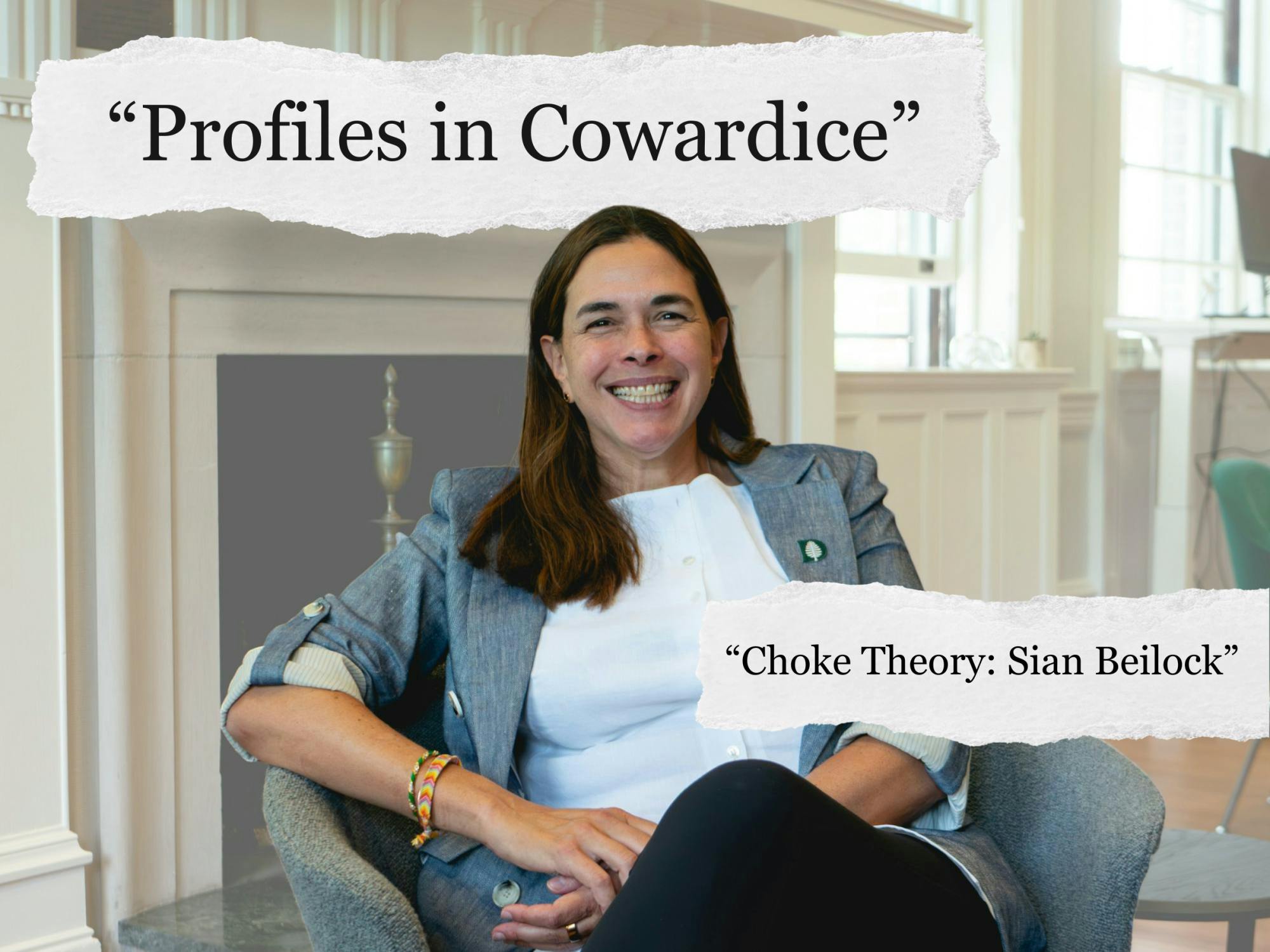
College President Sian Leah Beilock is one of eight public figures featured in former Slate Magazine editor Jacob Weisberg’s book “Profiles in Cowardice: A Study of Collaboration in the Trump Era,” which was published on Sept. 15 and reached seventh on The New York Times nonfiction best-seller list on Oct. 4.
In “Profiles in Cowardice” — an inversion of the title of former President John F. Kennedy’s 1956 book “Profiles in Courage” — Weisberg profiles national leaders who he says “recognized the danger” that President Donald Trump “posed to American values” prior to his return to office in 2025 and “had the ability to say no to him” but did not, according to the book’s introduction.
“It’s about those … who at earlier moments showed flickers of integrity — but who, when a more serious test came, failed to act courageously, in ways that reveal both their moral weakness and the fragility of the institutions they represented,” Weisberg wrote.
In an interview with The Dartmouth, Weisberg said he was inspired to write the book by the “wave of capitulation by institutions and leaders” between President Donald Trump’s first and second terms. He focused on Dartmouth because of its “foundational role” in establishing “academic freedom in the United States” during the 19th century, he added. Amidst attempts to convert Dartmouth from a private institution to a state university, the Supreme Court decided in the 1819 case Trustees of Dartmouth College v. Woodward that Dartmouth would remain a private institution. The case set a precedent that states could not interfere with the administration of private corporations and institutions.
In addition to the chapter on Beilock, “Profiles in Cowardice” includes chapters on Amazon founder Jeff Bezos; former President George W. Bush; former Paul, Weiss, Rifkind, Wharton & Garrison chairman Brad Karp; political commentator Megyn Kelly; Sen. Mitch McConnell, R-Ky.; Supreme Court chief justice John Roberts; and Blackstone chief executive officer Stephen Schwarzman.
In the chapter on Beilock — titled “Choke Theory: Sian Beilock,” in reference to the title of her 2010 book, “Choke: What the Secrets of the Brain Reveal About Getting It Right When You Have To” — Weisberg argues that Beilock is “substituting a behavioral toolkit for a moral compass” in response to the Trump administration’s attacks on higher education.
Beilock “treated a genuinely existential challenge to American higher education as if it were a text of flexibility, not of principle,” Weisberg wrote in “Profiles in Cowardice.” “She kept her head down, kept her board and donors mollified and put her own career first.”
A College spokesperson declined to comment on behalf of Beilock.
Weisberg points to the American Association of Colleges and Universities open letter, the institutional restraint policy and the response to the Compact for Academic Excellence in Higher Education as examples of Beilock’s capitulation to Trump. The Dartmouth reviewed the chapter about Beilock and contextualized Weisberg’s claims with previous reporting and interviews with faculty members.
American Association of Colleges and Universities open letter
On April 22, 2025, the American Association of Colleges and Universities published a joint letter opposing “undue government intrusion” in higher education in response to the Trump administration cutting federal funding from six of the eight Ivy League schools. As of the time of publication, 666 schools have signed the letter; Dartmouth was the only Ivy League school to abstain. In an email sent to campus on April 23, 2025 defending her decision, Beilock wrote that she believes open form letters are “rarely effective tools to make change.” Instead, the College submitted unsworn declarations in support of two Association of American Universities lawsuits opposing National Institute of Health and Department of Energy caps on universities’ utilities, research administration and library costs.
In the book, Weisberg claims that Beilock’s reasoning for not signing the AACU letter “wasn’t true” given that she has written opinion articles for national publications in the past. As president of Barnard College, Beilock co-wrote a June 2022 New York Times letter to the editor against the overturning of Roe v. Wade and a May 2023 CNN opinion column advocating for more women and people of color in semiconductor-related sectors.
But Beilock “pledg[ed] to refrain from official commentary on political issues” as Dartmouth president, Weisberg wrote. “It was a striking evolution for a leader who, a couple of years earlier, had championed anti-racism initiatives as an institutional responsibility.”
In April 2025, College spokesperson Kathryn Kennedy wrote in a statement to The Dartmouth that the AACU letter was “different” from the op-eds Beilock previously co-wrote because its authors “worked together to develop the language,” as opposed to a “symbolic form letter signed by hundreds of people, most of whom had no role in its creation.”
Weisberg said during the interview with The Dartmouth that he did not see “any meaningful difference between a letter to the editor signed by six people and the kind of group letter we’re talking about with the AACU.”
Institutional restraint
On Dec. 10, 2024, the College announced that it was adopting an institutional restraint policy. The current policy, which has not been modified since its adoption, states that the College and its “institutional spokespersons” will “exercise general restraint in issuing institutional statements” unless they are “on issues that affirm core values” of the College.
Dartmouth was the first Ivy League university to adopt an institutional restraint policy, garnering attention from other leaders in higher education and media outlets. Missouri State University president emeritus Michael Nietzel wrote a Forbes article saying Dartmouth’s policy could be a “model for other institutions.” The headline of an article in The New Yorker dubbed Dartmouth “the Ivy League’s Switzerland” for largely evading targeted funding attacks and threats from the federal government. The Foundation for Individual Rights and Expression’s 2026 report ranked Dartmouth the highest in the Ivy League for free speech at 35th. Last year, Dartmouth ranked 224th.
Since adopting the policy, Dartmouth has joined three amicus briefs in support of lawsuits against the federal government over federal funding cuts, constitutionally-protected speech and the termination of Harvard University’s participation in the Student and Exchange Visitor Information System.
When asked about the amicus briefs the College has filed, Weisberg said they are not the same as “decrying attempts at political interference.”
Amicus briefs are “different from what the open AACU letter said, which is ‘you have no right to try to interfere in the academic affairs of the university,’” Weisberg said.
In the book, Weisberg claims that the “pragmatic explanation” for Beilock’s “restraint” was that Dartmouth was the only Ivy League school that did not get “hit with a civil rights investigation” and that “an influential advocate inside the [Trump] administration” — assistant attorney general for civil rights Harmeet Dhillon ’89. On July 22, the Department of Education launched a civil rights investigation into the Geisel School of Medicine over “alleged racial discrimination” in admissions.
In an email statement to The Dartmouth, government professor Russell Muirhead wrote that “there’s a lot of courage” in the institutional restraint policy.
“To stand for an ideal of the university as an institution that is meant to harbor disagreement rather than impose an ideological monoculture requires, in the political atmosphere of the moment, courage,” Muirhead wrote. “The cowardly thing to do was nothing.”
Computer science professor David Kotz ’86, who served as provost from 2021 to 2025 and chartered the institutional restraint committee, said there are issues where Dartmouth is “decidedly not neutral.”
“I personally signed some of these declarations that were part of lawsuits, not just amicus briefs,” Kotz said. “We felt that the government had overreached in some of its actions, and it was important to participate in suing the government, to reverse some of those decisions.”
Compact for Academic Excellence in Higher Education
On Oct. 1, the White House approached Dartmouth and eight other universities for feedback on a “Compact for Academic Excellence in Higher Education.” The compact asked universities to limit the enrollment of international students to 15%, limit grade inflation and adopt a binary definition of sex and gender, among other stipulations, in exchange for federal funding benefits.
The College was the last of the Ivy League universities that were initially approached by the Trump administration to reject the compact. On Oct. 18, 2025, Beilock wrote an email to campus that the College would not sign the compact as doing so would “compromise our academic freedom.”
“I do not believe that a compact — with any administration — is the right approach to achieve academic excellence,” Beilock wrote. “I welcome further engagement around how we can (a) enhance the long-standing partnership between the federal government and this country’s leading research universities and (b) ensure that higher education stays focused on academic excellence.”
In the interview, Weisberg said the tone of Beilock’s Oct. 18 email was “sycophantic.”
The compact “is a bad-spirited, malicious effort by the Trump administration,” Weisberg said. “You’ve got to dismiss that out of hand and not play footsie with them. She’s instead played footsie with them.”
Faculty reception of Weisberg’s book
Religion professor Christopher MacEvitt — who introduced a motion of censure against Beilock following the May 1, 2024, arrests of 89 individuals, including himself, during a pro-Palestinian protest on the Green — wrote in an email statement to The Dartmouth that Beilock’s “strategy” of institutional restraint has “lead to a great deal of anxiety on campus,” but disagreed with the book’s title.
“I would have liked to see President Beilock speak up more forcefully in defense of the independence of academic study, and to position herself and the College as less accommodating to the Trump agenda,” MacEvitt wrote. “Nevertheless, I am not sure that President Beilock’s strategy deserves the label of ‘cowardice.’”
Muirhead wrote that Beilock’s ability to “take decisive action under conditions of disagreement” reflect “courageous leadership.”
“I’m not saying I agree with every one of President Beilock’s decisions,” he wrote. “Her job is not to agree with me. The undeniable fact is that she is eager to engage those who disagree with her.”
Government professor Sean Westwood wrote in an email statement to The Dartmouth that “real change happens behind closed doors, in legal briefs and in meetings with political officials.”
“The president serves to protect the institution, not to advance her personal views or the political views of her faculty,” Westwood wrote.
The Dartmouth contacted 22 individuals named either in Weisberg’s chapter on Beilock or related coverage. Two referred The Dartmouth to other sources, two were not available for comment by the time of publication, three declined to comment and nine did not respond to requests for comment.
Sahil Gandhi ’29 is a reporter from Staten Island, N.Y., and is majoring in environmental studies and government modified with philosophy and economics. He loves word searches and falling down internet and Wikipedia rabbit holes.


