
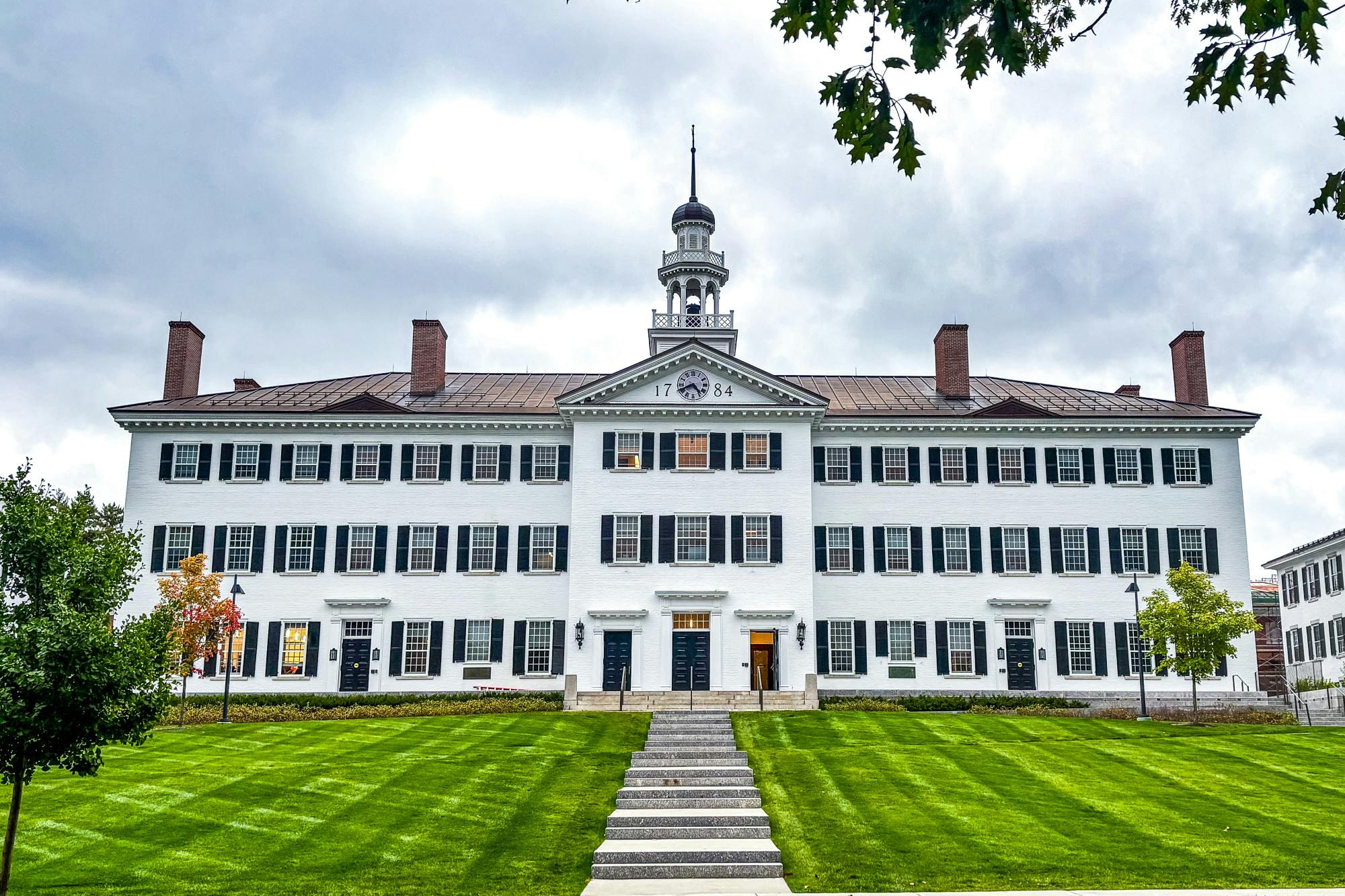
Dartmouth is the highest-ranking college in the Ivy League for freedom of expression, according to the Foundation for Individual Rights and Expression’s 2026 report. The prominent free-speech organization ranked the College 35th in the nation, a “massive improvement” from last year’s rank of 224th.
FIRE is a nonprofit that annually ranks the toleration of American universities based on survey data from over 68,000 college students. Among the 257 colleges and universities on FIRE’s list, 166 received failing grades for their speech climate.
Dartmouth was the only Ivy League school to receive the nonprofit’s “green light” rating — which means FIRE “is not currently aware of any serious threats to students’ free speech rights in the [College’s] written policies.”
Dartmouth also ranked sixth in the nation for “political tolerance,” sixth for “tolerance for controversial liberal speakers” and second for “tolerance for controversial conservative speakers” and “mean tolerance” of controversial speakers overall.
The College retained its green light rating from last year, when FIRE increased Dartmouth’s score after incoming College President Sian Leah Beilock removed the College’s “bias incident reporting” protocol. The protocol was first introduced in 2013.
“Under this protocol, students could be reported by their peers — and investigated and disciplined by administrators — for offenses as minor as ‘joke telling’ and ‘stereotyping,’” according to FIRE’s 2024 report on the College. “FIRE told Dartmouth that the protocol was inconsistent with the school’s stated commitment to free expression.”
Freedom of expression is a fraught topic on campus, particularly after the May 1, 2024, arrest of 89 individuals at a pro-Palestinian protest on the Green. The 2026 FIRE report notes that the College’s subsequent revision of its freedom of expression policy and adoption of institutional restraint enabled the College to maintain its green light rating and boost its overall score by eight points.
Those policies stirred controversy this spring and summer. Beilock cited the College’s institutional restraint policy when she was the only Ivy League president to abstain from signing a letter condemning the Trump administration’s renegotiation of funding for higher education. When Beilock welcomed the Class of 2029 to campus, she asserted that Dartmouth is “not a political organization” while addressing today’s higher education climate.
Turning Point Dartmouth vice president Colin Jung ’28 said he’s “never felt, inside or outside of the classroom,” that Dartmouth was “unwelcome toward certain perspectives or opinions.”
“I’m personally a fan of the way [the College] has been addressing the free speech issue,” Jung added.
Still, Dartmouth’s rise in the FIRE rankings — as well as the metrics behind those rankings — have their skeptics on campus.
Government professor and Polarization Research Lab director Sean Westwood said that FIRE’s results may not “generalize to Dartmouth as a whole.”
“Those surveys tend to have very small sample sizes,” Westwood explained.
Philosophy professor Sam Levey, who chaired the committee that recommended the April 2025 revisions to Dartmouth’s freedom of expression policies, described himself as a “friendly skeptic” of the FIRE ranking system.
“Ordinal rankings between colleges don’t give a good quality sense of information about where Dartmouth is and how it’s faring with free speech,” Levey said. “Changes in the rankings can reflect very small changes on the ground, and big changes on the ground may or may not lead to large changes in the rankings.”
But Levey also credited the College’s revised freedom of expression and institutional restraint policies, as well as programs like Dartmouth Dialogues, for improving the speech environment on campus and improving the College’s “reputation,” regardless of where it falls in the rankings.
Beyond institutional efforts, student groups’ commitment to broadening conversation has assisted in improving Dartmouth’s FIRE rankings. The nonpartisan Dartmouth Political Union, for instance, does a “big favor” for campus, according to Westwood.
“Regular programming where we bring speakers with very divergent points of view, ones that are not popular, is good for the health of our community,” Westwood said.
Westwood added that Dartmouth’s recent experiences with free speech have guided the College in a positive direction.
“Students have seen protests go wrong on our campus, and they’ve seen protests go right,” Westwood said. “We can learn from our mistakes, and I think that’s part of what the institution is trying to do.”
Westwood added that he appreciated Dartmouth’s newfound “position to lead” in freedom of expression debates.
“We have clearly under President Beilock’s leadership established a norm of what we’re going to do going forward,” Westwood said. “And I don’t think that’s going to change based upon the public mood.”


