
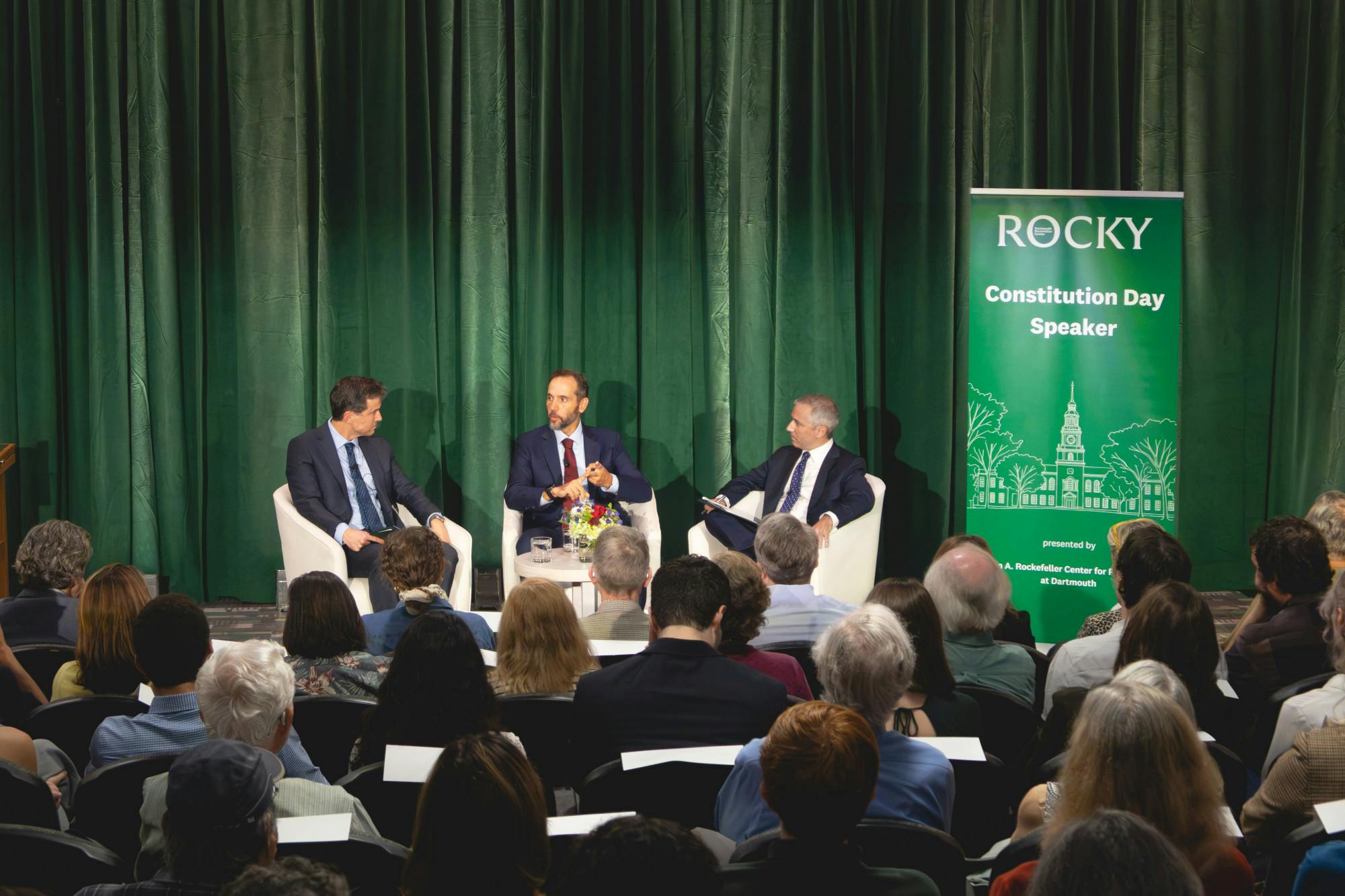
At a Sept. 17 event hosted by the Rockefeller Center for Public Policy, former U.S. Department of Justice special counsel Jack Smith said the DOJ has experienced a “tremendous loss of credibility” during the second Trump administration. Smith was appointed by then-attorney general Merrick Garland in November 2022 to investigate Donald Trump for allegedly interfering in the transfer of power following the 2020 presidential election.
Approximately 200 people attended the event in Filene Auditorium, which was moderated by former DOJ attorney John Pelletieri ’97 and government professor Brendan Nyhan. The discussion commemorated the signing of the Constitution and explored “the role of law, justice, ethics and public policy in the lives of individuals and society,” according to Rockefeller postgraduate policy fellow JJ Dega ’26.
Smith previously served as a federal prosecutor for the U.S. Attorney’s Office in New York from 1999 to 2008. He later worked in the Office of the Prosecutor for the International Criminal Court in The Hague, Netherlands, from 2008 to 2010. Smith was appointed chief prosecutor at the ICC in 2018, where he investigated war crimes in Kosovo.

Smith opened the Rockefeller Center event by discussing the lessons he learned during his time as a career prosecutor. He highlighted the importance of the “rule of law,” which he defined as “treating people equally under the law.”
“You follow the facts, you follow the law,” Smith said. “You can’t control the outcome. Doing the opposite is where you have authoritarianism, where you’re going to have an outcome no matter what.”
Smith added that he has been “saddened and frankly angered” since leaving the DOJ in 2025 by the “attack that you see on public service.” According to Smith, the attack on public service stems from the “loss of credibility” that the department is experiencing.
“Every day, we see judges making findings about prosecutors not being straight with them, not trusting prosecutors anymore,” Smith said. “But in the time that John [Pelletieri] and I were in the department, that would have been seismic.”
Smith explained that the recent “loss of credibility” in the DOJ under the second Trump administration is “not normal.” He attributed a lack of DOJ investigations to the Department’s concern that it “might uncover inconvenient facts [that] would interfere with the narrative this administration was trying to press.”
One example of an incident that should have been investigated, Smith argued, occurred in March 2025 when then-national security adviser Mike Waltz accidentally added the editor-in-chief of The Atlantic, Jeffrey Goldberg, to a group chat used to discuss then-impending airstrikes against Houthi rebels in Yemen. The DOJ did not investigate the incident, which Smith observed meant the public “can’t say if that was a crime or not.”
However, the DOJ has initiated investigations under the second Trump administration that Smith could not “fathom” being proposed during his tenure. For example, the May 2025 incident where former Federal Bureau of Investigation director James Comey was indicted for threatening and transmitting a threat against Trump by the DOJ after posting a picture of seashells spelling “8647” that called for Trump’s firing, was an instance when the DOJ proposed a case Smith could not fathom.
“Right now, we’re having cases where people are being charged with crimes that never, ever, ever would have happened during my time in the [DOJ] in any administration, Republican or Democrat,” Smith said.
As the DOJ moves forward to rebuild credibility, it must find a “balance between accountability and independence,” Smith added.
“We need a [DOJ] that is better at communicating, that we actually have integrity, that we are independent, that we tell the truth,” Smith said.

During the following Q&A session, a student asked if formalized rules for prosecutorial conduct could preserve the independence and credibility of the DOJ. Smith responded that prosecutors can not “replace traditions for rules” because “being a prosecutor involves exercising judgment” about DOJ cases.
However, Smith acknowledged that a combination of formalized rules and unspoken traditions can guide the DOJ and its prosecutors.
“The things you learn from people over the years … will guide people’s actions,” Smith said. “That doesn’t mean we can’t have reforms, doesn’t mean we can’t have laws and new regulations that deal with some of the excesses we’re seeing now. But it has to be a combination of both.”
Smith ended the event by reminding students and audience members of their shared “responsibility” to improve the country.
“I believe all of us have a responsibility to our fellow citizens to rewrite things and make sacrifices to make our country better,” Smith said.
Attendee Ethan Sides ’30 said in an interview after the event that he “enjoyed” Smith’s bipartisan approach to the discussion and his choice to focus on discussing his career at the DOJ.
“I really enjoyed how bipartisan he kept it, rather than focus on one side,” Sides said. “He used his history in the [DOJ], which, as he emphasized, should be a bipartisan department of the government, to talk in terms of the rule of law and not biased issues.”
Attendee Alexa Burns ’28 said she thought Smith did a “great job” of making issues in the DOJ more accessible to the broader public.
“A lot of what he had to say regarding the importance of upholding your own personal values of integrity, of experience and dignity is very relevant to what he was talking about for the [DOJ] and also can be applied more broadly to students,” Burns said.
The Department of Justice did not respond to requests for comment.
Kailyn Holty ’29 is a news reporter from Redwood City, Calif., and is majoring in economics and quantitative social science.


