This article is featured in the 2026 Freshman Special Issue.
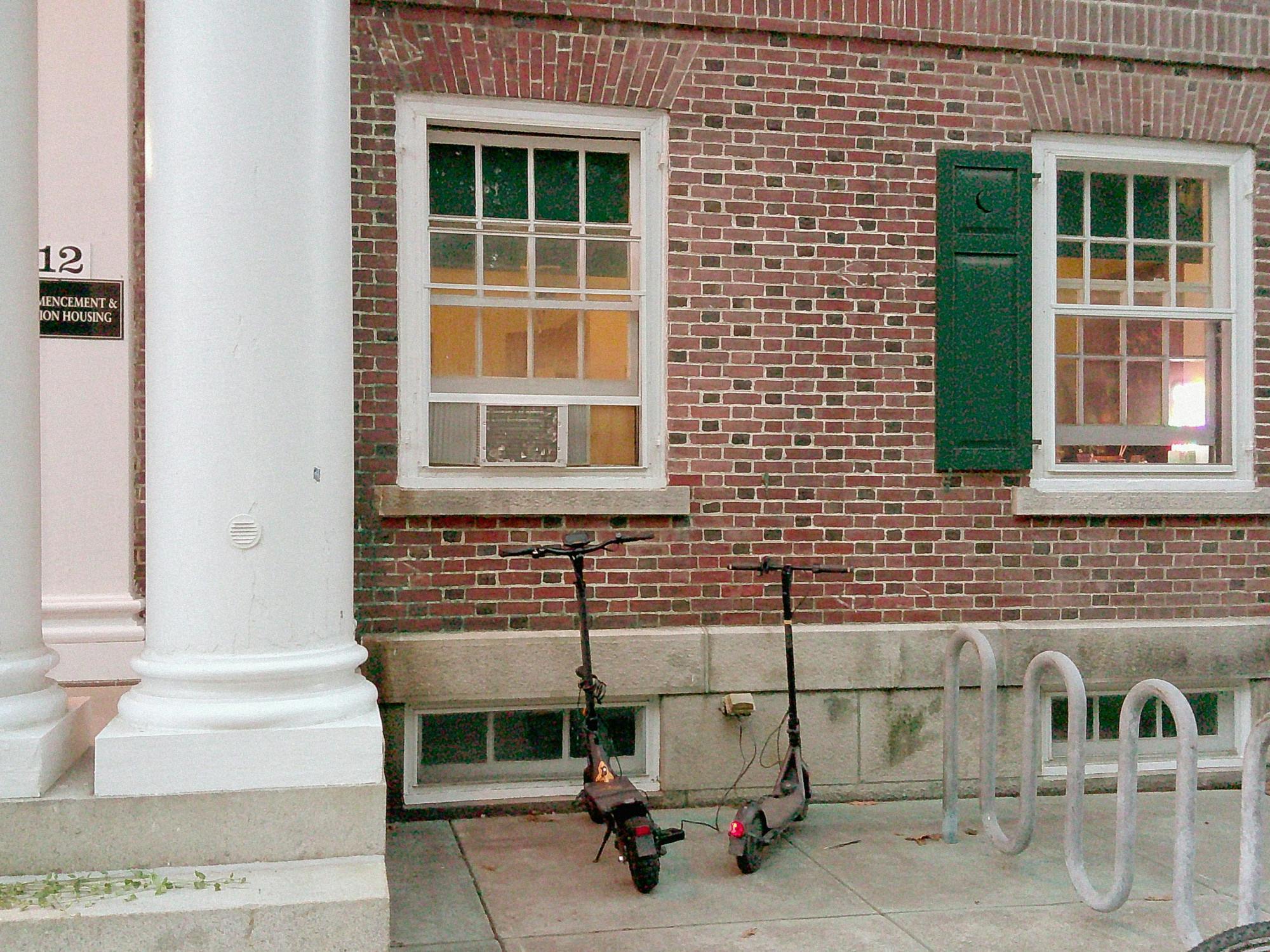
At first glance, Hanover doesn’t look too different from a typical college town. Zoom out, however, and you’ll find a unique form of transportation: electric scooters. Almost everywhere, students, particularly athletes, race to class, Foco and their dorms on the not-so-typical form of transit.
Hanover town manager Robert Houseman said e-scooters have “exploded on the scene” over the last few years.
“The state budget hasn’t kept up [with the e-scooter increase],” Houseman said. “...Just like a bicycle or an e-bike, they’re supposed to obey the rules of the road, with the flow of traffic, signal stop, yield to pedestrians [and] stay off sidewalks.”
Athletes, in particular, have become some of the most prominent scooter users on campus. To Club B soccer player Cameron Brown ’29, who doesn’t use an e-scooter, it feels like “99% of people who use scooters on campus are probably athletes.”
According to Dartmouth Athletics, students who opt for scooters purchase them on their own. Students purchase them from a variety of brands, such as KQI. E-scooters on the KQI website range anywhere from $200 to $1,100.
Baseball player Mason Smith ’29 told The Dartmouth that his e-scooter helps him cut down on long walks and ensure that he is not “compromising important, healthy things” like sleep and food in his busy schedule.
“I lived in the River [dorms], which is about a 20-plus minute walk to the baseball field and the locker room,” Smith said. “I wanted to make sure that I could cut that down timewise.”
Dartmouth swim team diver Milly Kirkman ’29 agreed, saying that scooters help student-athletes navigate their “incredibly tight” schedules.
“The athletes are doing the exact same classes, have the same commitments as people that aren’t athletes,” Kirkman said. “On top of that, we have a 20-hour [per week] athletic commitment.”
Kirkman added that for student-athletes, scooters can take “three or four extra miles off your feet,” which can be much-needed rest for athletes participating in practice or games later in the day.
“If I don’t use my scooter, I walk 15,000 steps a day sometimes, just going everywhere,” Kirkman said.
For students who are not varsity athletes, scooter sightings are few and far between.
Brown said that even while some club student-athletes opt for scooters, most do not.
“We are not real athletes in the same sense as varsity athletes, the commitment is so much less,” Brown said. “...It’s kind of far to get to our practice field sometimes, so it would be nice to use [scooters] then, but most people just hop in the back of someone’s car and are able to make it over.”
Houseman added that while convenient, scooters “seem to be getting faster every year,” posing a potential risk to community safety.
A 1999 Hanover town ordinance prohibits the use of bikes and scooters on all sidewalks. However, this ordinance intended to address manual scooters and bikes, not e-scooters, according to Houseman.
“The challenge with these mobility tools is that they’re being used in a way that puts the rider and others at risk,” Houseman said. “[Riders have] experienced collisions with cars, they’ve experienced collisions with pedestrians and bikes.”
To address these safety concerns, Houseman said the Town is working on new legislation to “bridge the gap between where we are today … and where the devices are moving.”
Houseman added that the College and the Town are collaborating to create “safe places” for these devices to be used so that users “ have an alternative” to riding on the sidewalk.
According to Houseman, the College plans to construct a “shared-use path” in front of the New Hampshire and Topliff dorms for both e-scooter drivers and pedestrians that are “designed to be slower-speed” zones. The path “recognizes that there’s a desire by a large portion of the College population to go to and from the athletic facilities, and their desired line also includes mobility devices like electric scooters,” Houseman said. College spokesperson Jana Barnello confirmed the plan in an email to The Dartmouth.
In spring 2025, the College convened a Personal Electric Vehicles Committee to address the substantial growth in use of e-scooters and to ensure all policies are updated, according to senior vice president for operations and strategic initiatives Josh Keniston.
A report released in August 2025 by the PEV Committee compiling survey results, safety findings and results from a pilot program revealed that 100% of PEV riders surveyed said being able to have their scooter is “very important” to them. On the other hand, 54% non-rider respondents said continued access was “not important,” mainly due to safety concerns, according to the report.
The report also indicated that the Department of Safety and Security and Hanover Police Department plan to “dedicate more time to” education and training regarding the devices. For example, for general safety, e-scooter riders should not use cell phones while operating PEVs and should “wear appropriately colored clothing,” Houseman said.
“The College is part of this community; the students are residents here,” he added. “We want everybody to be safe, including the users of these devices.”
Mira Wissman '29 is a reporter from Bethesda, MD., and is majoring in Neuroscience.