
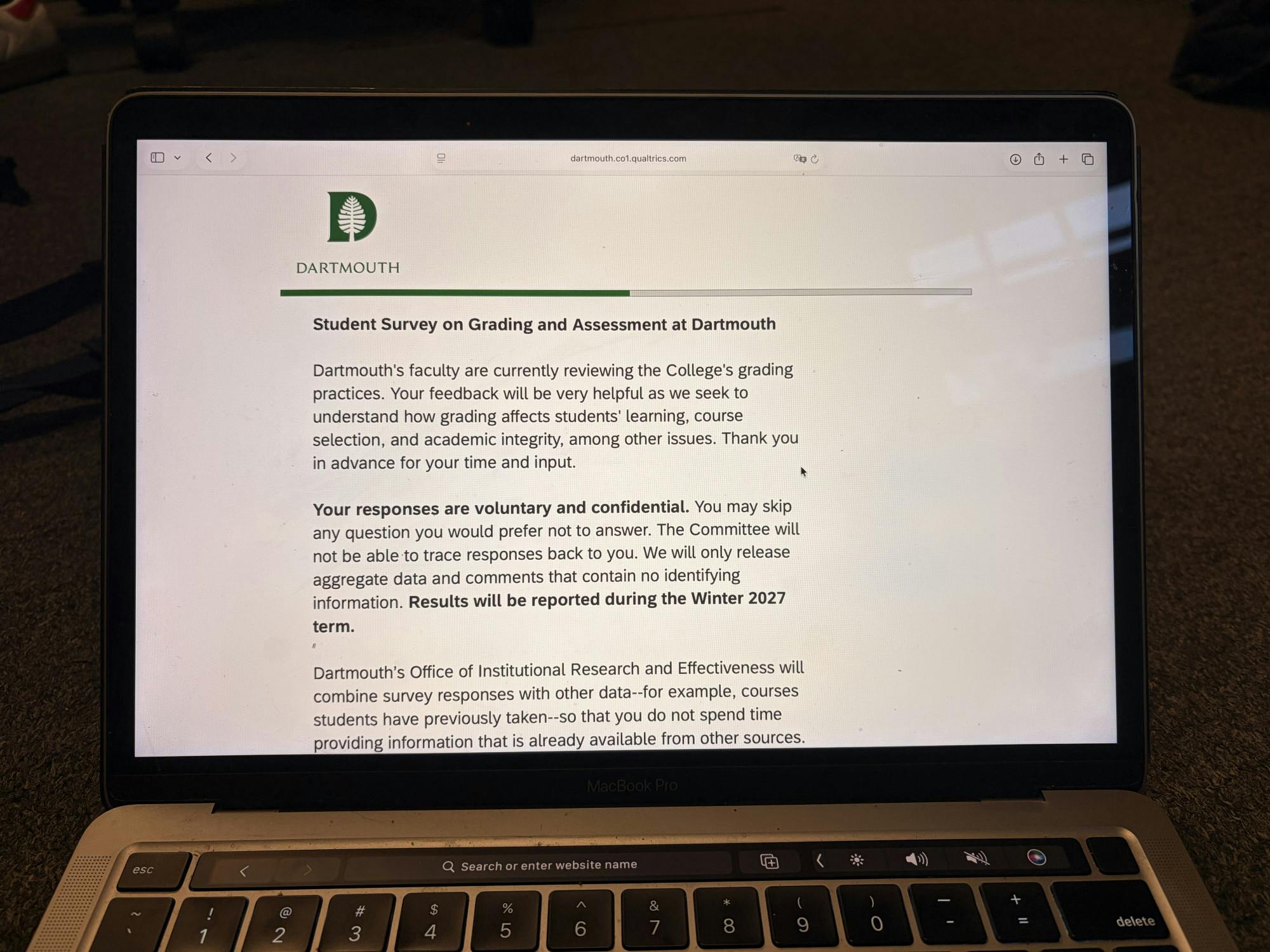
On Sept. 22, the College’s Ad Hoc Committee on Grading Practices and Assessment emailed a survey on grading policy to every undergraduate student who has completed at least one course at Dartmouth. The survey, which closes on Oct. 23, will be used by the committee to inform a winter report on grading and assessment policy, according to committee co-chair and anthropology professor Zaneta Thayer and committee member and government professor Jeffrey Friedman.
The committee will take the feedback into consideration when they “propose potential grading reforms for a faculty vote during the spring term,” Thayer and Friedman wrote in a joint email statement to The Dartmouth. They added that the survey asks students to “reflect on how grading practices shape their well-being” and whether Dartmouth faculty “assign grades according to appropriate standards.”
“The survey spans a wide variety of issues, including what students see as the most important purposes (if any) of assigning grades, what criteria students think grades should ideally reflect and what role (if any) grade expectations play in shaping students’ decisions about what courses to take or majors to pursue,” the pair wrote. The survey also asks about “AI use with respect to concerns about academic integrity.”
The survey is the committee’s first data collection effort since its founding by the College of Arts and Sciences’ Committee on Organization and Policy on April 21. The committee was founded amid national scrutiny of university grading practices, including the Trump administration’s October 2025 Compact for Academic Excellence in Higher Education, which demanded universities quell grade inflation. The College rejected the compact.
In an interview with The Dartmouth, Friedman said that the committee has scheduled meetings with the College’s Center for Career Design and Fellowships Office about how graduate schools and employers “evaluate” Dartmouth students’ transcripts.
“We want to understand how any changes we make to Dartmouth’s grading policies, or how Dartmouth’s current grading policies impact the way that students are viewed outside our campus,” Friedman said.
Friedman added that the committee is “empowered to consider a very wide range of potential changes to grades,” including policies at peer institutions intending to “eliminate or cover or deemphasize grades” and others intending to “deflate or decompress grades, or to make students transcripts more legible.”
Friedman said that the survey is important so that the committee is able to “deliberate on policies once we understand the preferences, values and perspectives of the community.”
“We don’t want to spend time trying to solve problems that people don’t agree are problems,” Friedman said.
The committee also met with Dartmouth Student Government, who collected data on student sentiments about grading policy in last year’s student issues survey, while writing the Oct. 23 survey.
Sixty-four percent of respondents to a question on last year’s student issues survey who self-reported taking a course with an enforced median answered “no” to whether they felt “course medians are a net academic benefit” at Dartmouth, according to student body vice president Maggie de la Fuente ’27.
“We’re definitely trying to represent that interest,” de la Fuente said. “As the committee gathers new data, we’re trying to make sure that as many students as possible are giving feedback and filling out those surveys so that the committee can make an informed decision.”
Other members of the committee directed requests for comment to Thayer and Friedman or did not respond to requests for comment. A representative for the Dartmouth Center for Career Design was not available to comment.
Correction Appended (Sept. 29, 1:15 p.m.): A previous version of this article erroneously referred to Friedman as a committee co-chair, stated that the committee had met with the Center for Career Design, referred to the committee as a “grade inflation committee” in the headline and stated that sixty-four percent of all respondents to the student issues survey had responded about course medians. In fact, Friedman is a committee member, the committee has not yet met with the Center for Career Design but has scheduled to do so, the committee is considering a range of grading practices included but not limited to policies concerning grade inflation and the sixty-four percent figure refers only to survey respondents who had already self-reported taking a course with an enforced median. The article has been corrected to reflect all changes.
Jackson Hyde ’28 is a reporter and editor. He is from Los Angeles, Calif., and is majoring in Government modified with Philosophy.


