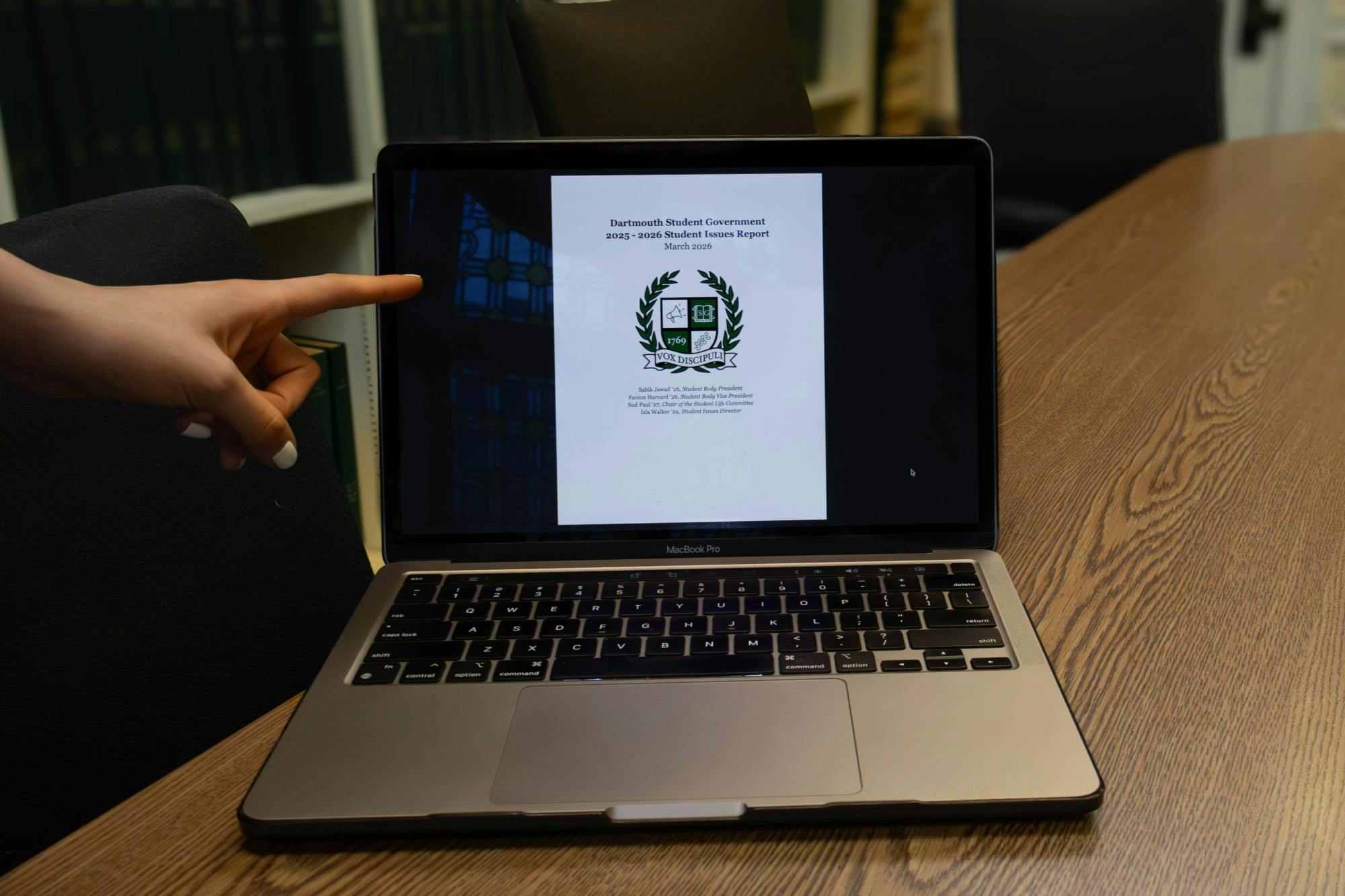
On March 10, the Dartmouth Student Government released the results of their 2025-2026 student issues survey, which was authorized by DSG’s Student Issues Task Force in September 2025. DSG uses data from the survey, which typically draws over 1,000 student respondents, to understand student needs and support projects in conversations with the College. The Dartmouth reviewed the 52-page document.
The majority of students agreed that freedom of speech is protected at Dartmouth. They agreed that academics had a negative impact on their mental health, but that all other surveyed factors had a positive impact. Three quarters indicated that their courses had clear artificial intelligence policies; one quarter reported using artificial intelligence more than half the time in academic settings. The vast majority requested more dining options, particularly fruits. The majority were not in favor of enforced medians. Even more were not in favor of hypothetical enforced medians across all departments.
This year’s survey contained 79 questions divided into sections for dining, housing, mental health and wellness, technology, academics, transportation and personal freedoms. Students were able to respond from Dec. 9 to Jan. 29.
The most frequently-mentioned topics in the survey’s free response section were a greater variety of dining options ranging from vegetarian to vegan choices, schedule flexibility, textbook costs, bikelanes, plowed sidewalks, infrastructure troubleshooting, mental health resources and pushing for increased support from financial aid.
This year, 1,335 students, a quarter of the College’s undergraduate population, completed the survey. Thirty-four percent of respondents were members of the Class of 2029, 28% were members of the Class of 2028, 19% were members of the Class of 2027, 18% were members of the Class of 2026 and 1% were from other class years.
1. Freedom of Expression
Sixty-eight percent of respondents somewhat or strongly agreed with the statement that “Freedom of expression is protected at Dartmouth.” Sixteen percent somewhat or strongly disagreed.
“Many respondents indicated a desire for dialogues of dissent but with increased emphasis on decorum and respect for all communities involved,” according to the report. “Other respondents also suggested less police and security response to student protests.”
To continue protecting freedom of expression, “many” respondents suggested in short-response questions that the College continue protection of international and undocumented students and requested additional events around the topics of diversity and inclusion.
2. Mental Health and Wellness
In the report, respondents rated how academic, interpersonal and cultural factors impacted their mental health and wellness on a scale ranging from extremely negative to extremely positive.
Other than academics, to which 53.11% of respondents reported a negative effect, each factor had a “positive effect on mental wellbeing.”
Physical health, campus culture, relationship with professors and relationships were ranked as “extremely positive” factors for students’ mental health. The relationships factor was selected as “extremely positive” most often — by 36% of respondents.
Seventy-one percent of respondents indicated that they agree “on some level” that they “can identify and access mental health resources when struggling.” Eleven percent disagreed with that statement. Fifty-eight percent of respondents indicated that they believed the College administration is “supportive” of their mental health.
To improve mental health resources, respondents suggested an increase in the number of picnic tables and benches at the Green, the Native American House, Moore Psychology Building, the Class of 1982 Engineering and Computer Science Center, Kemmeny Courtyard, Tuck Mall, College Park and Goldcoast Lawn.
In response to the open comment question, “several” respondents also requested more free counseling appointments and long-term counseling at Dick’s House.
3. Technology
Seventy-six percent of respondents somewhat or strongly agreed that their courses had clear policies on AI.
In the optional AI usage frequency question, which 55% of total respondents answered, a third of respondents indicated they used AI models half the time or more often in academic settings.
Forty-four percent of respondents indicated they are “mostly satisfied” with Dartmouth campus WiFi services. One-third of respondents indicated that they were “mostly” or “extremely” dissatisfied with campus WiFi services.
4. Dining
Respondents requested more vegetables and proteins at the Class of 1953 Commons. The majority of free writing question responses requested additional dining options, including more food options from a diverse range of cultures, such as “Asian, Latin American, Indigenous, Afro-Caribbean and Mediterranean” choices.
Eighty-three percent of respondents indicated they would “include fruits in their meals if they were provided.” There are fruit options at every Dartmouth Dining location.
Ninety-six percent of respondents indicated that they would use dining dollars in town if they were offered the opportunity. Sixty-five percent of respondents indicated that they would use dining dollars in town half of the time or more, if given the option.
5. Academics
Fifty-eight percent of respondents have taken a class with an enforced median. Sixty-four percent said they do not believe that enforced medians yield a net academic benefit. Seventy-eight percent also indicated that, if grading policies were to change, they would not be in favor of an enforced median across all departments.
Fifty-eight percent of respondents said they prefer to keep the current textbook system with individual ordering.
DSG concluded the report by writing that they value “each and every student contribution” because “success can only be achieved with your support.”
“Every student is encouraged to attend weekly DSG meetings at Collis 101,” the authors wrote. “Students are always welcome to share their opinions.”
Madeline Kahn Ehrlich '29 is a reporter from upstate New York. She is considering studying English and Public Policy. She enjoys creative writing, art and reading historical fiction.