
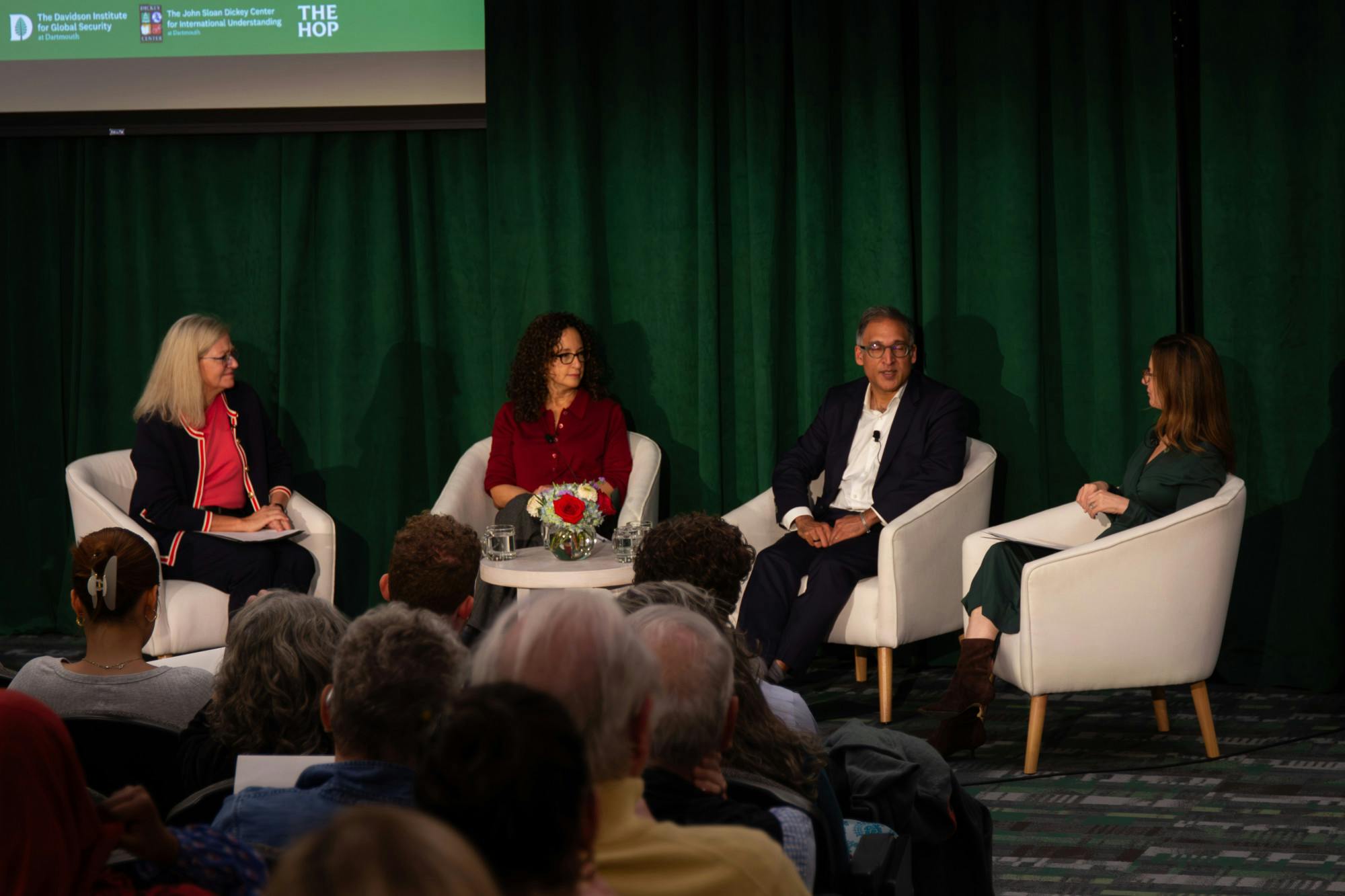
At an event hosted jointly by the Rockefeller Center for Public Policy and the Dickey Center for International Understanding on Sept. 24, former Department of Justice acting solicitor general Neal Katyal ’91 said that Supreme Court debates represent “American democracy at its best,” even with a current conservative majority. The event also featured creator and showrunner of Netflix series “The Diplomat” Deborah Cahn, who met with Katyal to discuss her series, diplomacy and the importance of dissent.
The event was moderated by U.S. News & World Report former editorial director and executive vice president Dafna Linzer and Dickey Center diplomat-in-residence Erica Barks Ruggles in Filene Auditorium. Approximately 200 people attended in person while another 450 attended the event virtually, according to Rockefeller Center associate director for public programs and special events Dvora Greenberg Koelling.
As acting solicitor general of the DOJ from 2010 to 2011, Katyal oversaw and conducted litigation on behalf of the U.S. government in the Supreme Court. Katyal said at the event that he is currently writing a television series about the inner workings of the Supreme Court with comedian John Mulaney.
Cahn’s series, “The Diplomat,” follows Katherine Wyler (Keri Russell) the newly-appointed U.S. ambassador to the United Kingdom, as she navigates the diplomatic relationship between the U.S. and the United Kingdom following an attack on a British vessel. Cahn has also written for other television series, including “Grey’s Anatomy,” “Homeland” and “The West Wing.”
Cahn attributed her inspiration for “The Diplomat” to her experience speaking with former U.S. ambassador Elizabeth Jones while working on “Homeland,” where she learned about Jones’ experience as deputy chief of mission to the ambassador to Pakistan.
“I just wrote in my notes, ‘She is a series,’” Cahn said at the event. “I called her and I said, ‘Can I hear your stories?’”
Cahn added that another idea that drew her to the story of “The Diplomat” was the importance of relationships in diplomacy.
“There were a lot of relatable TV stories about people forging personal connections,” Cahn said. “Decisions that appear from the outside to be technocratic or ideological or intellectual are often based on these very, very, very personal things.”
Katyal praised “The Diplomat” for demonstrating the positive change officials can have on government, while labeling the current administration as “dispiriting,” “all about personal agendas” and “not about the public good.”
“What [The Diplomat] has managed to do … [is] capture something beautiful about our foreign service offices, and what they give,” Katyal said. “It’s so meaningful to see that because I saw it in government, and now to see it on the screen — that’s not an easy story to tell.”
When asked about the current state of the relationship between the executive and judicial branches, Katyal said that the courts “can’t really police the executive in all its abuses of power when you have an executive that is bent on abusing power.”
Katyal himself has argued against the Trump administration as a private attorney. In Learning Resources Inc. v. Trump, argued in November 2025, Katyal argued that the International Emergency Economic Powers Act, which President Donald Trump began using in April 2025 to impose tariffs in response to the “influx of illegal drugs from Canada, Mexico and China,” did not authorize “reciprocal or drug trafficking tariffs.”
Katyal noted, in reference to his tariffs case against the Trump administration, that he was “aware that maybe once in American history has the Supreme Court said ‘no’ to a president on a signature initiative.”
“There’s a whole narrative about the court right now that it is in the pocket of conservatives,” Katyal said. “But here’s the thing, we won [Learning Resources Inc. v. Trump] six to three, including two of President Trump’s own nominees to the court.”
Katyal noted that “even with this conservative court,” there is “robust disagreement and debate.”
“To me, that’s like American democracy at its best,” Katyal said.
Cahn connected her experience of collaborating with writers who work differently than her to Katyal’s appreciation for discussion and disagreement, noting that debating ideas in the writing process gave her “the tools to be able to start and pivot and move on the job.”
“You always want to be, whenever you can, working for people who don’t think the way that you do,” Cahn said.
Katyal also noted that the episode of “The West Wing” titled “The Supremes,” which Cahn wrote, was what inspired him to start his current project writing his own television show about the Supreme Court.
“I saw it right when it aired on TV… [Cahn] captured what I loved about the Supreme Court, [which] was the rich dialogue between the different wings of the court,” Katyal said. “It was at that moment, actually, that I decided to write a TV show about the Supreme Court.”
Attendee Jonathan Ancrum ’29 described the conversation as “relevant” and “refreshing.”
“To see these two individuals from two different worlds talk about their experience, talk about how they view government, it was very grounding … and really surreal,” Ancrum said. “I think an event like that is something we need to see more.”
Attendee Sophia Kohmann ’28 noted that it was “awesome” to see the “interdisciplinary connections” between diplomacy and filmmaking.
“I think it’s so cool how Dartmouth is able to bring so many amazing speakers with a wide variety of different experiences,” Kohmann said. “It’s also really cool to see this perspective, coming at diplomacy and making a mark on the world through a different lens such as filmmaking.”


