On April 21, the Committee on Organization and Policy for the School of Arts and Sciences created the Ad Hoc Committee on Grading Practices and Assessment to “identify opportunities to strengthen the clarity, coherence and credibility” of College grading and assessment policies, COP committee co-chair and earth sciences professor Erich Osterberg wrote in a May 21 email statement to The Dartmouth.
The creation of the committee last month followed national scrutiny of university grading practices, particularly at peer institutions. In October 2025, the Trump administration offered the Compact for Academic Excellence in Higher Education to nine universities, including Dartmouth, in which it demanded — among other terms — that the universities “quell grade inflation.” The College rejected the compact, along with all other universities initially approached.
On May 20, 70% of Harvard University faculty members voted to limit the number of As awarded to 20% of each class, with flexibility for four additional As, starting in the fall 2027 semester. The Harvard vote came after an October 2025 report by Harvard’s Office of Undergraduate Education found that 60% of grades given during Harvard’s 2024-2025 academic year were As.
In an interview with The Dartmouth, Harvard dean of undergraduate education Amanda Claybaugh — who authored the Office of Undergraduate Education’s report — said the faculty committee’s proposal was shaped by the faculty’s “deep experience as teachers in a wide array of disciplines” and their “disciplinary expertise.”
“There were economists who were thinking about incentive systems, and there were psychologists who were thinking about measurement and assessment,” Claybaugh said. “They were therefore able to present a proposal that was up to the standards of rigor that we would expect from the research coming out of our university.”
Claybaugh added that Harvard students were an “invaluable source of information about how grading is experienced” while the Harvard faculty were drafting their proposal. Claybaugh said Harvard delayed implementation of the cap for As from the upcoming fall semester to fall 2027 due to “feedback from students” and “so that faculty can spend this year learning how to redesign their assignments and their courses.”
“They [faculty] are thinking about what’s in the students’ best interests,” Claybaugh said. “The more they know about students’ experience, the better they’ll be able to discern that best interest.”
Dartmouth’s Committee on Organization and Policy began “solicit[ing] comments” from faculty on a new grading committee and “ask[ing] for nominations” for members in February, COP co-chair and economics department chair James Feyrer wrote in an email statement to The Dartmouth.
“COP felt that the conversation about assessment needed to be led by faculty,” Feyrer wrote. “…Our goal was to staff the committee with a broad range of faculty committed to thinking deeply about these issues.”
The committee will “report its initial progress at the winter 2027 Arts and Sciences faculty meeting and submit a final written report to the faculty, including any proposals that would require a vote by the faculty, by the end of the 2026-2027 academic year,” according to the ad hoc committee’s chair shared with The Dartmouth by African and African American studies professor and ad hoc committee co-chair Laura Edmondson.
The committee “recogniz[es] that grading practices intersect with broader questions of pedagogy, student learning, institutional signaling and evolving technological contexts — including, most pressingly, AI,” the committee charge states.
The committee will be co-chaired by Edmondson and anthropology professor Zaneta Thayer and composed of chemistry professor Wendy Epps, English and creative writing professor Aden Evens, government professor Jeffrey Friedman, earth sciences professor Robert Hawley, Thayer School of Engineering professor Rafe Steinhauer and comparative literature and French professor Andrea Tarnowski, according to Edmondson.
The committee will begin “extensive outreach” across the “Dartmouth community” starting in the fall, Edmondson wrote.
“We’re especially keen to engage with students on this issue, and we’ve already begun preliminary conversations with [Dartmouth Student Government] about how to best do so,” she added.
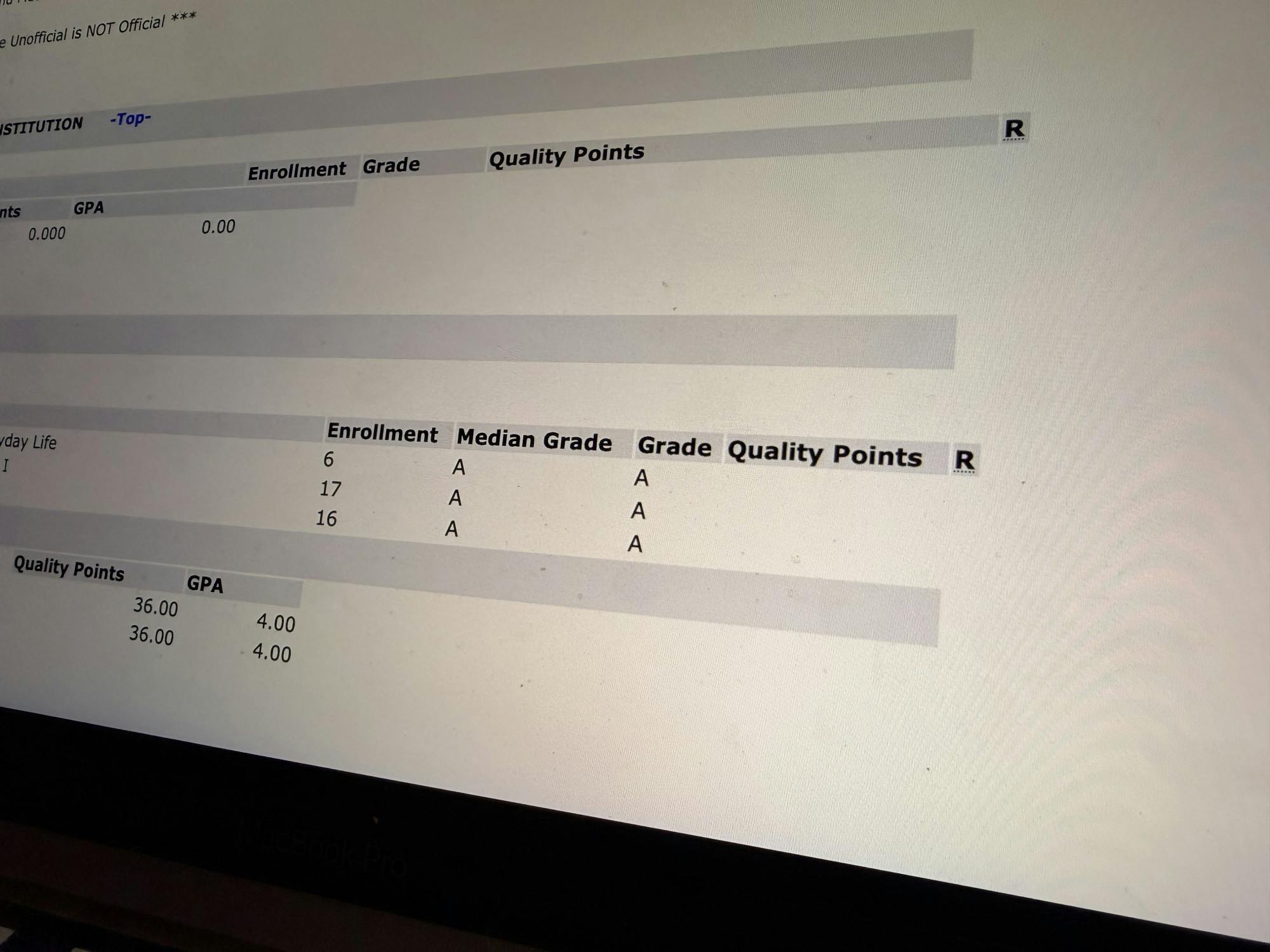
Median GPA data for Dartmouth undergraduates is not publicly available. Dartmouth registrar Eric Parsons wrote in an email statement to The Dartmouth that grade-point-average “inflation rate” at the College has “remained stable and consistent” across the different divisions — arts and humanities, sciences, social sciences and international and interdisciplinary studies — in the School of Arts and Sciences. Parsons declined to provide “any grading data beyond what is publicly available.”
According to publicly available data, GPA cutoffs for honors awards have risen in the past decade, indicating that median GPAs have increased. For the 2025-2026 academic year, the GPA cutoffs to graduate with summa cum laude honors is 3.97, for magna cum laude honors is 3.92 and cum laude honors is 3.83, according to the Arts and Sciences Registrar’s Office website. For the 2012-2013 academic year, the respective GPA cutoffs were 3.90, 3.78 and 3.62, according to Office of the Registrar archives.
Sahil Gandhi ’29 is a reporter from Staten Island, N.Y., and is majoring in environmental studies and government modified with philosophy and economics. He loves word searches and falling down internet and Wikipedia rabbit holes.