
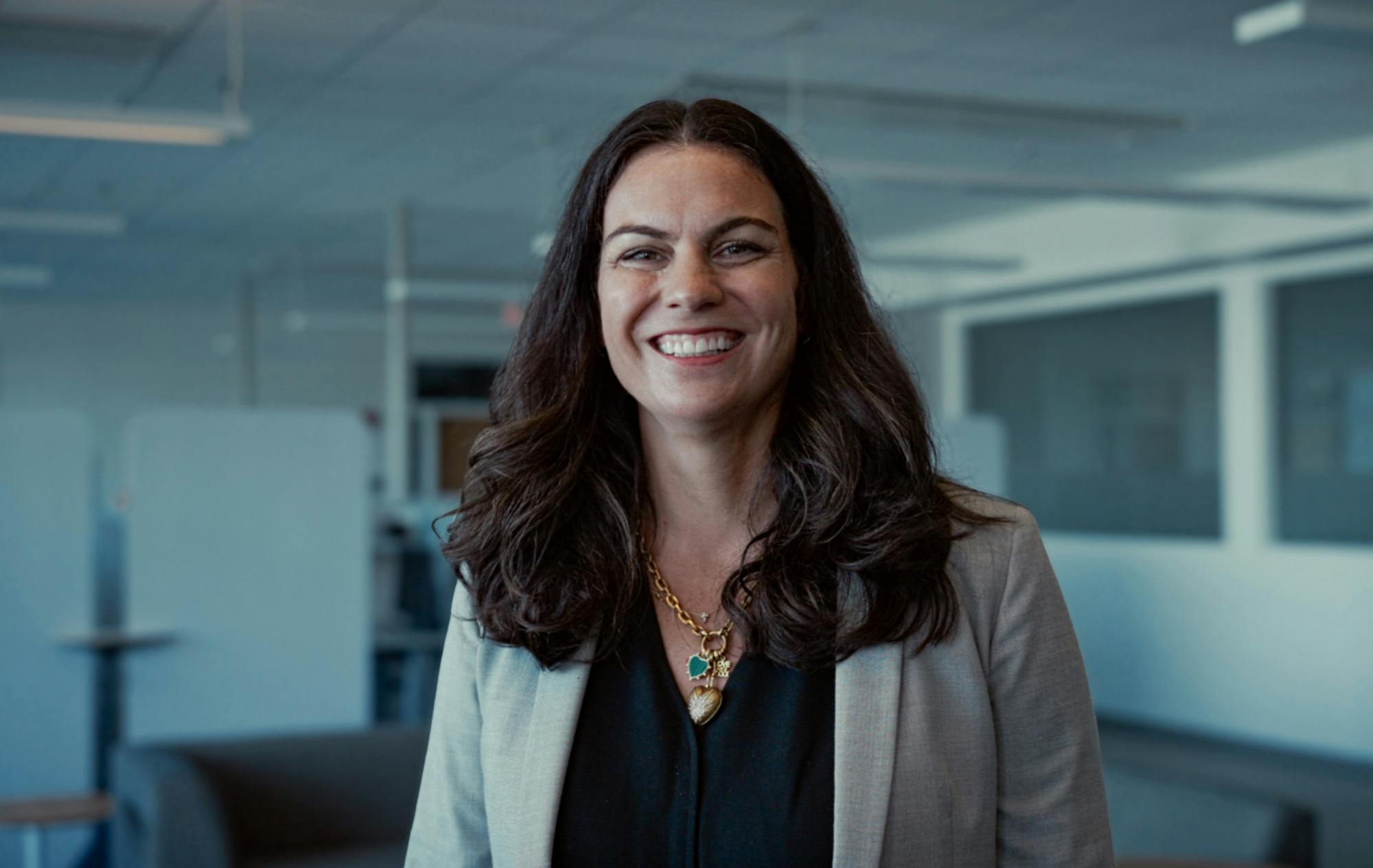
On Aug. 5, the College announced the appointment of health economist Carrie Colla ’01 as the next dean of the Guarini School of Graduate and Advanced Studies, following Jon Kull ’88’s transition to focus on teaching chemistry. Colla will begin her role on Sept. 1.
Colla has served as vice chair of the Dartmouth Institute for Health Policy and Clinical Practice, which conducts research on health policy and equity, and taught health economics and policy at the Geisel School of Medicine since March 2024. From 2021 to 2023, she served as director of the health analysis division of the Congressional Budget Office.
The Dartmouth sat down with Colla about her background, priorities and plans for the future.
What drew you to the dean position, and why do you think this is the right time to take on the role?
CC: As an alum, I’m drawn to helping Dartmouth improve and expand our education and research. I’ve also been involved in graduate education for a long time. I have a Ph.D. and have taught master’s students, and I’ve mentored students at the pre-doctoral, Ph.D. and post-doctoral stages. Working with students at this level to help them develop is one of my favorite mentoring relationships.
Under College President Sian Leah Beilock and Provost Santiago Schnell’s leadership, we’re thinking carefully about how to create world-class graduate education programs and excel in areas of research where the college already has strengths. I’m excited to work on those initiatives with them and figure out how graduate and advanced studies play a role.
How do you think your background as both an undergraduate alum and a professor at Geisel will inform the new role you’re taking on?
CC: Many of the Ph.D. programs that Guarini manages are located in Geisel, and I think having that broad view of having been a graduate school professor working with joint programs between Tuck and Geisel, as well as having attended the undergraduate programs and taught classes in the economics department, will give me a lot of insight into the needs of the programs that Guarini manages.
I feel very fortunate to have many of these different perspectives that are important to being a dean at Dartmouth, and I also think my deep institutional knowledge and relationships at Dartmouth will be an asset to Guarini.
What do you think Dartmouth’s graduate programs do well at the moment, and where do you see the most room for improvement?
CC: We do really well in some interdisciplinary areas, and we’ve launched a couple of programs recently that I think are really interesting and well suited to the strengths of Dartmouth. There’s a new program, the Master of Energy Transition with the Irving Institute, and the Guarini Ph.D. Innovation Program with Thayer, both of which are supposed to be very good. There’s also a new computational science and modeling Ph.D. program. I’m excited to learn more about all of our programs and evaluate how they’re doing and how they can be improved.
Do you see artificial intelligence as a challenge for graduate education or an opportunity?
CC: The use of artificial intelligence in both education and research is changing the game and changing what graduate students need to be taught. I would say it’s an opportunity as long as we go about it by staying at the cutting edge of technology and helping our students to come out fully equipped to be able to use AI in their positions.
Since taking office in January 2025, President Donald Trump has cut or frozen over $3 billion in grants for scientific research. Since the National Institutes of Health cancelled four of Dartmouth’s research grants last spring, only one has been reinstated. Trump’s mass funding freezes, while overruled by federal courts in March, have already had an impact on research. Congress largely refused to ratify his budget plan seeking to cut an additional $44 billion to research, but the administration’s request for fiscal year 2027 seeks similar cuts. How do you expect shifting federal policy to affect Dartmouth graduate students and researchers? What do you think Dartmouth can do to try to stay ahead of these changes?
CC: There are very important proposed policy changes occurring right now that will affect Guarini and research universities deeply. They’re affecting the way we recruit students, the types of financial mechanisms that potential students have access to for graduate education and the traditional funds used for training by organizations like the U.S. National Science Foundation, the National Institutes of Health and the Agency for Healthcare Research and Quality.
Dartmouth is already doing a lot, including commenting on proposed regulation in support of research and science. We continue to seek philanthropic funds to fill in gaps left by federal funding and to create new programs that fill in places where training and research are needed. There are major changes for higher education by policies being proposed, and Dartmouth is doing its best to respond to the environment and continue to create world-class science and research, even under new constraints.
Are there any particular programs or areas of research that you think might be especially vulnerable?
CC: In my areas of expertise, changes where we’ve seen important cuts in federal research funding include research around healthcare quality, health equity and maternal and child health. Those are the ones that I know about best because of my personal history as a Geisel professor, but there are many others that have been impacted as well.
How can Dartmouth balance the necessary pursuit of funding with maintaining its academic and institutional independence?
CC: Dartmouth will always maintain its academic integrity and independence as one of the top priorities, while working to be competitive for the contracts and grants that are available.
The federal government is currently investigating Geisel’s and several other medical schools’ admission practices for “alleged racial discrimination” against white and Asian applicants, and Secretary of Education Linda McMahon has called on universities to make statements about admissions transparency, free speech and intellectual diversity. How will federal scrutiny of higher education affect graduate education at Dartmouth?
CC: We will comply with all of the rules and regulations around recruiting and admissions. We don’t yet know what the impact of the new rules and regulations will be.
How do you think Dartmouth can pursue a diverse graduate student body while also navigating these legal and political constraints?
CC: If we continue to have best-in-class programs, we hope to attract a diverse student population.
What are your top priorities during your first year as dean?
CC: I certainly have a lot to learn. My top priority is working with the current Guarini team, advisory boards and the former dean to get up and running as quickly as possible on strategic priorities, informing myself by listening well to others. Working to improve the standing of our graduate programs, and in particular the placement of our graduates and their career trajectories, will also be a priority for me.
Is there anything specific that you hope to have accomplished by the end of your first year as dean?
CC: I am looking forward to having a well-functioning team operating within a budget that has been established, and working to provide very high-value services for our graduate and advanced studies students and programs across the campus.
This interview was edited for clarity and length.


