
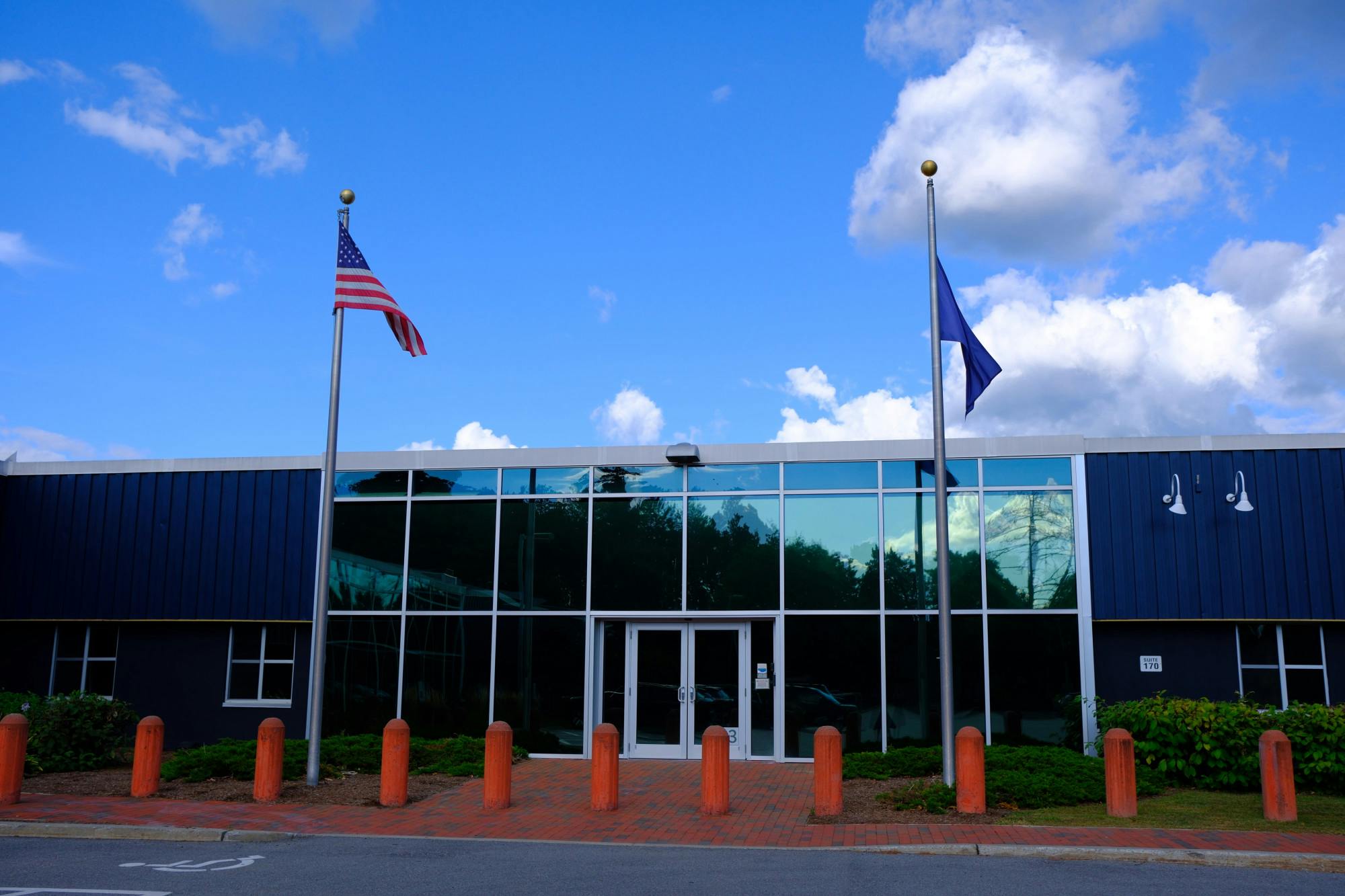
Vermont attorney general Charity Clark charged 12 protestors, four of whom were Dartmouth students, with unlawful trespassing during a July 24 sit-in at the Immigration and Customs Enforcement’s National Criminal Analysis and Targeting Center, a surveillance facility located in the White Cap Business Park in Williston, Vt. All 12 pleaded not guilty at their arraignment in Burlington, Vt., on Sept. 24.
Vermont State Police arrested Henry Dorr ’28, Kate Pressgrove ’29, Jackson Price ’28, Gabbie Ross ’28, Roan Wade ’25 and eight other activists after they disobeyed VSP directions to leave the NCATC — which “analyzes data in numerous law enforcement and immigration databases to develop leads on removable noncitizens,” according to an ICE document — on July 24. VSP wrote in a July 24 press release which has since been removed from its website that the building’s owner, Graham Goldsmith, asked police to remove protesters after they refused requests to leave the property. VSP did not respond to a request for comment as to why the press release was removed from its website.
While multiple previous protests at the NCATC have ended in arrests, this is the first time protesters face charges.
Dorr, Price, Ross, Wade and the eight other defendants were released on conditions, including that they not return to the White Cap Business Park until their cases are resolved. Their next hearing is scheduled for Dec. 16. Unlawful trespassing in Vermont carries a maximum sentence of three months in jail or a $500 fine.
Pressgrove, who was 18 — a minor under Vermont sentencing law — at the time of the arrest, was initially charged with the other 12 protestors in adult criminal court, but her case was dismissed on Sept. 24 prior to the arraignment, according to retired Vermont defense attorney Robert Appel, who represents the 12 protestors with ongoing cases and Pressgrove before her adult case was dismissed. Prosecutors then charged Pressgrove as a minor.
Chittenden County state attorney Sarah George, who is not involved in the prosecutions of the July 24 protestors, previously declined to prosecute individuals arrested at the NCATC, citing her office’s “limited resources.” She declined to prosecute 13 demonstrators arrested after a Feb. 9 sit-in, including Wade and Geisel School of Medicine professor Donald Kollisch, and four protestors arrested during another sit-in at the NCATC on May 14. In both previous protests, individuals were arrested after they entered the privately owned building and remained after being directed to leave by VSP.
George did not respond to a request for comment.
Vermont State Police referred the July cases directly to the Vermont attorney general’s office. Clark and George, who are both up for reelection in November, have concurrent jurisdiction to press charges in state criminal courts.
In a statement to The Dartmouth, Clark wrote that her responsibilities as attorney general require her to apply the law regardless of whether she agrees with protesters’ political aims.
“Whether I support or oppose the cause of a protest cannot be the determining factor of whether the law applies to a defendant,” Clark wrote. “That kind of viewpoint discrimination has no place in our justice system.”
Clark wrote that she was “horrified by the ways that ICE is terrorizing communities” and claimed she has protested at Williston ICE facilities in the past. The Dartmouth could not verify Clark’s previous participation in ICE protests. According to her campaign website, she has sued the Trump administration 49 times since January 2025.
“I encourage Vermonters to continue to stand up for our values and for each other with respect and courage, including lawful protest,” she wrote in her email statement to The Dartmouth.
Clark did not comment on Pressgrove’s case or why Vermont State Police referred the July cases directly to her office rather than to George, the county attorney. VSP did not respond to a request for comment.
On the morning of July 24, protesters entered the building as part of an effort to disrupt operations at the NCACT. Ross, one of the arrested Dartmouth students, said remaining after being asked to leave was a “part of our civil disobedience.” Her participation was motivated in part by concerns about how the Trump administration’s immigration enforcement policies could affect her own family and community, she added.
“I’m the daughter of an immigrant, and ever since Trump [took office], I have been very fearful for my family,” Ross said. “I just want to do whatever I can to protect people like my mom and people in my community.”
Price wrote in a statement to The Dartmouth that he knew the complex was privately owned and that other businesses operated inside it, including a gym and medical center. He said demonstrators targeted “only” the entrance to the NCACT.
Ross and Wade told The Dartmouth in separate interviews that they checked the court docket for weeks without seeing their cases listed, expecting them to be dropped as previous cases had been, until their arraignment “appeared” on Sept. 22. Wade said protesters received paper notices of their Sept. 24 arraignment at the time of their arrest, but they had received a similar one for their February case, which George dropped.
Ross said the two-day notice for their arraignment was “incredibly stressful.”
“We had to rush to get housing, transportation and, of course, a lawyer to defend our case” before the arraignment, Ross said.
Vermont Gov. Phil Scott, who is running for reelection in November, defended the prosecution during a Sept. 24 press conference, saying he did not direct the attorney general’s office to take up the cases.
“I know it’s not easy for the attorney general to make this decision to prosecute and that doesn’t mean that they [the 12 protesters] are all going to be thrown in jail, but they’re going to be held accountable for violating the law,” Scott said.
Scott added that the response “might be different” if the protest occurred at a “standalone ICE facility.”
“There’s other businesses there [that] have a right to continue to do business without being encumbered,” he said.
Multiple Democratic Vermont politicians have spoken out against the charges. State treasurer Mike Pieciak wrote in a Sept. 24 press release that he was “surprised” by Clark’s decision to prosecute the protesters. He criticized the use of state resources on the cases and called for Clark to dismiss the charges.
“I disagree with this decision to prosecute Vermonters for peacefully exercising their First Amendment rights in the face of serious injustices against our immigrant neighbors,” Pieciak wrote in the press release. “It is clear to me that pursuing this case will not bring justice to our communities and is a waste of taxpayer dollars.”
Appel said he is considering raising a “necessity defense” on behalf of the protesters. Under that theory, a defendant argues that breaking one law was justified as an effort to prevent greater harm. Although Vermont courts have limited the circumstances in which defendants can present necessity arguments to juries, Appel said he believes the current political context warrants attempting to use the defense.
“Their breaking the law on trespass pales in comparison to the harm that we’re trying to prevent,” Appel said, referring to ICE’s “extremely violent” enforcement practices and “racial profiling.”
Wade accused the state of using the prosecutions as a “deterrence strategy” against protests at the NCATC, which Wade called a “node” of ICE operations. They said they plan to continue protesting.
“It’s been clear that we will continue protesting and that our protesting is effective at reducing ICE’s capacity to commit harm,” they said.
Ross said the prosecutions would not end organizing at the Williston facility. Protesters are planning a week of demonstrations from Oct. 4 through Oct. 9, she added.
“I don’t want what happened to scare other people from protesting,” Ross said. “Even though we may be punished for standing up for what is right, the broader picture is more important — defending our families and neighbors and friends.”
A College spokesperson, Goldsmith and Dorr did not respond to requests for comment.
ICE did not respond to a request for comment.
Iris WeaverBell ’28 contributed to reporting.
Haley S. Rodriguez ’29 is a reporter with roots in New York City. She is studying history and biology and enjoys long-distance running, reading and sailing.


