
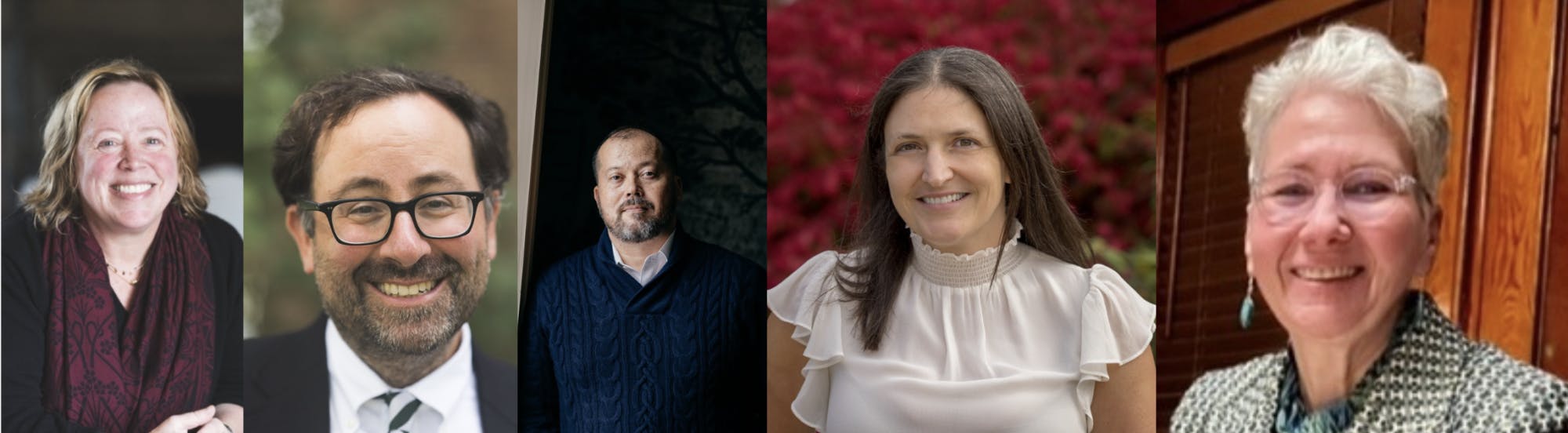
If you told yourself you were going to read this year but have yet to find a book: look no further. Eight English and creative writing professors have 10 new releases that are worth your time and attention.
“Cannon” by Paige Lewis
English professor Matthew Olzmann “just started reading” Lewis’s debut novel, which was published by Viking in May. It follows the quest of two heroes, blending myths from different cultures.
“It’s by a fantastic poet — one of our best writers — and I’ve been looking forward to the book for a long time,” Olzmann wrote.
“Complete stories” by Ingeborg Bachmann, translated by Philip Boehm and Tess Lewis
English department administrator Katherine Gibbel is excited for Dartmouth comparative literature professor Tess Lewis and playwright and literary translator Philip Boehm’s translation of Bachmann’s lifetime collection of short fiction — written during the 1950s, ’60s and ’70s — which will be published by New Directions on October 27, 2026. It is the first time all of Bachmann’s short fiction has been compiled and translated from German into English.
Bachmann’s “short stories often address fascism, about which she wrote, ‘It begins in relationships between people,’” Gibbel wrote.
“Data Empire: The Power of Information to Organize, Control, and Dominate” by Roopika Risam
English professor James Dobson recommended “Data Empire: The Power of Information to Organize, Control, and Dominate” by Dartmouth film and media studies professor Roopika Risam, published by HarperCollins on July 14. The book explores the history of human data tracking technology, from cave paintings to artificial intelligence.
“This is an absolutely brilliant book about the history of data and the attempts to control it and the people it represents,” Dobson wrote.
“Etna” by Paul Yoon
Published by Simon and Schuster on Aug. 4, English professor Alexander Chee’s first choice is a “novel about a dog from the dog’s point of view — a war dog in an unnamed war who just wants to go home,” Chee wrote. Although he has not read it yet, Yoon is one of Chee’s “favorite” short story writers.
“If anyone is going to do something interesting about dogs and war in 2026, I believe it is him [Yoon],” Chee added.
“Land: A Novel” by Maggie O’Farrell
Released in June and published by Alfred A. Knopf, “Land” became an instant New York Times bestseller. It’s also “the best new novel” English professor Carolyn Dever has “read in a long time.”
“Maggie O’Farrell’s latest novel knocked me sideways, stood me up and did it all over again,” Dever wrote. “She sets the book in post-Famine Ireland and in prehistoric Ireland, telling the story of the land, a family, a diaspora. ‘Land’ is politically pointed without being intellectualized, historically detailed without being dull, sentimental but not mawkish. It is lyrical and plot-driven and intensely emotional and also frustrating because it caused this reader to wish it weren’t so.”
“Little Sound” by Katherine Gibbel
English professor Rebecca Clark recommends the English department administrator Katherine Gibbel’s upcoming poetry collection, which University of Chicago Press will publish on October 6, 2026.
“Not only do I frequently rely on Kate to point me towards the most delightful, moving and clever of contemporary poetry, but I always jump at the chance to listen to her read her work aloud,” Clark wrote. “I’ve had the privilege of being able to hear portions of her upcoming collection, ‘Little Sound,’ over the years and cannot wait to have the book in my hands!”
This summer, Clark is teaching ENGL 65.03: “Summer Tomes: Moby-Dick.” Clark drew a comparison between Gibbel’s upcoming collection and Hermann Melville’s classic.
“It shouldn’t come as a shock that I’m a sucker for a slightly obsessive, associative deep dive into etymology and esoteric facts that is by turns beautiful, strange, meditative and surprisingly funny,” Clark wrote.
“The True True Story of Raja the Gullible (and His Mother)” by Rabih Alameddine
Alameddine’s ninth book spans six decades of a Lebanese family’s life, from the Lebanese Civil War (1975-1990) to the COVID-19 pandemic. Although this novel came out in hardback in September 2025 — and won the 2025 National Book Award for fiction — you can find paperbacks in bookstores for the first time on Sept. 1.
“The novel made me laugh and cry, sometimes on the same page, and it plays with the line between comedy and tragedy in fantastically innovative ways,” English professor Christie Harner wrote. “The Beirut/Lebanese Civil War hostage narrative is not a new one, and it’s been covered in a range of other media, but Alameddine finds a way to turn it into something surprising. The novel’s sensory representation of the city — sound, taste, smell, sight, feel — is also incredible.”
“Tailbone” by Che Yeun
Chee’s second recommendation is Yeun’s debut novel, which was published by Bloomsbury Publishing in April. “Tailbone” is about a young woman in South Korea during the 1990s International Monetary Fund crisis who lives in a boarding house “with women who are not making the best choices — but this is precisely why they matter to her,” Chee wrote.
“This is a novel about when the bottom drops out on your life and you kick at it to make sure it really falls,” Chee wrote. “Bold, beautifully written, it had me from the first pages.”
“Tiny Gardens Everywhere” by Kate Brown
English professor Melissa Zeiger’s pick is a non-fiction book about gardeners in cities and suburbs who are creating “hidden-in-plain-sight” gardens and farms. Brown, a history of science professor at the Massachusetts Institute of Technology, is “a wonderful, lively writer,” Zeiger wrote in an email statement to The Dartmouth.
“She traces the activist history of such gardens and suggests future possibilities for sustainability and mutual aid,” Zeiger added.
“Vector Media” by Fabian Offert and Leo Impett
Published by Meson Press and University of Minnesota Press in April, Dobson’s second pick is a nonfiction book that argues that artificial intelligence collapses all mediums, including visual, text and audio, into a mathematical vector space.
“Offert and Impett develop a media theoretical analysis of the representations produced by the neural networks powering today’s AI technologies and discuss the commensurability involved in these representations as demonstrating ‘neural exchange value,’” Dobson wrote.
Iris WeaverBell ’28 is a reporter and editor. She is from Portland, Ore., and is majoring in economics and minoring in public policy.


