This article is featured in the 2026 Commencement special issue.
If you have ever tried explaining Dartmouth Greek life to someone from another school, chances are they have never heard of “Chi Delt,” “KDE” or “Sig Delt.” Dartmouth’s three local sororities comprise a Greek system where local organizations have shaped the College’s social scene for decades. Today, of the seven College-recognized houses in the Inter-Sorority Council, three operate independently from national organizations: Chi Delta, Kappa Delta Epsilon and Sigma Delta.
In addition to the ISC houses, the College recognizes sororities in two other Greek councils: the National Pan-Hellenic Council — which oversees historically Black Greek organizations at Dartmouth, including Alpha Kappa Alpha and Delta Sigma Theta — and the Multicultural Greek Council, which includes Sigma Lambda Gamma. These organizations operate separately from the ISC and have their own membership intake processes.
Office of Greek life and student societies director Hunter Carlheim said sororities have played an important role in shaping support systems and social spaces for women at Dartmouth since the College became coeducational.
“There is a profound history of women empowerment, equity, accessibility, diversity and inclusivity in the sororities that have existed and continue to exist on campus,” Carlheim said. “For the last 50 years, these organizations have provided space for women to have a home on campus, feel supported by a community and share common values.”
The difference between local and national status affects sororities’ finances, oversight, recruitment process and social life. While national sororities follow policies established by their national chapter, Dartmouth’s local sororities govern themselves. Carlheim said Dartmouth’s Greek system is unique because of the longstanding presence of both local and nationally affiliated organizations.
“There are a few campuses in 2026 that still operate with a large presence of local organizations,” Carlheim said. “Here at Dartmouth, we have some of the longest running local organizations in the country juxtaposed with national chapters who are nationally some of the best chapters in the country.”
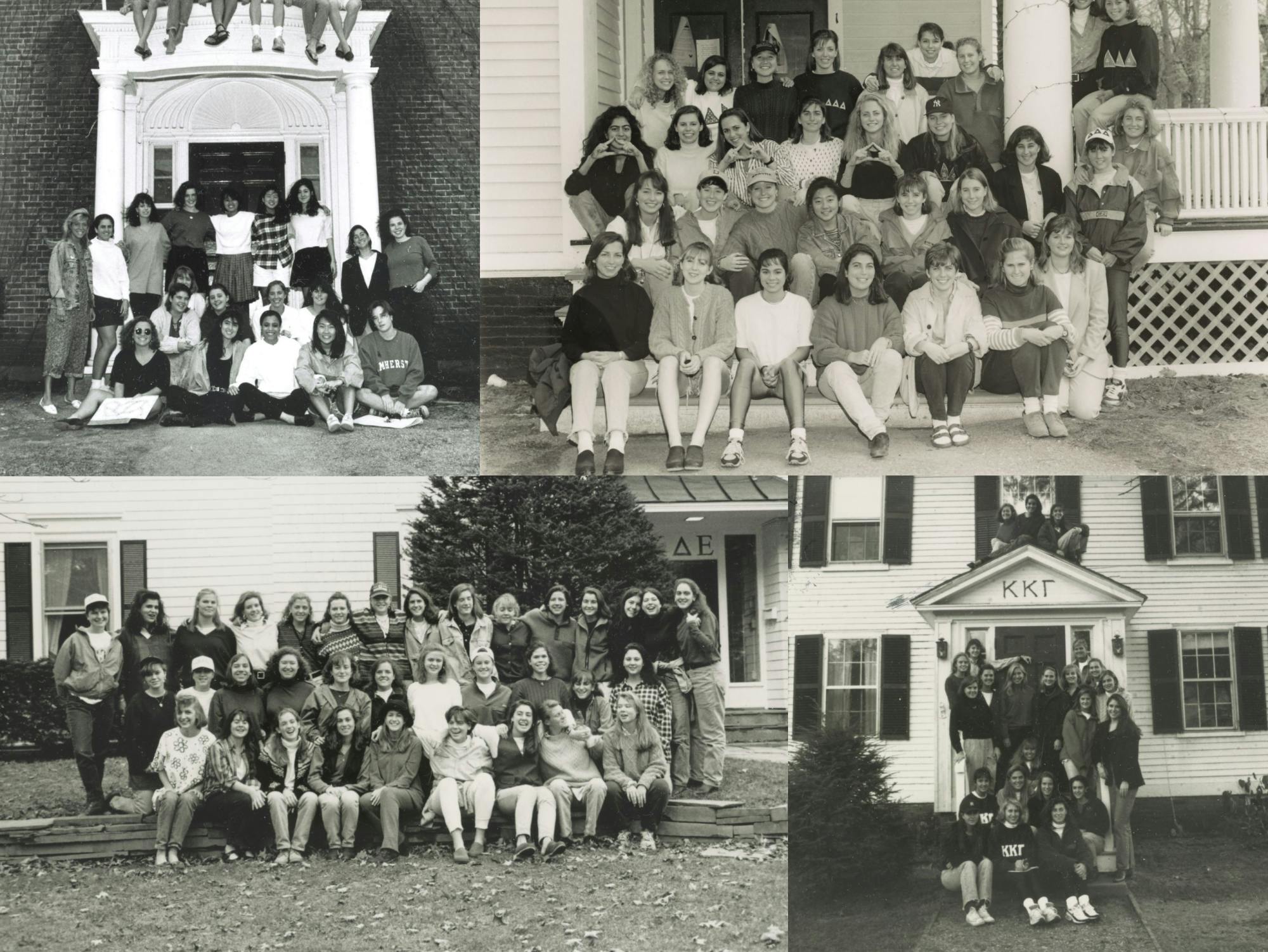
Sororities first emerged at Dartmouth in 1977, five years after the College became coeducational in 1972. The Zeta Lambda chapter of Sigma Kappa was established first, followed by the Epsilon Chi chapter of Kappa Kappa Gamma in 1978. Additional sororities formed throughout the coming decades.

A sorority can be established at Dartmouth in several ways. According to College policy, a national organization may establish a chapter on campus, an independent student organization may petition for recognition or an existing chapter may separate from its national organization and become a local sorority.
Sigma Delt became the College’s first local sorority by disaffiliating from Sigma Kappa in 1988 after members raised concerns about “strong religious references in rituals that we felt did not belong to our chapter” and “too much emphasis on the sorority members’ interaction[s] with men” within the national organization, according to an interview with former Sigma Delta president Libby Carrier ’89 published in previous coverage from The Dartmouth on Nov. 1, 1988.
Sigma Kappa did not respond to multiple emails for comment.
In 1990, Xi Kappa Chi disaffiliated from Alpha Chi Omega — which was established at Dartmouth in 1980. However, after dwindling membership caused financial instability and vacancy in their College-owned house on Webster Avenue, the Dartmouth Panhellenic Council — the governing body of the College’s sororities at the time — voted to dissolve Xi Kappa Chi and replace it with KDE, a new local sorority, in 1993.
In 1992, Epsilon Kappa Theta sorority was formed after members voted to disaffiliate from Kappa Alpha Theta — which was established at Dartmouth in 1982 — because of differences in national and local organizational values over gender inclusion. EKT was a member of the ISC until April 2024, when it voted to become a gender-inclusive house and subsequently joined the Gender-Inclusive Greek Council in winter 2024.
More recently, according to previous reporting by The Dartmouth, Chi Delt disaffiliated from the national Delta Delta Delta sorority in 2015 in part to exercise greater autonomy over programming and management.
“We don’t believe in a lot of [Tri Delta’s] principles and rituals that have a lot of religious undertones, and we think that as a chapter we should be a secular organization,” Chi Delt president Lauren Buchanan ’16 told The Dartmouth at the time.
Tri Delta declined to comment.

Unlike fraternities, which were an established fixture of student life at Dartmouth over a century before coeducation, sororities developed within a campus culture as women were still carving out social spaces of their own.
Dartmouth’s policy handbook for rules governing student organizations, titled “Privileges and Expectations of Recognized Student Organizations,” mandates that organizations must recruit members, create governing documents and secure a faculty or staff advisor to gain recognition. Sorority recruitment is held twice each academic year: first in the fall, then the winter. Students are eligible to rush for the first time by their sophomore fall.
Sorority localization is an extensive process that can involve substantial financial and administrative changes. The first step towards disaffiliating involves notifying the national organization and voting internally on whether to separate. Chapters would then need to negotiate the surrender of national rituals, traditions and property while reorganizing finances, insurance and nonprofit status, according to previous reporting by The Dartmouth on guidelines for localization developed by former vice presidents of policy and research of the former Panhellenic Council Samantha Cheng ’16 and Carly Schnitzler ’16.
Local and national sororities differ significantly in structure. Carlheim said that local sororities are “run solely by Dartmouth alumni and undergraduate members,” which includes managing everything “from chapter operations, to finances to housing.” On the other hand, national sororities have “additional resources provided by a centralized headquarters that support alumni advisors, volunteers, philanthropic causes, dues collection, marketing, housing support, insurance, officer training, leadership development and more,” according to Carlheim.
One of the clearest distinctions involves alcohol policies and social space. Chapters of the National Panhellenic Conference — which at Dartmouth include Alpha Phi, Alpha Xi Delta, Kappa Delta and Kappa, and formerly included Tri Delta and Sigma Kappa — are prohibited by their national headquarters from having alcohol in their sorority house, limiting national sororities’ ability to host parties. Local sororities, in contrast, are not bound by those regulations and therefore have more flexibility over how they use their physical spaces.
“The inability to host is kind of restricting, but it is something we knew going into [joining a national sorority],” KD member Mazvita Nhidza ’28 said. “It holds up old-fashioned ‘men party and women should be demure,’ when the two of these things should not be necessarily mutually exclusive.”
KDE president Simone Wuttke ’27 said KDE’s status as a local sorority gives members more autonomy.
“I think it’s really nice being a local sorority because we have a lot more freedom in a lot of ways,” Wuttke said. “... We’re allowed to host, which I think is huge and a super empowering thing, being the only sorority on frat row and being one of the only sororities that can actually throw parties and give people the opportunity to go to spaces that aren’t frats or male-centered.”

Being a local sorority also gives KDE flexibility to change organizational rules and policies from year to year, Wutke added.
“I think there’s a lot more … personalization with figuring out what works for the house in that specific year,” she explained. “We have a constitution that we can amend and can change the foundations of how the house is run if we think something isn’t working or if something could be improved.”
The structural distinction also affects finances. Members of national sororities pay dues both to their local chapter and to the national organization, while local sororities retain all dues internally.
“I would say that being in a national sorority does have a heavier financial burden, even though there is financial aid,” Nhidza said. “There usually are problems getting the aid in time for dues.”
KD President Loralei Forgette ’27 declined to comment on the timing of financial assistance for sorority dues.
Supporters of localization have argued that local sororities provide greater autonomy and accessibility. Without national regulations and fees, local organizations can maintain more control over finances, philanthropy and social programming.
“We don’t believe in the fact that we send tons of money to them every year, and we don’t really feel that we see the payback of that,” Buchanan told The Dartmouth in 2015 about Chi Delt’s localization.

National organizations, however, provide benefits of their own, including broader alumni networks, established philanthropic infrastructure and professional networking opportunities that extend beyond Dartmouth.
Carlheim said members’ experiences are often shaped less by whether a sorority is local or national and more by the culture of individual organizations.
“All organizations, local and national, are striving to provide a home at Dartmouth,” Carlheim said. “If a student finds their people and their home in one house over another, we see that any experience can be a positive one.”
“At the end of the day, people don’t just join an organization,” Carlheim said. “People join people.”
Elizabeth Ray ’27 is a news executive editor of The Dartmouth and member of Kappa Delta sorority. Vidushi Sharma ’27 is a news executive editor of The Dartmouth and member of Kappa Kappa Gamma sorority. Annabelle Zhang ’27 is the editor-in-chief of The Dartmouth and a member of Chi Delta sorority.