
This article is featured in the 2026 Commencement special issue.
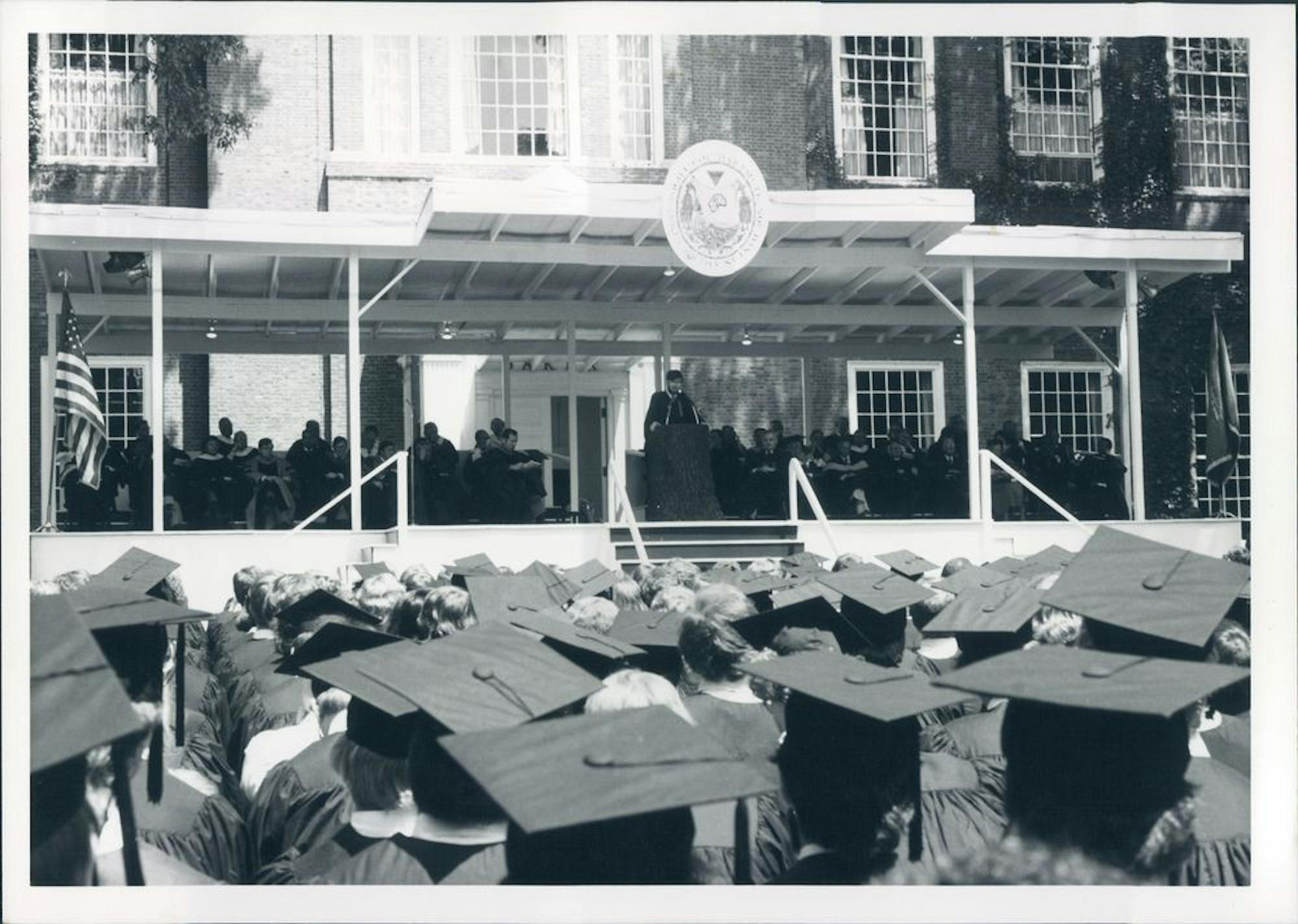
Fifty years ago, Dartmouth conferred degrees on the Class of 1976, the first four-year coeducational cohort in the institution’s history.
With the exception of a handful of transfer students, the College had been all-male since it was founded in 1769. But on Sept. 5, 1972, following the Board of Trustees’ landmark vote to admit women as degree candidates, 251 women — 177 freshmen and 74 transfer students — arrived on campus to join a male undergraduate population of 3,030. The same year, the College implemented a revised Freshman Year Experience, designed to foster community among incoming students, and the “Dartmouth Plan,” meant to resolve the housing shortage driven by rising enrollment.
The Dartmouth asked alumni from the Class of 1976 to reflect on their undergraduate years, a period marked by this drastic transition to coeducation.
‘Dartmouth was entering a multiverse’
After fraternity sink night — a celebration of new members’ commitment to their new Greek house — in April 1973, a lewd and misogynistic letter was slipped under every door in the all-female Woodward Hall. It made explicit sexual demands and labeled the women at Dartmouth “co-hogs.” The letter closed with a threat: “Our movement is large. Things must change.”
The early years of coeducation were marked by such turbulence and flux. Sharon Ali ’76 described campus to be “fairly dynamic, but evolving.” She lived in North Massachusetts Hall, one of three all-female dormitories. Ali recalled “going into the lunchroom” and there being “very, very few women, and even more so from an African-American standpoint.”
Ali said the lived experience of coeducation often lagged behind the policy itself. It was “one thing to clearly make the decision,” but it was “something entirely different in terms of the day-to-day reality,” she explained.
Kenneth Monteiro ’76 described Dartmouth as navigating a period of profound social and political turbulence.
“Dartmouth was entering a multiverse,” Monteiro said. “[Campus] was a picture postcard, like it still is, but the Civil Rights Movement was at its height … because racism and sexism was at its height.”
Several alumni who spoke with The Dartmouth described the dean of the College at the time, Carroll Brewster, as a hindrance to women’s integration on campus. In May 1975, Brewster awarded a song called “Our Cohogs” — which was performed by the brothers of the Theta Delta Chi fraternity — the prize for “Most Creative and Original” entry in the Inter-Fraternity Hums contest, an annual acapella competition between fraternities held during Green Key weekend. The lyrics include dehumanizing insults and sexually explicit attacks on female students: “Our cohogs, they play seven / They have ruined our masculine heaven.”
“[He] was as racist and sexist as everyone says,” Monteiro said.
Brewster was not available for comment by time of publication.
Martha Beattie ’76 remembered feeling a sense of “trepidation” when arriving on campus, as if she were “walking on eggshells.” She described an example of the hostility she felt: In March 1974, residents of Russell Sage Hall protested the Committee on Student Life’s recommendation to make the building coed by 1976. They hung banners from the building’s exterior that read “keep sage all male” and “no coeds.”
“It was at times hard when ugly incidents popped up,” Beattie said. “We did what we could do to make Dartmouth a good place for women. I wanted to love it as much as any man had ever loved it, and after four years, I felt that I really achieved that.”
‘A big period of change that happened very rapidly’
For the women who matriculated during such profound change, Dartmouth was a place of potential.
Brewer Doran ’76 said she remembered that “the juniors and the seniors were a little less prepared for women.” She thought that this was because “a lot of them had gone through college with just men, they were not prepared to compete with women.”
Doran described the integration of women into Dartmouth tradition as gradual and nonlinear.
“It got better over the four years, but I think sometimes some of the women who had the hardest times were those who came in the early ’80s classes,” she said, “because they came after several years of coeducation. They expected it to be normal, and it wasn’t.”
Steve Bell ’76 praised his female classmates who chose to be a part of a “big period of change that happened very rapidly.”
“I give immense credit to the women in the first 10 years, maybe longer, who had to fight through the reluctance and the anger,” he said.
Bell expressed that he “would not have applied or gone to Dartmouth if it wasn’t co-ed,” a sentiment he also shared with campus in The Dartmouth’s “Voces Clamantium” section — a collection of recent letters to the editor — on May 2, 1974.

“One of the greatest joys I have at Dartmouth is my fraternity and the many friends I gained there. This has occurred with women in residence. Women have not affected this in the least,” Bell wrote in his letter to the editor. “If you use your heads and not your prejudices I think you will see that these Dartmouth women have had quite a job adapting here… The only thing wrong with the women at the College is that their numbers are too small!”
Still, a lasting community
Fifty years later, such trailblazing continues to carry heavy weight.
“It is something that I look back on with pride, certainly as we’re heading into our 50th reunion,” Ali said. “It was a very, very historic milestone.”
Beattie recalled that being a part of the first coeducational class at a “cool place like Dartmouth” stuck with her.
“Being a pioneer, truly a pioneer ... it’s not something you get to do very often,” Beattie said. “So that in and of itself was just such a remarkable and defining piece of our experience.”
She credits several male faculty members and fellow students with making her feel supported, citing her experience on the women’s rowing team as an example.
“We were not officially recognized by the athletic office, but with no budget, [heavyweight rowing coach Peter Gardner] coached us for the first two years in the fall of my sophomore year,” Beattie said. “There were these really magical moments where we had support.”
Facing shared challenges to integrating into Dartmouth brought the women of the class closer together.
Kipp Barker ’76 said attending the College created “this one incredible connection: going to school at Dartmouth … being a Dartmouth graduate, being an undergraduate at this unique, special place.”
“It was hard sometimes to find the other women,” Beattie said. “When we found each other, we really just glued together. Those bonds are still really strong.”
“[Dartmouth] taught me the sanctity of friendship,” Doran said.
Monteiro, the Class of 1976’s representative on the Dartmouth Alumni Council, said “Dartmouth is still very, very wonderful to me.”
“The people we bonded with when we left Dartmouth … We can be anywhere in the world, call one of our friends from Dartmouth, say ‘I need you to help me with X, Y and Z,’” she said. “We do it because we went through war together.”
Bell said his experience at Dartmouth was characterized by “establishing the best friends that I’ve ever had, and continue to have.”
“Dartmouth has always been a base for me,” he said. “I loved being there. My best friends shared that experience.”
The alumni encouraged current students to take advantage of the College’s distinct academic and social opportunities.
“Embrace the uniqueness of Dartmouth,” Doran said. “Embrace the resilience that you learn. I think that’s still a hallmark of a Dartmouth education.”


