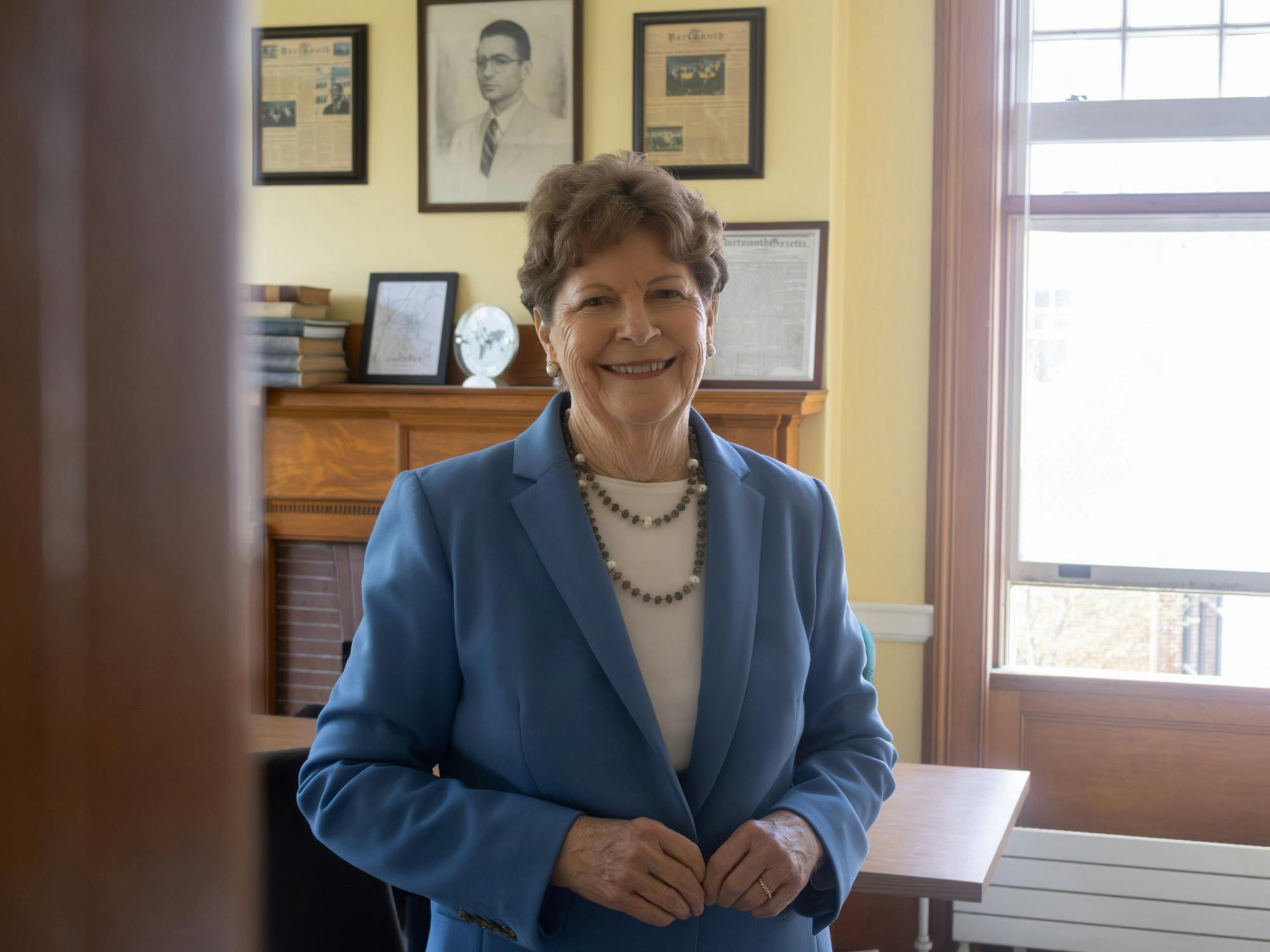
As part of The Dartmouth’s coverage of the upcoming 2026 midterm and gubernatorial elections, the paper is publishing an interview series, “A Sit-Down with The Dartmouth,” featuring in-depth conversations with candidates and political leaders connected to statewide and New Hampshire district races.
In this installment, The Dartmouth interviewed retiring Sen. Jeanne Shaheen, D-N.H., who announced earlier this year that she will not seek reelection in November. Shaheen is the first woman to be elected governor of New Hampshire, the first woman in U.S. history to serve as both a governor and U.S. senator and the first woman of either party to chair the Senate Foreign Relations Committee.
During the interview, Shaheen reflected on her decision to step away from public office after more than three decades, endorsed U.S. Rep. Chris Pappas as her preferred successor and warned against the “ideological extremes” in both parties.
Why was this the right moment to step aside? How does that decision reflect your view of where the country and New Hampshire are right now?
JS: The decision was really more about what was important for me to do for the rest of my life and my family. I felt we had a good potential successor in place. I’m rooting for Chris Pappas to succeed me because I think it’s important to have somebody who is going to continue to work to make a difference for New Hampshire families and small businesses and for what we need in the state. I will have served in public office for 30 years and been involved in politics for more than 50, so I’m ready for a little more flexibility in my schedule.
This series has focused on the future of New Hampshire’s political leadership. As you step away and endorse Chris Pappas to succeed you, what does that choice say about the kind of leadership you think the state needs next?
JS: I think we need leaders who are going to continue to stay focused on New Hampshire — on our small businesses, on health care, on creating job opportunities and on ensuring that the role the United States plays in the world is a positive one.
Your daughter, Stefany Shaheen, is running for Congress in New Hampshire’s 1st District. What role do you plan to play in that race?
JS: I intend to root her on. I think she’s a great candidate. Obviously, I’ve watched her create a small business several times. I’ve watched her serve as a city councilor in Portsmouth and on the police commission. I think she’ll do a great job.
Will you campaign for her?
JS: I’m sure at some point I will.
You have been an outspoken opponent of New Hampshire’s new voting laws, including recently holding a press conference with student journalists after the state banned the use of student IDs as valid voter identification. What do you believe these changes will mean in practice for college students, including those at Dartmouth, who want to vote here?
JS: I think what we’re seeing both in New Hampshire, where the Republican legislature has controlled voting laws in recent years, and across the country, is an effort by the Republican Party and the Trump administration to limit who gets to vote. Because their policies don’t necessarily align with where the majority of voters in the country are, their goal is to decide who gets to vote. They’re trying to limit anybody who tends to vote more Democratic or progressive, whether that’s students, lower-income voters, women or people of color.
Students have historically tended to vote more Democratic and more progressive, so the goal is to keep students from voting. I remember when I first got involved in politics, students at the University of New Hampshire were not allowed to register and vote in Durham. I remember [civil rights activist] Jesse Jackson leading students from campus to town hall to force the clerk to register them. Anything that disenfranchises people is not good for democracy.
You’ve warned about the impact of tariffs and deteriorating relations with Canada on New Hampshire’s economy, particularly tourism. What does that tell you about how national economic and foreign policy decisions are affecting states like New Hampshire right now?
JS: Clearly, decisions made at the federal level affect states and affect people across the country.
We know the average family is expected to pay about $1,700 more this year because of tariffs. Tourism is our second-largest industry in New Hampshire, and we know many Canadian tourists did not come last year because of the president’s attacks on our Canadian neighbors. It does not help New Hampshire businesses or the United States to attack the people who have historically been our closest allies.
You have taken a nuanced and evolving position on U.S. support for Israel. As the Gaza conflict has expanded into a wider confrontation involving Iran, how do you think about the U.S. role in the region and its relationship with Israel going forward?
JS: Israel and the United States will continue to be very strong allies because we share values and a commitment to democracy. But I am very concerned about the leadership Prime Minister Netanyahu is providing in Israel. The attacks on Gaza and the West Bank, the thousands of civilians who have been killed and the attacks in Lebanon are not something I support. I think they undermine Israel’s long-term security in the region. If we are going to have long-term peace in the Middle East, there needs to be a Palestinian state.
Should Congress play a more active role in overseeing or conditioning weapons sales?
JS: Congress does play a role. Unfortunately, the White House can override what Congress decides, and that’s what administrations have been willing to do when they disagree with congressional decisions about weapons sales.
What we’ve seen with the various joint resolutions of disapproval is that we simply have not had enough support for them. But I would point out that the most recent round saw a significant increase in support because of concerns about the way Prime Minister Benjamin Netanyahu has conducted the war.
The country and New Hampshire are deeply divided, with each party often blaming the other for that division. What do you see as the root of our polarization?
JS: I think it’s a combination of things. As primaries have become more dominant, both parties have been pushed toward the ideological extremes. The amount of money in politics has had a huge impact. The Citizens United decision magnified that tremendously. Many members of Congress no longer spend time in Washington with one another because they are constantly returning home to campaign and raise money.
And leadership has also been a challenge. I think this president’s rhetoric has made things worse.
Do you think the country can move out of that division?
JS: Americans have to decide they’ve had enough. The thing about democracy is that everybody has to participate. If people think they can disengage and not pay attention to who they are voting for or what those leaders stand for, then they get the outcome they deserve.
I think many people voted for President Trump believing they were going to get a different leader than the one they got. He campaigned on lowering costs and ending endless wars overseas. He has not done those things, and I think Americans are unhappy about that — for good reason.
As your time in office comes to an end early next year, how would you like to be remembered by the people of New Hampshire?
JS: I hope people will remember the work we did as an effort to make a difference for people in New Hampshire and to make life better for them. When people call our office, we do not ask whether they are Democrats or Republicans. We ask what we can do to help. I hope people remember that.
This interview has been edited for clarity and length.
Isabel Menna ‘29 is a reporter from Leavenworth, Wash., is majoring in economics and is a member of the Dartmouth Ski Patrol.