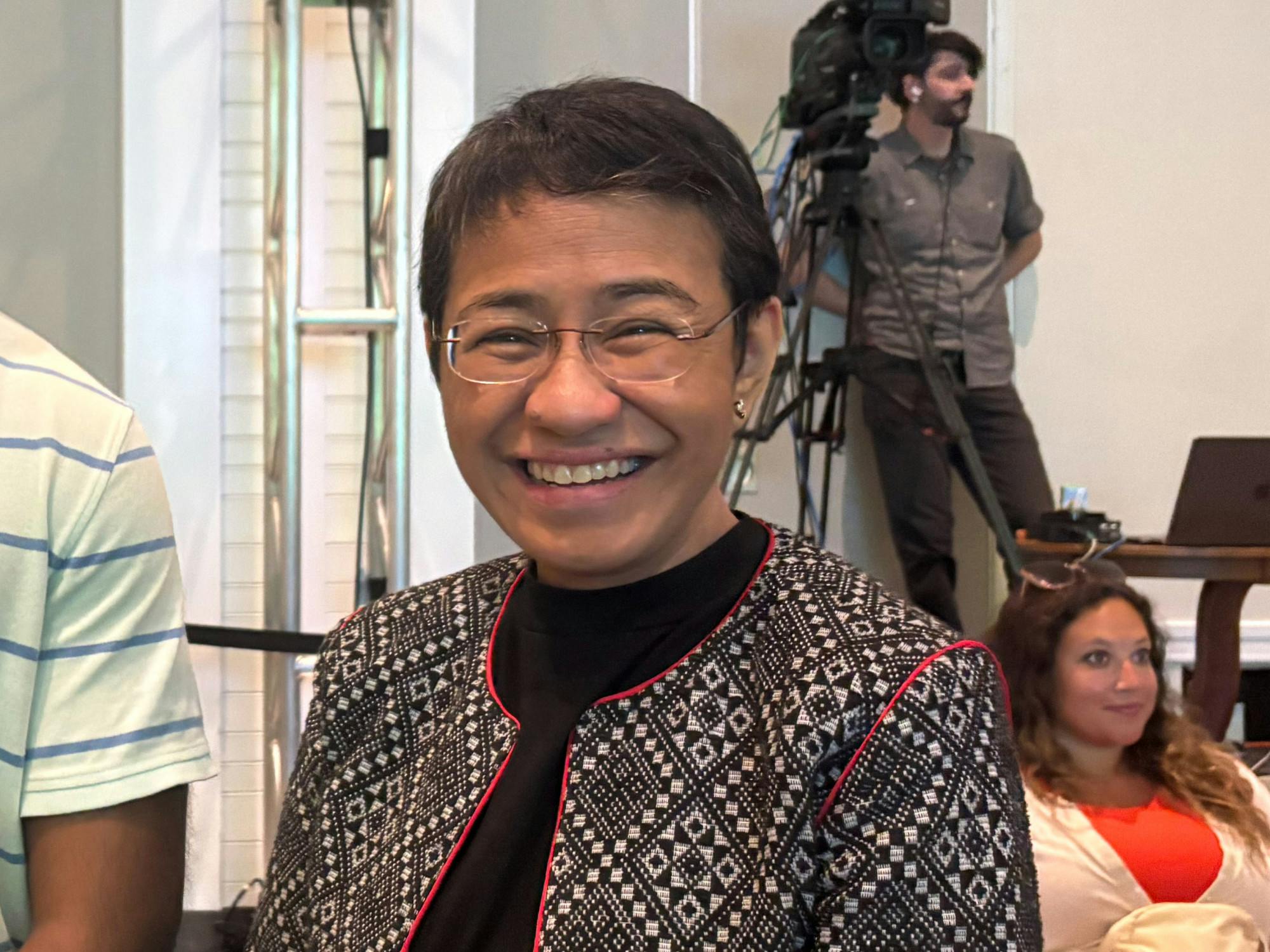
On May 20, journalist and free speech advocate Maria Ressa visited Hanover to give the keynote address for this year’s Social Justice Awards ceremony. The awards, hosted by the College’s Division of Institutional Diversity and Equity, honor Dartmouth alumni, faculty, staff and community members for their commitment to “social justice locally and worldwide,” according to IDE’s website.
Ressa is the co-founder and chief executive officer of the Filipino news website Rappler. Prior to founding Rappler in 2012, Ressa served concurrently as CNN’s bureau chief in Manila and Jakarta. She was also named TIME Magazine’s Person of the Year in 2018 and won the Nobel Peace Prize in 2021 for her “efforts to safeguard freedom of expression” in the Philippines. The Philippine government has filed several criminal cases against Ressa and Rappler.
The Dartmouth spoke with Ressa about her work in journalism, the Philippine government’s prosecutions against her and her views on the state of free expression in the United States.
What motivated you to become a journalist, and what pushed you to start Rappler in 2012?
MR: I became a journalist almost by accident. I graduated in 1986 when the People Power Revolution happened, and I went back to the Philippines on a Fulbright scholarship. One of the things I did was walk into what used to be the old government station that had been taken over by the people. I said I direct, and then they made me direct the nightly newscast. After the Fulbright, I never left. It was an incredible time period.
The Philippine government has repeatedly targeted you and Rappler on charges of cyber libel and tax evasion. How do you balance your reporting work with defending Rappler from prosecution?
MR: I separate them. Our reporters go and cover it, but I never look at those stories. We’ve won all the cases except one. There were 11 criminal charges filed against me and 10 against Rappler in a little over a year, and now there’s only one left. I hope that we should be acquitted, so I’m waiting for the decision.
But here’s the thing for Americans and for Dartmouth students. When you lose your rights, it takes far longer to claw them back. I haven’t had the right to travel. Every time I travel I have to ask the Philippine Supreme Court for approval. My team has to plan one month ahead before I go anywhere.
From 2016 to 2022 under Rodrigo Duterte’s presidency, Rappler fought several battles with the Philippine government over corruption and free expression. How have civil rights in the Philippines changed from Rodrigo Duterte’s presidency to Bongbong Marcos’s presidency, and how have they stayed the same?
MR: We went from hell to purgatory. And that’s personal, because under the Duterte administration, there’s no way that I would have won the cases. It was what you’re seeing here now: fear. When judges are individually targeted, would they risk their families to make the right call?
I understand what fear feels like, but I have three other co-founders, and we’re all women. We have a rule that only one of us can be afraid at a time. So we pass the fear.
You’ve faced misogynistic and racist attacks from pro-Duterte online trolls. How do you think social media corporations should address threats and abuse?
MR: They should have been held liable for them. Ultimately, algorithms are like editors. They choose what appears on your feed, and they choose it based on what will keep you scrolling, meaning profit and power is what drives that. When tech companies became the gatekeepers and took it over from traditional media, they got rid of all the standards and ethics of the gatekeeper, and instead they shifted it.
What was your reaction to winning the Nobel Peace Prize in 2021? Did the award change the Philippine government’s stance toward you?
MR: Absolutely. They allowed me to travel again. There had been almost two decades of increasing attacks against journalists that went hand-in-hand with the quality of democracy decreasing. Being a journalist, it’s tough, but the quality of journalism determines the quality of a democracy. That’s the reason why they gave [us] the Nobel Peace Prize. They gave it to a Filipino and a Russian journalist. I thought it was way overdue.
How would you evaluate the state of free expression in the U.S. right now?
MR: I think we are living through the Filipinization of America. America has long been the beacon of freedom and democracy that you aspire to. It’s horrific to see that change and to see the country that anchored the post-World War II world begin to destroy it. I’m shocked to see Americans afraid to speak out.
What advice would you have to other journalists or aspiring journalists on tackling difficult investigative stories?
MR: This is the best and the worst time to be a journalist. What you do matters now more than ever, and you need to bring that fresh energy and idealism to a battered industry. The industry has to fight for a new business model. The current business model is dead.
It’s an existential moment for journalism, but young journalists will bring in new energy. If journalism dies, who holds power to account? Who’s crazy enough to go ask a dictator, "How corrupt are you?" That takes courage, and it’s the kind of courage that you don’t get from the incentive structure of social media.
This interview has been edited for clarity and length.
Jeremiah Rayban is a reporter and editor for The Dartmouth from Wilmington, Del., majoring in economics. Outside of The D, he enjoys reading, art and trivia.