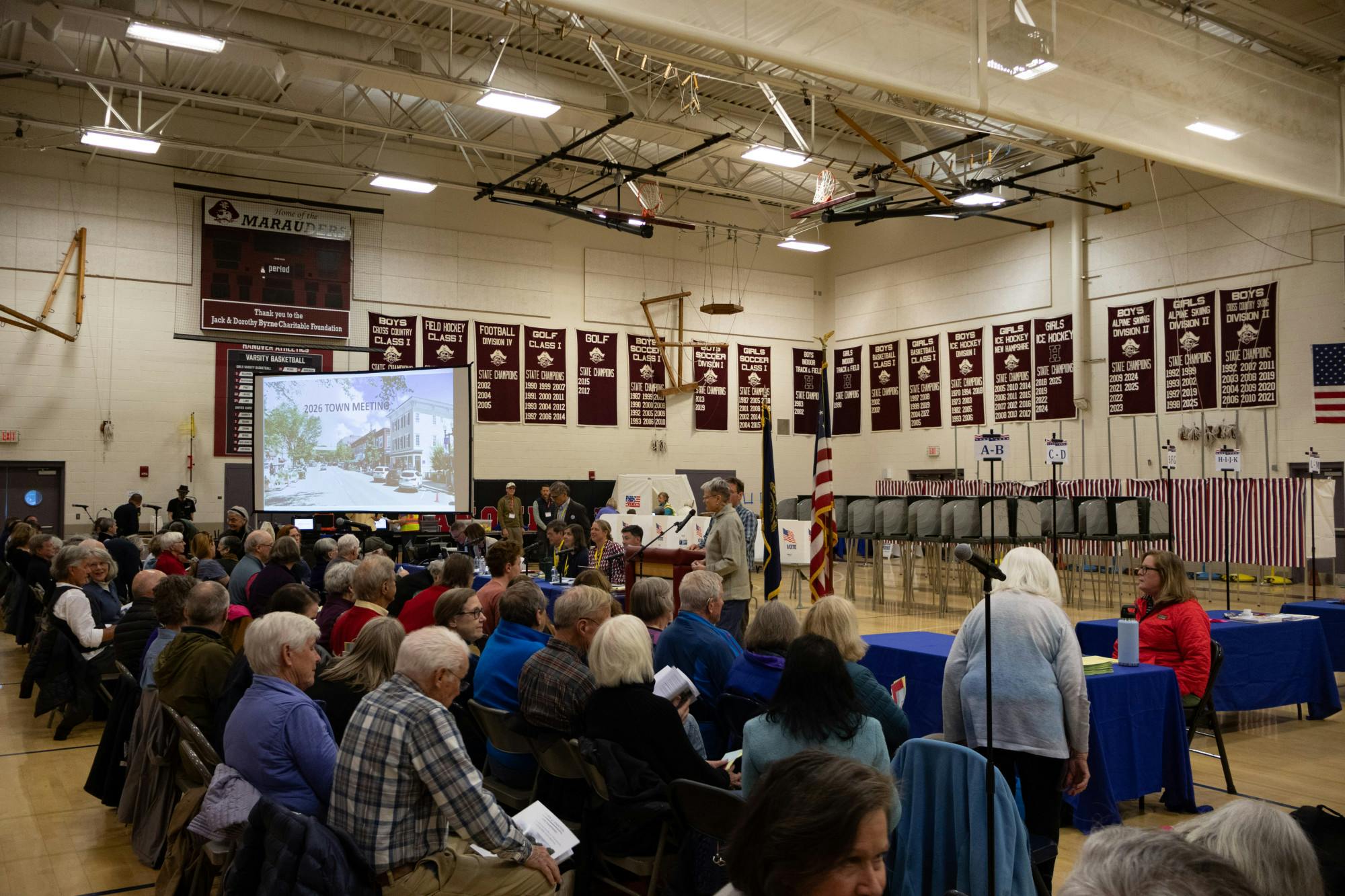
Today, Hanover will vote on the the articles of the town warrant at the annual town meeting. Voting will take place at Hanover High School in two phases: first, from 7 a.m. to 7 p.m., by secret ballot for articles 1 through 7; then, at 7 p.m., with public debate and placard voting for articles 8 through 23. Shuttles sponsored by the Dartmouth Student Government will run every hour on the hour from Baker-Berry Library to Hanover High School starting at 7 a.m.
Voters can register today by presenting proof of Hanover residence, proof of citizenship — such as a U.S. passport, birth certificate or naturalization papers — and proof of identity. Already-registered voters in New Hampshire are required to show proof of identity at their polling location to receive a ballot and vote.
School-issued IDs are still valid proof of residence and identity for registration and obtaining a ballot. A state law that passed last month, which would mandate that voters present a government-issued ID to obtain a ballot, goes into effect on June 2.
More detailed information about the town warrant can be found here. Follow this page for updates throughout the day.
11:18 p.m.: The town meeting is adjourned
11:18 p.m.: Anti-terrorism pledge fails, anti-apartheid pledge passes
Iris WeaverBell, Max Hubbard and Olivia Sapper / The Dartmouth
The anti-terrorism pledge failed 57 to 33. The anti-apartheid pledge passed 59 to 35.
10:56 p.m.: Residents debate PSC’s anti-apartheid pledge
Max Hubbard and Olivia Sapper / The Dartmouth Staff
Judith Schmidt, who identified herself as a 92-year-old Jewish woman, said she is “heartbroken about what [her] people in Israel are doing to the people of Palestine.”
“I have this hope that even on the [college] campuses, Palestinian and Jewish people can stand together to claim non-apartheid, that we could all live together. Maybe in my lifetime.”
English professor Ellen Rockmore said the pledge is “an attempt to manufacture consensus.”
“It seems to be disingenuous to pass a motion that says this is the view of the people of Hanover when it is obvious to everyone in this room that this is not a unanimous view,” Rockmore said.
Darcy Rochkind ’28 said her family is “descended from Holocaust survivors who escaped Nazi Germany.”
“The idea of calling them settler colonists seems very disheartening … this is very nuanced,” she said.
She applauded the attendees for “how inspiring this meeting has been as a whole.”
“The amount of times I have heard ‘Democrat,’ ‘Republican’ I can count on one hand,” she said. “This is really inspiring — we should continue to ensure this is a place where partisanship doesn’t take over.”
Another student said the pledge is “meaningless.”
“Benjamin Netanyahu is not on the phone waiting for the results of the Hanover vote,” she said. “Most of the people who were voting on the tower truck have left … this is not representative of the town of Hanover or what the town of Hanover believes.”
Ramsey Alsheikh ’26 said he wanted to “talk to some people in the middle” of the issue.
“It’s very hard, if not impossible, to separate Israel from all the other issues: If you care about [Immigration and Customs Enforcement’s] overreach, if you care about Palantir’s overreach, as a resident of Hanover you should care about what’s going on,” he said.
Kriegsman said he would “unequivocally agree” with “peace process,” but this is “not what these motions have shown,” referring to the rejection of Daniel Rockmore’s amendment.
“These [the pledge] are not words of peace; they are words of war,” he said. “If this town votes down a disapproval of Hamas, this is a vote of hatred and discrimination.”
Voting on the proposal is now happening by secret ballot.
Ramsey Alsheikh is a former opinion editor and current opinion columnist for The Dartmouth. He was not involved with writing or editing this article.
10:50 p.m.: Proposed amendment to PSC’s pledge fails a vocal vote
Max Hubbard and Olivia Sapper / The Dartmouth staff
Computer science professor Daniel Rockmore proposed an amendment to PSC’s pledge.
“I do not agree with the calling out of Israel but I know you will not modify the language,” he said. “So I propose an amendment which is consistent with the general principles, consistent with equality and the right to live freely, and the lack of bigotry and racism, and safety as our last speaker brought up.”
“In addition, the town of Hanover adopts an anti-terrorism pledge and stands against sectarianism violence and condemn the use of rape as a weapon of war an action taken by Hamas,” Rockmore read. “Reject the influence of the terrorist organization Hamas in Gaza … and stand against the actions of Hezbollah … and call out the Chinese government who have sequestered Muslim people and prevented them from expressing their faith.”
Rockmore’s amendment failed a vocal vote.
10:37 p.m.: PSC reads anti-apartheid pledge
Max Hubbard and Olivia Sapper / The Dartmouth staff
A member of the Palestine Solidarity Coalition proposed that Hanover enact an “anti-apartheid pledge” by adopting that of Apartheid-Free Communities.
“We declare ourselves an apartheid-free community and to that end, we pledge to join others in working to end all support to Israel’s apartheid regime, settler colonialism and military occupation,” the PSC member read.
10:23 p.m.: Dartmouth student proposes for “anti-terrorism pledge”; votes are being cast by secret ballot
Max Hubbard and Olivia Sapper / The Dartmouth Staff
In the first Article 23 motion, Oren Poleshuck-Kinel ’26 proposed an “anti-terrorism pledge.”
“We move that the Town of Hanover adopt the following anti-terrorism pledge,” Poleshuck-Kinel read.
The pledge “affirms [the town’s] commitment to opposing terrorism, antisemitic violence and politically motivated violence wherever they occur. It “condemns” terrorist organizations such as Hamas, Hezbollah and the Iranian Revolutionary Guard Corps, all of which it alleges “have engaged in violence against civilians, repression of dissent, and the promotion of terrorism.” It condemns the October 7, 2023 attacks and “the use of sexual violence and rape as weapons of war, including documented acts committed during and after the October 7 attacks.” More broadly, it condemns “antisemitic violence, harassment and intimidation directed at Jewish individuals and communities around the world in response to events in the Middle East.”
The voice vote was inconclusive, with several residents saying “nay.” Eggleton said five individuals signed a request to conduct the vote on this proposal by a secret ballot.
David Kriegsman ’29, Hillel at Dartmouth executive director Rabbi Seth Linfield, Jacob Markman ’27 and Darci Rochkind ’28 signed for the secret ballot. The fifth signatory’s name could not be heard by reporters.
Secret ballots were cast and are being tallied.
10:12: Motion to adjourn fails
Iris WeaverBell / The Dartmouth senior staff
The debate will continue after a five minute break. Many attendees appear to be leaving.
10:09 p.m.: Town residents in attendance are debating whether the meeting should adjourn before the Palestine Solidarity Coalition is able to present an “anti-apartheid pledge”
Max Hubbard and Olivia Sapper / The Dartmouth staff
“The reason why I believe we should not adjourn this meeting is because there are practices in this community which I have witnessed which I believe suppress our ability to participate and carry out our civic duties,” says one Hanover resident.
“We’re all tired; we’re not a foreign relations think tank; this is not our business,” says Jacob Markman ’27. “The majority of people have already left. This is not democratic. I think we should adjourn.”
Roan Wade ’25, a member of the Palestine Solidarity Coalition who spoke with The Dartmouth earlier about the PSC’s plan to propose an “anti-apartheid pledge” during the resident proposal period reserved by article 23, steps up to speak.
“People have been putting a lot of work into this motion — canvassing with the community, talking to people, sitting here for hours — and should be able to have our voices heard,” they say. “I know everyone is tired and we are too, but everyone’s voices should be heard.”
Dartmouth Student Government senators Issa Allison ’29 and Trace Ribble ’29 are also speaking up in opposition to the motion to adjourn.
10:05 p.m.: Attendee motions to adjourn due to “division” over PSC’s yet-to-be proposed “anti-apartheid pledge”
Max Hubbard and Olivia Sapper / The Dartmouth Staff
David Kriegsman ’29 made a motion to adjourn the meeting before the symbolic PSC “anti-apartheid pledge” pledge could be read during the resident proposal period facilitated by article 23.
“I understand that there is a proposal to make a comment on the Middle East conflict,” Kriegsman said. “This will generate a lot of unnecessary division. I therefore move to adjourn the meeting.”
The moderator and Selectboard were initially unsure if this motion was valid within the town statute.
“I would like to give them an opportunity to speak .. I’m not sure what is about to be presented but we should hear them out,” an unnamed resident said.
Town moderator Jeremy Eggleton said that the nature of Article 23 means any motion passed will have no direct effect on the Selectboard’s actions.
“Under New Hampshire law, we as a town cannot take action under any vote that gets taken during this article,” he said. “At best, any motion that gets passed during this period is advisory in nature. You can’t direct the Selectboard to do anything under this article.”
After consulting the town meeting statute, Eggleton is allowing 5 minutes of debate on the question of whether to adjourn the meeting. PSC members in attendance are walking down to the microphone to speak.
10:03 p.m.: Article 19 passed
Max Hubbard and Olivia Sapper / The Dartmouth
Article 19 passed with a voice vote.
The article will “permit the negotiation of a lease” of a portion of land behind Gile Hill for the “placement, operation and maintenance” of a telecommunications tower, according to Houseman.
“This is a public process that will require Selectboard and Planning Board approval,” he said.
The telecommunications tower will help “provide better cell phone service.”
“If you have coverage today there will be no change in that coverage,” Houseman said. “Nothing is going away. The reality is we have poor coverage downtown, and this is the Selectboard's opportunity to move forward with one of their [goals].”
A resident inquired whether the tower would be “unsightly and unseemly.” Another raised concerns about the location.
Houseman responded that the town had a consultant “come in and look at all our lands within the town.”
“They looked at our water tanks, they looked at our buildings,” he said. “The combination of topography and height made this site the preferred location.”
10:05 p.m.: Article 20 passed
Max Hubbard / The Dartmouth Staff
Article 20 passed with a voice vote.
It creates a financing mechanism for land owners based on C-PACER — Commercial, Property, Assessed, Clean, Energy and Resiliency — to allow them to get a better loan financing deal for sustainability-related improvements.
Selectboard member Jennie Chamberlain said that “a whole host of projects” qualify for the financing, such as the installation of energy efficient infrastructure, the removal of lead from water and the improvement of air quality.
The change applies to commercial and non-profit properties in the town, not residential properties.
“Instead of a traditional bank loan, the financing is provided by private lenders but secured by a special assessment lien on the property. This means the loan is tied to the property itself rather than the individual owner,” the town warrant reads.
Town counsel Laura Spector Morgan clarified that “the town could not spend new town funds to repay these [private] loans.”
9:59: Article 9 passed 180-7
Max Hubbard / The Dartmouth Staff
Article 9, which was debated earlier this evening, passed with 180 votes for and seven votes against. It required a three-fifths majority vote by secret ballot to pass. It enables the town to raise $2.4 million in funding for a new tower truck for the Hanover fire department.
9:40 p.m.: Government professor emeritus casts doubt on town zoning project
Max Hubbard / The Dartmouth Staff
Article 7, petitioned by local architect Randy Mudge, failed earlier tonight. If passed, it would have repealed last year’s amendment permitting the construction of duplexes, triplexes and fourplexes in certain areas zoned for single-family homes. The multi-family zones will be preserved, except for the modifications created by the passage of articles 2 and 3, also announced tonight.
Government professor emeritus Linda Fowler said she voted yes on Article 7. In an interview with The Dartmouth after exiting the business portion of the meeting, she expressed concern over the “problems of parking” once major construction is completed.
“What’s going to happen is that people are going to be parking on front lawns and blocking driveways,” she said.
She also cast doubt on the zoning project entirely and said she wanted it to be “rethought” in future amendments given the types of buildings developers have proposed already.
“We’ve had a year to see how popular this program is, and primarily the developers taking advantage of it are building cramped little apartments for students,” she said. “We’re not going to get the local librarian. We’re not going to get the neighborhood plumber living in our neighborhoods. It’s just going to be a way for a small number of irresponsible landlords to maximize their profits.”
Fowler added that she is not against the construction of student housing in single-residence neighborhoods, as she “gets along fine” with students living near her.
“A lot of it just depends on whether the [developers] who are doing these conversions are doing it in a thoughtful way, and they're not,” she said. “It’s a travesty.”
9:36 p.m.: All uncontested town position holders are reelected
Max Hubbard / The Dartmouth Staff
Trust fund trustee Kari Asmus, Selectboard chair Carey Callaghan ’83, Selectboard member Jennie Chamberlain, town moderator Jeremy Eggleton, supervisor of the checklist Alison Gorman, cemetery trustee Petra Sergent and Etna Library trustee Elizabeth Storrs all won uncontested re-elections.
9:34: Zoning amendments sponsored by Hanover Selectboard pass
Max Hubbard / The Dartmouth Staff
Zoning articles 2, 3, 4, 5 and 6 all passed.
Article 2 — which “clarifies” the multi-family zoning rules passed in 2025 and “tightens definitions and standards” — passed 1261 to 26.
9:30: Article 18, establishing town budget for fiscal year 2027, passed earlier
Olivia Sapper / The Dartmouth Staff
The budget — Article 18 — passed with a majority vote. Five nays could be heard.
Article 18 allows the town to appropriate $34,506,766 to pay for the town’s operating expenses in fiscal year 2027.
The Selectboard presented the budget to the town.
“The budget goal areas centered are people, the governance process, and very importantly advancing Hanover’s sustainability,” Selectboard chair Carey Callaghan ’83 said.
Although the total town budget for fiscal year 2027 is $40.8 million, Article 18 only appropriates $34.5 million because of capital appropriations earlier passed in Article 14 and 15. The town tower truck funded by Article 9 is not included in the budget.
Residents will see “modest” increase in the tax rate in line with the inflation rate, according to Callaghan. According to Chamberlain’s presentation, last year, residents paid $13.91 per $1,000 in property valuation. This year, it will increase by 3.1% to $14.77 per $1,000.
He added that the town’s undesignated fund balance — the town’s “rainy day fund” — is on track to reach $5 million “based on known and identifiable near-term capital needs.”
Callaghan noted there could be “wildcards” in managing the budget for the coming year and said there is “clearly economic uncertainty” in the country at this moment.
“This morning, we had inflationary pressures of 3.8%, which is high and could affect how quickly we could see unanticipated cost changes,” he said. “Economic uncertainty and this large capital spending represents some challenges ahead of us for the town.”
Hanover Finance Committee leader John Dolan recommended the adoption of zero-based budgeting, a process where “fresh eyes” will look over the budget year after year. In March, he gave a presentation warning the Selectboard of possible $70 million capital expenditures from fiscal years 2027 to 2033, primarily due to the future projects on South Main St. and West Wheelock St.
“We think it’s imperative that Hanover residents become aware and understand the magnitude of capital expenditures coming our way,” he said. “The Selectboard should educate residents on the purpose, scale and cost of these projects.”
9:10 p.m.: Article 7 fails, zoning amendments sponsored by planning board pass
Iris WeaverBell / The Dartmouth Senior Staff
Article 7 failed 816 to 792 — a margin of 24 votes.
“It was a debate that was conducted with a lot of comportment and I appreciate that,” town moderator Jeremy Eggleton said.
9:06 p.m.: Results of secret ballot votes cast earlier today are being announced
8:55 p.m.: Article 17 passes
Max Hubbard and Olivia Sapper / The Dartmouth Staff
Article 17 appropriates $50,000 into the town’s annual contingency fund for fiscal year 2027 from the town’s undesignated fund balance. Article 17 passed with a majority vote.
Whitcomb said the contingency fund can be used “to address unforeseen expenses” during the fiscal year.
Houseman said the contingency fund will cover “unexpected” expenses, such as costs from a recent New Hampshire Supreme Court ruling that the town could have to pay “up to $79,000” for Valley News’s legal fees. The Valley News sued Hanover in 2024 over Hanover Police Department refusal to release two student protesters’s October 2023 arrest documents.
Whitcomb said the town “cannot use” the undesignated fund balance without an appropriation at the annual town meeting.
“The contingency fund allows [the Selectboard] to spend money without having to do a special emergency town meeting process,” Whitcomb said.
8:38 p.m.: Article 16 passes
Max Hubbard and Olivia Sapper / The Dartmouth staff
Article 16 would “raise and appropriate 200,000 for the design and construction of a paved multiuse path along Reservoir Road, extending from Lyme Road to Curtis Road.”
Hanover resident Todd Minsk questioned the “real utility” of the project at the meeting.
“There’s already a sidewalk on the north side of reservoir road, and reservoir road is not a particularly high speed or busy road,” he said. “Is this really necessary?”
“The utility is to get our younger people — our middle school kids in particular – off the reservoir when it is busy, and on to safer roads,” Selectboard member Joanna Whitcomb replied.
Article 16 passed with a majority vote.
8:33 p.m.: Article 14 and 15 pass
Max Hubbard and Olivia Sapper / The Dartmouth staff
Article 14 would raise and appropriate $3,918,660 from taxation and different designated fund balances for capital expenditures, which includes new infrastructure like bridges and vehicle replacements such as police vehicles or ambulances.
Athos Rassias added that Articles 14 and 15 “are how we create capital reserve funds for large capital projects.”
“The purpose of these funds is to spread out the lumpiness that comes out with buying new equipment so our tax rate is stable as we can make it,” he said.
Article 14 has passed with a single nay.
Article 15, which also passed, will raise and appropriate $2,092,519 for other capital expenditures such as water treatment.
8:32 p.m.: Article 13 passes
Max Hubbard and Olivia Sapper / The Dartmouth staff
Article 13, which would raise $35,095 into the Municipal Transportation Capital Improvement Fund, passed with a majority vote.
8:32 p.m.: Article 12 passes
Max Hubbard and Olivia Sapper / The Dartmouth staff
Article 12, which would raise $400 dollars for deposit into the Conservation Fund, also passed with a majority vote.
8:31 p.m.: Articles 11 passes
Max Hubbard and Olivia Sapper / The Dartmouth staff
Article 11, which would raise and appropriate $400 for the Land and Capital Improvements Fund, passed with a majority vote.
8:20 p.m.: Article 10 is tabled
Max Hubbard and Olivia Sapper / The Dartmouth Staff
Article 10, which was intended to enable the Selectboard to create zones where alcohol can be consumed publicly outside of businesses, has been tabled due to what Jarett Berke “procedural defect associated with the timeline” of the article’s drafting.
“Even if we were to hold a vote it would be unlawful and ineffective,” he said. The motion was approved.
8:12 p.m.: Attendees are casting their ballots on article 9
Max Hubbard and Olivia Sapper / The Dartmouth Staff
Attendees are now leaving the stands to cast their ballots on article 9. Voting will be open until 8:35.
Article 9 would appropriate funds for the purchase of a new tower truck for the Hanover fire department. Because the article requires the passage of municipal bonds, the motion must be approved by a three-fifths majority secret ballot vote.
The tower truck will cost $2.4 million to build, and the funds will be raised through the “issuance of bonds [...] spread out over many years.” The build will take 3.5 years, and the town will sell the old tower truck after the construction of the tower truck.
“We will pursue all funding options available to us in the next three and a half years to ensure we bring the price down to ensure affordability,” Houseman said before the secret ballots were cast.
The current truck is “becoming more and more difficult to service… and repair,” Selectboard member Athos Rassias said. The new tower truck "is an important truck for our town as it allows us to safely approach taller buildings in particular to extinguish figures and provide rescue maneuvers.”
Hanover must own a tower truck to meet safety requirements triggered by the building height of College dormitories, according to town manager Robert Houseman.
7:40 p.m.: Article 8 passes and Article 9 discussion begins
Max Hubbard and Olivia Sapper / The Dartmouth Staff
The business portion of the town meeting began with voting on Article 8. Hanover will elect one advisory board of assessors, three fence viewers, two surveyors of wood and timber, and such other officers that the town “may judge necessary."
Besides the advisory board, each office will serve for a term of one year.
These positions are symbolic and date back to the colonial era. Selectboard member Jarett Berke, who was up for re-election earlier?, nominated James Kennedy and Timothy Bent as surveyors of wood and timber and Matt Marshal, Sarah Packman, and Bruce Simpson as fence viewers.
The nominations passed with a majority vote.
The town now moves to Article 9, which would appropriate funds for the purchase of a new tower truck for the Hanover fire department. Because the article requires the passage of municipal bonds, the motion must be approved by a three-fifths majority secret ballot vote.
7:18 p.m.: 181 attendees gather for the business portion of the town meeting
Max Hubbard and Olivia Sapper / The Dartmouth Staff
The business portion of the annual town meeting has begun.
Hanover resident Sarah Morgan said she came to the meeting “because community engagement is mission critical.”
“For citizens to understand what's happening and to vote and to just participate in the democratic process [...] is really important,” she said.
Town Moderator Jeremy Eggleston has begun introducing members of the Selectboard and said that the meeting “will try to move quickly and efficiently” with debate and voting on articles.
7:00 p.m.: Polls close with 1,596 ballots cast
Max Hubbard / The Dartmouth Staff
1,596 ballots were cast during the secret ballot portion of this year’s Hanover town meeting, up from 1,296 in the 2025 town elections, according to town manager Robert Houseman.
English and women, gender and sexuality studies professor and Hanover resident Renee Bergland said that she felt there was a “good mood” when she cast her vote ten minutes before polls closed. She said she voted no on Article 7.
“I felt like I was voting for inclusion and affordability because I want this to be a small town where the people who work here live here,” she said. “I don’t know how the vote’s going to turn out, but it’s great to be part of a town with a town meeting. I just hope [other voters] followed the planning board recommendations to make [Hanover] as affordable and inclusive as possible.”
Hanover resident Cat Smith said she was “confused” by the wording of Article 7.
“I wasn't sure exactly what it was trying to say,” she said. She ultimately voted against it.
4:00 p.m.: ‘Hanover is too expensive’: Protesters denounce Article 7
Olivia Sapper / The Dartmouth Staff
Fourteen protesters line the entrance to Hanover High School, holding signs in support of and opposition to Article 7.
In a joint interview outside the polls, Hanover resident Nicolas Macri ’24 and Hanover general welfare assistance coordinator Jen Gantrish, who are both against Article 7, said Hanover is “too expensive.”
“The median [home price] is $1.2 million, and 80% of people who work in town can’t afford to live here,” Macri said.
Macri said the zoning amendments passed in 2025 — which permitted the construction of multi-family units in formerly single-family unit zones — “allow[ed] for more families to live in town.”
“It’s not fair; it’s not right,” he continued. Hanover “should be a town where we have options for everybody ... We need more options because the old zoning [before 2025 amendments] was creating a situation where the only options you have are more than a million dollars.”
Gantrish said that in her role as general welfare assistance coordinator, she “helps people who need emergency housing” because they are “struggling to afford to live in town.”
“Hanover needs to be part of the solution to creating more housing, to help bring up the stock, bring down the price,” Gantrish said.

3:55 p.m.: Palestine Solidarity Coalition members will propose “anti-Israeli apartheid” pledge during the business portion of the town meeting tonight
Olivia Sapper / The Dartmouth Staff
Palestine Solidarity Coalition member Roan Wade ’25 told The Dartmouth that PSC plans to propose an article that, if passed, the town would commit to signing an “anti-apartheid pledge” in opposition to “atrocities carried out by Israel.” The proposal is not on the town warrant yet, but Article 23 reserves time for additional resident proposals during the business portion of the town meeting.
PSC’s proposed pledge is taken from Apartheid-Free Communities, a “coalition of communities who pledge to work together to end Israeli apartheid [...] originally created by faith groups,” according to its website. The AFC pledge is printed on a pamphlet being distributed outside the polls.
“We declare ourselves an apartheid-free community and to that end, we pledge to join others in working to end all support to Israel’s apartheid regime, settler colonialism and military occupation,” it reads in part.
The pledge has been passed by 10 towns in Vermont, according to the AFC website. Hanover would be the first to do so in New Hampshire.
“Our hope is that by passing the pledge, we move towards a human rights procurement policy,” Wade explained.
On the back of the pamphlet, the PSC wrote that “$539,221 of income tax paid by Hanover town residents in 2024 went to military aid for Israel,” citing Not My Tax Dollars, an organization that tracks U.S. aid sent to Israel. According to Not My Tax Dollars’s publicly available methodology, the organization calculates cities’ contributions using data collected by the U.S. Census Bureau in its 2021 American Community Survey, the 2025 “amount of U.S. military funding to Israel” — which it estimates to be $12 billion — and the “number of households in each city.”
“This is money that should be invested locally to solve the housing and healthcare crises,” PSC wrote on the pamphlet.

12:30 p.m.: Article 7 draws divide between former town manager and petitioner, contested by protestors
Max Hubbard / The Dartmouth Staff
Article 7 of the town warrant is being highly debated. If passed, it would undo last year’s zoning amendment that permitted construction of multi-family units in parts of Hanover that were previously zoned for exclusively single-family homes, restoring single-family only residential zones.
Alongside the voting polls, several protestors held up signs that read “No on Article 7,” including Dartmouth students — who did not wish to be identified but were with Palestine Solidarity Coalition — handing out flyers supporting their position. Randy Mudge, the local architect who proposed Article 7, was also present with signs supporting his petitioned amendment.
Julia Griffin, who served as Hanover’s Town Manager for 22 years and now works for the local affordable housing board Twin Pines Housing Trust Board, told The Dartmouth at the polls that she voted against Article 7 because she believes Hanover “desperately needs more housing.”
“I’m a big proponent of supporting the decisions the Planning Board makes,” she said, referring to the Hanover Planning Board’s 5-1 vote to disapprove of Article 7 during a public meeting in March.
Griffin said the town has not given last year’s zoning amendment “enough time to percolate in this community,” adding that it would be “wrong to ax it” after one year.
“Anything that we can do to increase the opportunity to build housing that’s more affordable for those who have fixed incomes, or for folks who can’t afford to live in the community where they work, is really important,” she said during the interview.
In an interview with The Dartmouth at the polls today, Mudge said the construction of more triplexes and fourplexes would not “match the existing residential scale” and would not drive housing prices down. He added that he is not opposed to the construction of duplexes in “small pockets” of single-family residential areas.
“Article 7 just says, ‘Let’s encourage duplexes, let’s not have multi-family housing here,’” Mudge said. “They [proponents of 2025 reforms] said it was modest; it was not a modest move. They said it would be affordable. There’s no way it’s going to be affordable.”
Mudge pointed to the high cost of new housing developments in Hanover, such as recent construction on Centerra Drive, arguing that any new units could still sell for hundreds of thousands of dollars.
“Affordability is the most difficult thing to fulfill because the values have gotten so high because of supply and demand,” Mudge said. “Around here, they jack the values so high everywhere.”
Griffin said she “loves the opportunity for Dartmouth students to get engaged” and appreciated students coming to the polls and advocating against Article 7.
Mudge added that students should “look at both sides of the story” before voting on the article.

7:00 a.m.: Polls open at Hanover High School gymnasium
Max Hubbard / The Dartmouth Staff
Ballot voting for town warrant articles 1 through 7 opened at 7 a.m. in the Hanover High School gymnasium at 41 Lebanon St.
Article 1 covers Hanover town official elections, including the reelection bids of trust fund trustee Kari Asmus, Selectboard chair Carey Callaghan ’83, Selectboard member Jennie Chamberlain, town moderator Jeremy Eggleton, supervisor of the checklist Alison Gorman, cemetery trustee Petra Sergent and Etna Library trustee Elizabeth Storrs. All elections in Article 1 are uncontested.
The remainder of the ballot articles amend Hanover’s zoning ordinance. Articles 2 through 6 would make it easier to build denser housing in accordance with a state law passed last July. Article 7, submitted by local architect Randy Mudge, aims to undo last year’s zoning amendment that permitted construction of multi-family units in parts of Hanover.
Results from ballot articles will be announced at the business portion of the annual town meeting, which begins at 7 p.m. in the Hanover High School gymnasium.
Iris WeaverBell ’28 is a reporter and editor. She is from Portland, Ore., and is majoring in economics and minoring in public policy.
Max Hubbard '29 is a reporter from Boston, Mass., and is majoring in government and minoring in French. In his free time, he enjoys listening to music, running and watching movies.
Olivia Sapper ’29 is a reporter from Darien, Conn., and is majoring in Government.