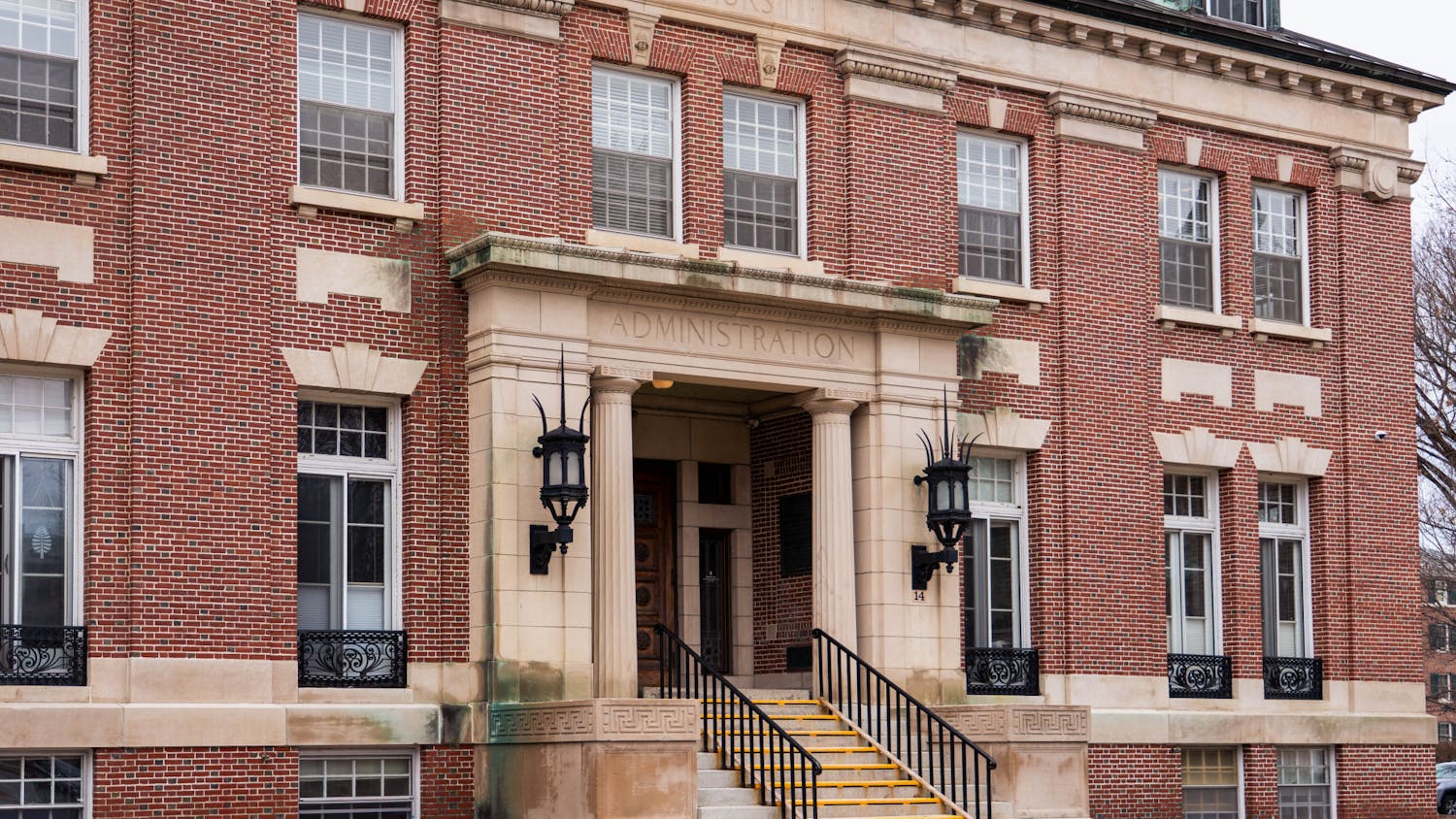
On Memorial Day morning, approximately 50 students, veterans and community members gathered in front of Dartmouth Hall to place 554 flags on the lawn, each representing a Dartmouth student or alumnus who died in military service since the Civil War.
Hosted by the Dartmouth Undergraduate Veterans Association, the observance began with the flag placement at 7 a.m., followed by a memorial ceremony at 9 a.m.
Throughout the rainy morning, attendees remained gathered around the flags, many holding umbrellas or standing in soaked clothing as DUVA members, student veterans and community members reflected on the meaning of Memorial Day.
DUVA treasurer Julian Nelson ’27, who served for five years in the Army before coming to Dartmouth, said the weather made the morning even more of a “dignified experience” for him. Nelson helped organize the ceremony and placed flags before delivering remarks.
“My body’s cold, my feet are wet, but my heart is warm,” Nelson said during the ceremony. “For Memorial Day, we honor those who gave their lives in service.”
Nelson said hammering each flag into the ground was a “solemn experience” because every flag represented an individual life of a Dartmouth alum and veteran lost.
“It’s hard to realize, as I’m hammering each flag, the significance of it, that this represents a person who gave their life,” Nelson said. “At the same time, I feel like the Dartmouth community and the greater Upper Valley community have really come out to support us.”
The ceremony included remarks from DUVA members, an invocation and moment of silence led by Navy chaplain and St. Denis Catholic Church priest James Cuddy and a performance of Amazing Grace by Sofia Uribe ’29.
Uribe, who said she became close with members of DUVA after meeting one student veteran on her first-year trip, described herself as “an ally to the veterans.” She said performing “Amazing Grace” at the ceremony felt like a way to contribute to the ceremony’s emotional weight because of the song’s themes of “grace, loss and understanding,” especially as the flags made the number of fallen feel “less abstract.”
“As humans, we see bigger numbers and it just becomes another statistic,” Uribe said. “Seeing that visually shown, it’s a different layer of depth.”
For several DUVA members, the event marked an expansion of a tradition that began only a few years ago. The flag placement began in 2022 with Ryan Irving ’24, a Marine Corps veteran and former DUVA president, and other student veterans, staff members and student volunteers.
Irving, who was not at this year’s ceremony but interviewed about the tradition’s origin, said the flag-placing idea grew out of a conversation with former College President James Wright, a Marine Corps veteran and advocate of veterans’ education, about how to remember service members who died in “politically contentious wars.”
“He [James Wright] was my hero,” Irving said. “Whoever said ‘don’t meet your heroes’ never met James Wright.”
At the time, Irving was working with the Rauner Special Collections Library on an exhibit about Dartmouth students and alumni who died in war. Through that research, Irving said he and others identified the number of Dartmouth service members who had died and began thinking about how to represent those lives visually on campus.
“What we really wanted in the center of campus was a visual display of Dartmouth veterans’ sacrifice,” Irving said. “Each one of those flags … represented a young man or woman who spent their formative and best years at Dartmouth, and their lives were cut short in service of their country.”
Irving said the first flag placement was a “ginormous team effort” that involved student veterans, the dean’s office, facilities staff and friends outside DUVA. The placement followed a fraternity formal the night before, Irving said; three of his fraternity brothers slept outside on a couch cushion so they would not miss the early morning setup.
“It was kind of profound, the amount of effort they put in just to support the organization and support veterans,” Irving said.
This year’s ceremony was the first time the organization expanded the Memorial Day observance into a fuller public ceremony, DUVA president Jules Teffer ’28.
This year’s ceremony was the first time the Memorial Day ceremony — “one of the most pivotal, serious and monumental days” in the lives of many veterans — was fully public, DUVA vice president and Navy veteran Giovanna Lopez ’28 said.
“A lot of veterans here today have lost friends in service,” Lopez said. “It’s hard to put in words how close we hold this day to our hearts, how grateful we are to our friend for being in our lives.”
Teffer said Memorial Day is about remembering not only service members killed in action, but also those who returned from service and later died by suicide or from the lasting effects of trauma.
“The first thing you think about are the people we’ve lost,” Teffer said. “Mostly those in service, but there’s also those who died out of service, who lost a war of the body and the mind.”
DUVA executive officer and Air Force veteran Laura Vestal ’28 said Memorial Day reminds her of a friend who died while she was stationed overseas.
“For a lot of the veterans that you’ll see out and about, the war isn’t necessarily on the battlefield,” Vestal said. “When I think of Memorial Day, I’m thinking of my friends who lost a battle that wasn’t physical.”
Madory said seeing the hundreds of flags representing fallen Dartmouth service members made the number feel more tangible.
“If there were 554 people standing here, it’d be a huge crowd,” Madory said. “Definitely understanding that this is how many people gave their lives for a country, it’s really impactful.”
The observance closed with Teffer giving thanks to those who attended, placed flags and stood in the rain to honor the lives represented on the lawn.
Reflecting on the ceremony, Nelson said he hopes passersby will “have a moment of contemplation.”
“The lives we live now depend on the sacrifices of those who served,” Nelson said. “Memorial Day each year is a great opportunity for the community at large to take a moment and contemplate and appreciate. And that’s all we ask — to honor and remember the fallen veterans.”
Haley S. Rodriguez ’29 is a reporter with roots in New York City. She is studying history and biology and enjoys long-distance running, reading and sailing.