
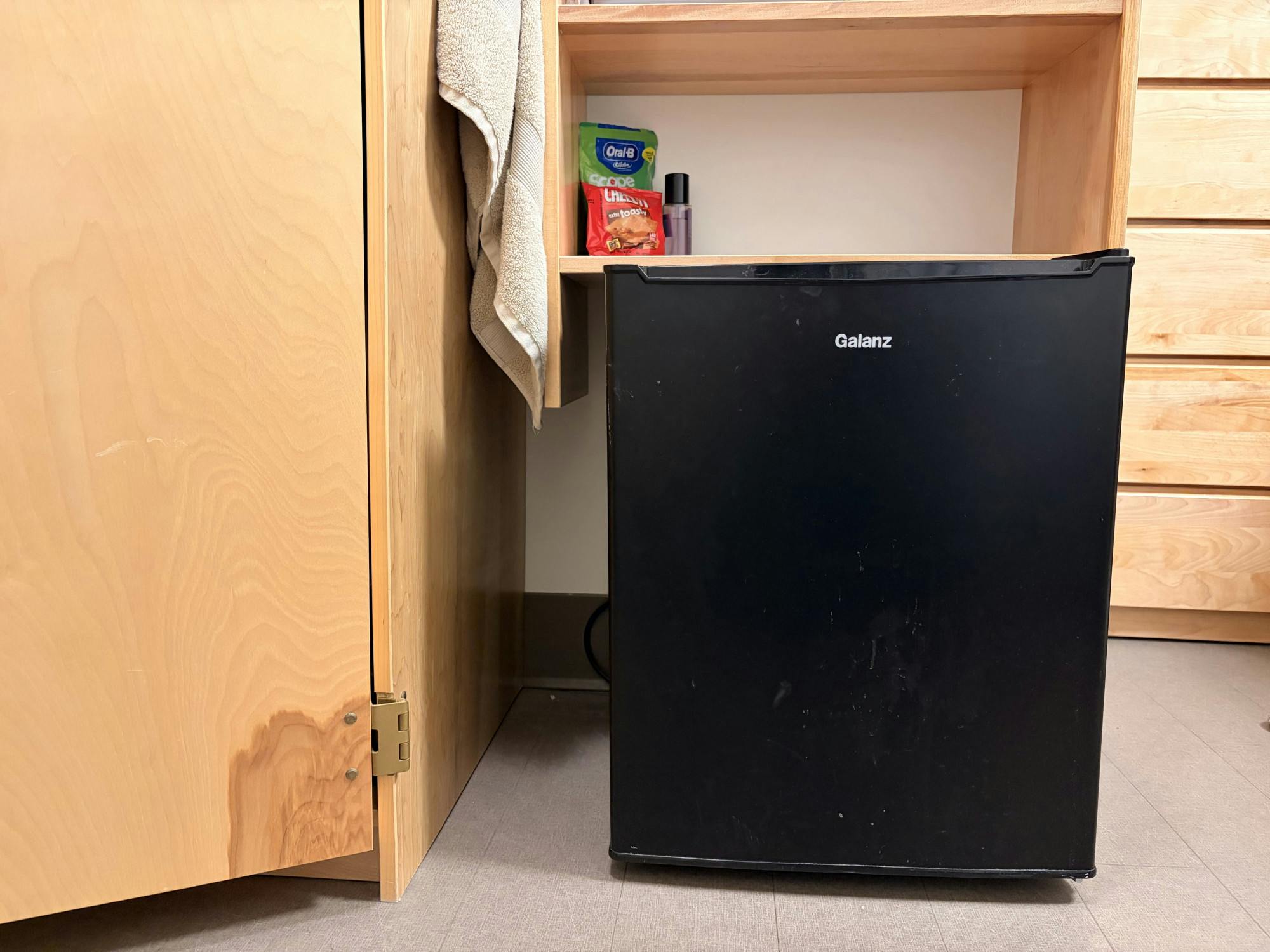
On May 14, the Dartmouth Sustainability Office and the Office of Residential Operations announced that new energy-efficient microwave and mini-fridge units will be installed in all residence halls, living learning communities and College-owned Greek houses by fall 2026.
The new MicroFridges units combine a refrigerator, freezer and microwave into one, using roughly half the energy of typical mini-fridges, according to the Sustainability Office’s website. If students currently own a personal mini-fridge, they “will need to remove it during move-out” at the end of the last term they are on campus before fall 2026, the website reads.
The MicroFridge project started as a research initiative launched by Dartmouth Sustainability waste diversion interns Gabriel Nunez ’26 and Miguel Chagas Monjardim ’27 and sustainability staff members Marcus Welker and Erin Kelly GR’26 in fall 2024. Their research found that installing MicroFridges in residential halls reduces refrigerator-related emissions by an estimated 30% and decreases overall energy consumption.
Welker said he believes it is “fantastic” that the College is providing students with “high performance and energy efficient refrigerators and microwaves.”
Victoria Webb ’29 said that she is “very happy” with the MicroFridge project because she gets “a lot of use out of [her] mini-fridge right now” and thinks it would be “really nice to have a microwave.”
However, Webb noted that it “might be somewhat wasteful” as some students may not want a mini-fridge or microwave at all.
Mira Bechtolt ’29 said she thinks that the MicroFridge project is “a bit unnecessary” because there are already shared fridges in residence hall kitchens, and the school “will have to constantly maintain” the new fridges. She added that she is “a bit annoyed” that she will no longer be able to use her personal mini-fridge.
Welker said the MiniFridges project would be less “time-intensive, labor-intensive [and] cost-intensive” than having students buy their own personal mini-fridges since “a lot of students leave them behind” after they graduate. He added that it is more costly to “pay for the energy that the energy-inefficient fridges use.”
Welker said “many other” colleges and universities “use a similar model,” which allows “shifting responsibility” for fridges and microwaves between the “residence hall user” to the “institutional management.”
Nunez said the research team’s survey of 539 students in October 2024 found that “60 to 70%” of students currently use mini-fridges that “tend to exceed 400 to 500 kilowatts” of energy consumption annually.
MicroFridges, in contrast, “use approximately 195 kilowatts per year, and so … there [will be] about a 30% energy decrease in consumption,” he said.
Arya Goyal ’29 expressed excitement about the project overall, but raised concerns about whether the fridges would get “too dirty” if the College is “reusing [them] year after year” since some students “probably won’t take care of the fridges.” The Sustainability Office website mentions that “students are responsible for keeping their room clean, including all furnishings.”
Abby Zhao ’29 — who brought a personal mini fridge to her room in Berry Hall — said carrying the fridge up to her dorm was “a hassle.” Having a MicroFridge provided in each dorm would be “awesome” and would “obviate a lot of the struggles” she faced during move-in.


