Even describing “I Love Boosters” presents a strange challenge. It’s a film so committed to its own weirdness that its plot turns and genre-bending are almost impossible to believe without actually seeing it. For any of its flaws, of which there are several, there’s no denying that the movie is the product of the singular, uncompromising vision of writer-director Boots Riley.
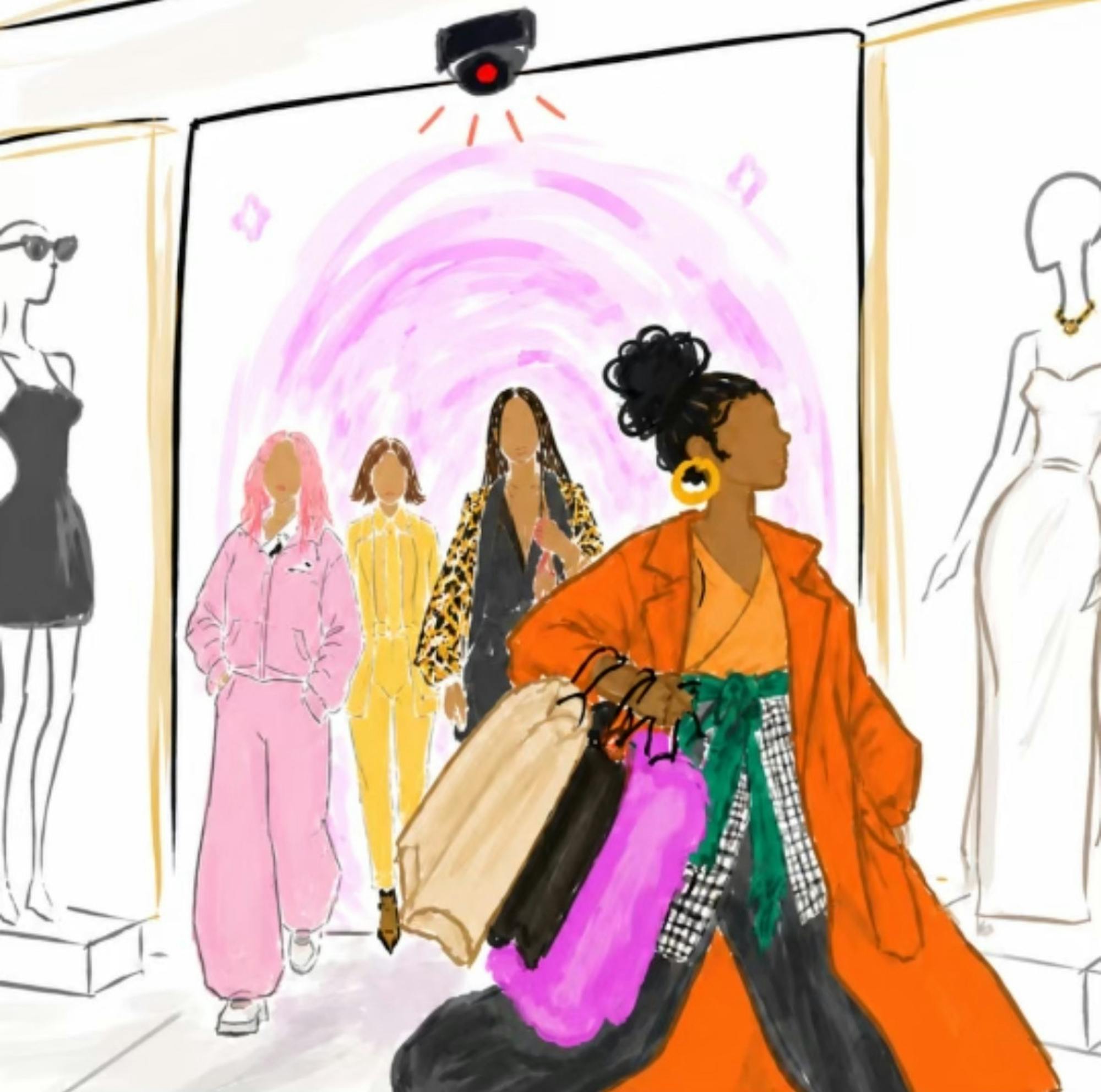
The basic premise revolves around the “Velvet Gang,” a trio of Black women in the San Francisco Bay Area — known as “boosters” — who shoplift and resell luxury clothes at lower prices. Corvette (Keke Palmer), Mariah (Taylour Paige and Robin Thede) and Sade (Naomi Ackie) target Metro Designers, a chain of high-end clothing shops owned by self-important designer Christie Smith (Demi Moore). Corvette admires Christie’s success and aspires to become a designer herself — and to claw her way out of the financial hole that’s left her squatting in an abandoned chicken restaurant.
It quickly becomes clear the film’s world follows absurdist logic. Christie works, for instance, in a ridiculously slanted skyscraper that seems to defy the laws of physics. Mariah has the ability to suddenly pass as white — played in these moments by a completely different actress — to avert the suspicion of store employees, so long as she holds her breath. Televisions play live interviews with hilarious chyrons like “Crying Black Mother Demands More Police” or “Upstanding Community Member Praises the Freedom of Lower Pay.”
Things only become loonier as the film progresses, particularly with the introduction of a teleportation — and reality-altering — device in the possession of Jianhu (Poppy Liu), a worker from the Chinese sweatshop where Metro Designers clothes are produced. Riley’s 2018 satire “Sorry to Bother You” similarly involved surreal sci-fi twists, but this film dials things up even further. The absurdity is far more outsized — it’s hard to overstate just how insane it gets — and the social commentary more obvious.
The film eventually boils down to celebrating workplace unionization as a financially and spiritually liberating resolution — both for the workers of the world and for the plot. One character explains that the teleportation device works by “heightening the contradictions” of the things it targets; this turns into a lengthy monologue intended to summarize dialectical materialism, a central concept of Marxist theory. This kind of esoteric, didactic storytelling feels intended to share ideas with a sympathetic audience of socialists — it might play best at a Democratic Socialists of America conference.
“Sorry to Bother You” made clear political critiques without sacrificing a compelling narrative. As “I Love Boosters” gets wackier and more pointed in its politics, though, it begins to lose steam and feel somewhat weightless. While the twists in Riley’s prior film were genuinely shocking, the world on display here is so outlandish to begin with that its unexpected turns cannot land with the same force. The setting is already so absurd that anything seems possible, leaving little room for genuine surprise. Meanwhile, the main characters start to feel less like fleshed-out individuals and more like analogues for competing attitudes toward revolution: the parasitic bourgeoisie, proletarian self-interest, genuine activism and Corvette, the conflicted protagonist who finds closure only by joining the movement.
Still, the humor lands well, particularly in the first act when the novelty of the absurdism is fresh. The best recurring gag is an oft-promoted pyramid scheme called “Friends Being Friendly,” run out of a furniture store by charlatan Dr. Jack (an unrecognizable Don Cheadle). The film’s pop-art visuals provide plenty of vibrant eye candy, while the circus-like score by Tune-Yards is catchy and suitably ridiculous, if slightly overbearing.
The result is something akin to the madness of “Everything Everywhere All at Once,” but without the emotional core that made that film so powerful. Instead, the weirdness is geared to making its pro-labor political point. One thing is abundantly clear — no one else could have made this film. It feels ripped directly from the funhouse mind of Boots Riley, imprinted with his aesthetic and political sensibilities at every step. Even if it ends up a little more overstuffed and less coherent than “Sorry to Bother You,” a film this unabashedly itself is its own reward.