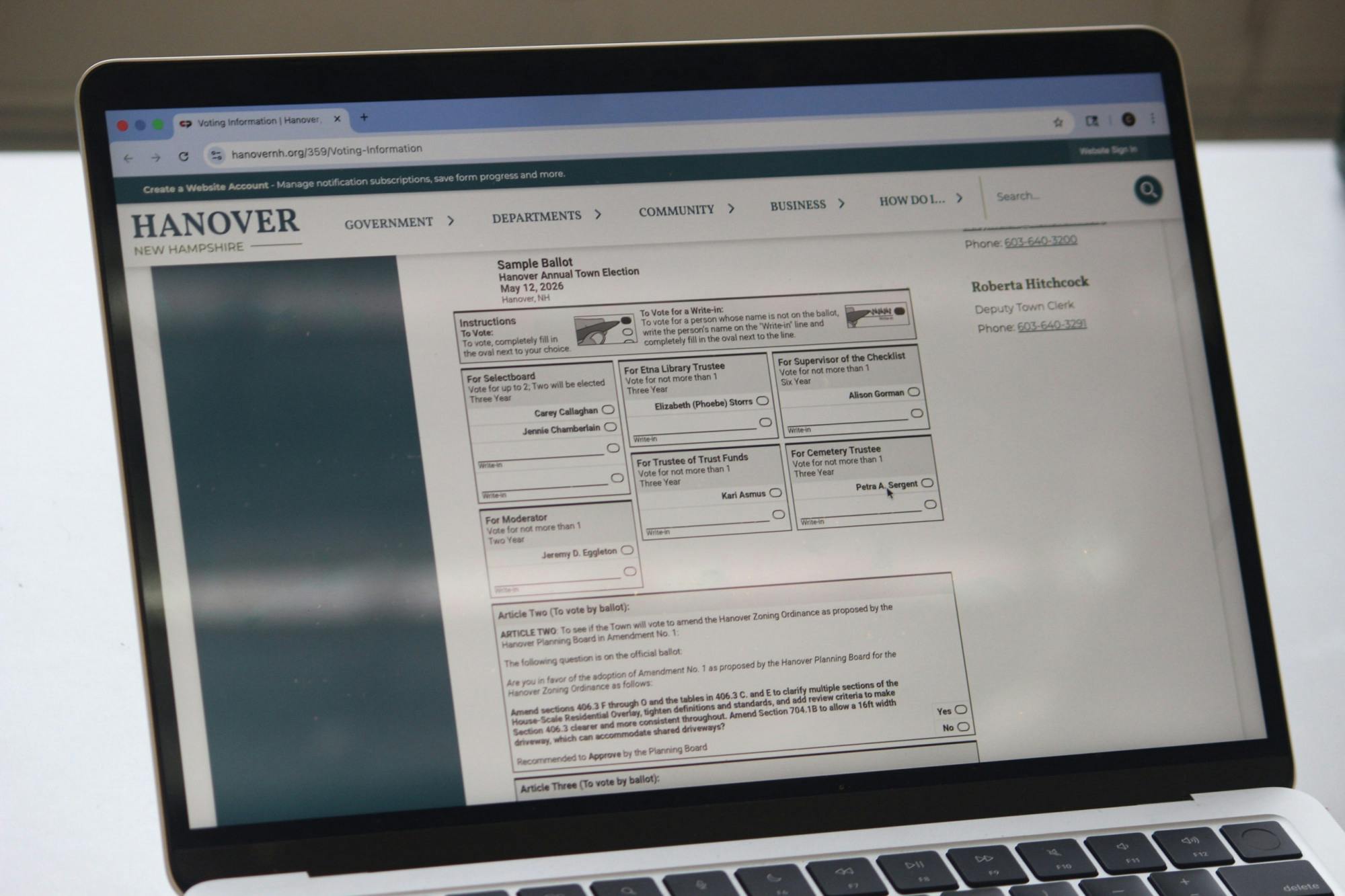
From 7 a.m. to 7 p.m. today, Hanover residents will vote by ballot on seven articles, including major zoning ordinances, to begin the ballot portion of the annual town meeting.
The next articles of the town warrant, numbered 8 through 23, will be debated and voted upon at the ensuing business portion, which will start at 7 p.m. in the Hanover High School gymnasium. Any resident will be able to give a speech of a maximum of five minutes. After all volunteers have spoken for an article, residents in attendance will vote on it by placard. The article passes if a majority of attendees vote yes.
While the state of New Hampshire banned student IDs as valid forms of identification for obtaining a ballot in April, they can be used in town elections through June, according to Hanover clerk Tracy Walsh.
“The new voter ID rules do not go into effect until June 2 so they [students] may use a Dartmouth ID, driver’s license or other government issued ID to verify identity at this election,” Walsh wrote in an email statement to The Dartmouth.
Day-of voter registration will take place at the Hanover High School Gymnasium at 41 Lebanon St., according to Walsh. If students are registering to vote for the first time in Hanover, they are required to provide proof of citizenship, including a U.S. passport, birth certificate or naturalization papers, and proof of domicile.
Article 1 of the warrant covers the election of six town officials, each of whom is running unopposed. Selectboard chair Carey Callaghan ’83 and Selectboard member Jennie Chamberlain are running to renew their three-year Selectboard seats after their current terms expire this year. The Cemetery Trustee, Town Moderator, Supervisor of the Checklist, Trustee of Trust Funds and the Etna Library Trustee positions are also on the ballot.
Articles 2 through 7 will amend Hanover’s zoning ordinance, if passed. The Hanover Planning Board sponsored and recommended approval for Articles 2 through 6. Article 7 was brought by a resident petition on Feb. 9 to reverse zoning amendments passed last year that made it easier to build denser housing in the town.
Article 2 would revise building guidelines created by last year’s House-Scale Residential Overlay, which is the zone in which multi-unit homes can be built, and clarify rules for development and allow wider shared driveways for new housing.
Article 3 would remove parking space requirements and bring Hanover into compliance with new state law that requires municipalities to undo additional zoning restrictions for accessory dwelling units, such as garages. If passed, builders could convert accessory dwelling structures into new housing.
Articles 4, 5 and 6 would further bring Hanover into alignment with recent statutory changes at the state level. Article 4 would remove “maximum gross floor area limitations” for buildings. Article 5 would exempt “agricultural uses” outside of “agritourism” from Hanover’s Noise Ordinance, which sets noise standards for events in town. Article 6 would extend the deadline to appeal zoning decisions from 15 to 30 days.
In a previous interview with The Dartmouth, Planning, Zoning and Codes director Jennifer Murray said Articles 2 through 6 are “clean up amendments” which would improve last year’s reforms.
The reforms would help increase the amount of housing in Hanover and restore the “missing middle,” a term for residencies between single-family housing units and large apartment buildings, such as duplexes, triplexes and fourplexes, Murray said at the time.
Article 7 was submitted as a resident petition by Hanover resident and architect Randy Mudge. The article would ban multi-unit housing development in certain areas of Hanover to maintain single-family housing zones.
Mudge previously told The Dartmouth that denser housing, allowed by 2025 amendments, would fundamentally alter the town’s fabric and neighborhood character by “trying to create” an “urban environment.”
The Hanover Planning Board voted 5-1 to disapprove of Article 7 at a public meeting on March 24.
In an interview with The Dartmouth, Zara Appiah ’29, who helped organize a Dartmouth Student Government town elections information session on April 30, did not take a stance on Article 7 but said that voting on it is “particularly important.”
If passed, Article 7 would “remove all the improvements that have passed since 2025,” she said.
The rest of the articles, which residents will vote on during the business portion of the town meeting, are mostly focused on town spending for the coming fiscal year. Town moderator Jeremy Eggleton, who will help run the annual meeting, wrote in the annual Town Report that the business portion is “an expression of pure democracy,” which is released every year in anticipation of the town meeting.
If passed, Article 8 will re-appoint additional town officers, including three fence viewers — who settle fence disputes between neighbors — Matt Marshall, Sarah Packman, Bruce Simpson — and appoint two wood and timber surveyors. James Kennedy and Timothy Bent are to be nominated for re-election by majority vote at the meeting.
Article 9 will authorize $2.4 million of appropriations for the purchase of a new fire engine tower truck. Because this requires the creation of bonds, the article needs a supermajority three-fifths vote to pass. The town’s current fire engine tower truck is “nearing the end of its usable life,” town manager Robert Houseman said at a Hanover Selectboard meeting on March 30.
Article 10 would authorize the town to create “social districts” — designated outdoor areas where people can consume and purchase alcohol publicly. The article does not immediately establish a district, but would enable the Selectboard to later develop one.
Articles 11 through 18 are all budget-related. 11 and 12 allow the appropriation of $400 into the Land and Capital Improvements and Conservation Funds, and 13 places $35,095 into the Municipal Transportation Improvement Fund.
Articles 14 and 15 allow for the appropriation of $3,918,660 and $2,092,519, respectively, into funds designated for capital projects. These projects include the replacement of rolling vehicles and infrastructure and major construction projects on South Main Street and West Wheelock Street.
Article 16 would fund the design and engineering of a multi-use path on Reservoir Road, a popular destination for bikers and pedestrians, and Article 17 would place $50,000 into the town contingency fund to “address unforeseen expenses,” according to the Town Report.
Article 18 would approve the town’s $34.5 million operating budget, which was drafted by the Selectboard and funds most public services and offices.
Article 19 would authorize the Selectboard to lease town-owned land at 221 Lebanon Street for the construction of a new cell tower to improve 5G coverage in downtown Hanover. The current coverage comes from a tower located at the Church of Christ at Dartmouth College on College Street and does not extend reliably through the area because it is blocked by trees, according to Houseman.
Article 20 would create a Commercial Property Assessed Clean Energy and Resiliency district in Hanover, a policy adopted from a state law passed in early 2025 that subsidizes commercial and industrial builders’ investments in sustainable infrastructure.
Articles 21 and 22 were submitted by resident petition and are not legally binding. If passed, the articles require the town to send results of the vote to Gov. Kelly Ayotte.
Article 21 would mandate “fiscal and educational performance reports” from charter schools and would also restrict access to school vouchers to those with “demonstrated financial needs.”
In 2025, the New Hampshire state legislature removed income limits from the state’s school voucher program for charter schools. According to the warrant article, the program will cost the state $110 million, collected from property taxes, over the next two years and “increas[e] pressure on local property taxes.” The stated intent of the article is to “provide fiscal and educational performance reports comparable to those required of public schools” for charter schools.
Article 22 would call on the state legislature to “protect local taxpayers by ensuring adequate state revenues for essential services, and by avoiding policies that shift costs onto local property taxpayers” in an official statement to Concord.
The petition’s authors wrote that “recent state budgets have reduced or eliminated key revenue sources, forcing towns and counties to raise property taxes to maintain education, healthcare, county nursing homes, public safety and infrastructure.”
Article 23 remains undesignated for any other matters that residents wish to bring to the town meeting.
DSG-funded shuttles will run from Baker-Berry Library to Hanover High every hour until polls close at 7 p.m. today.
Tune in for live updates on town elections throughout the day on The Dartmouth’s website
Max Hubbard '29 is a reporter from Boston, Mass., and is majoring in government and minoring in French. In his free time, he enjoys listening to music, running and watching movies.
Olivia Sapper ’29 is a reporter from Darien, Conn., and is majoring in Government.