
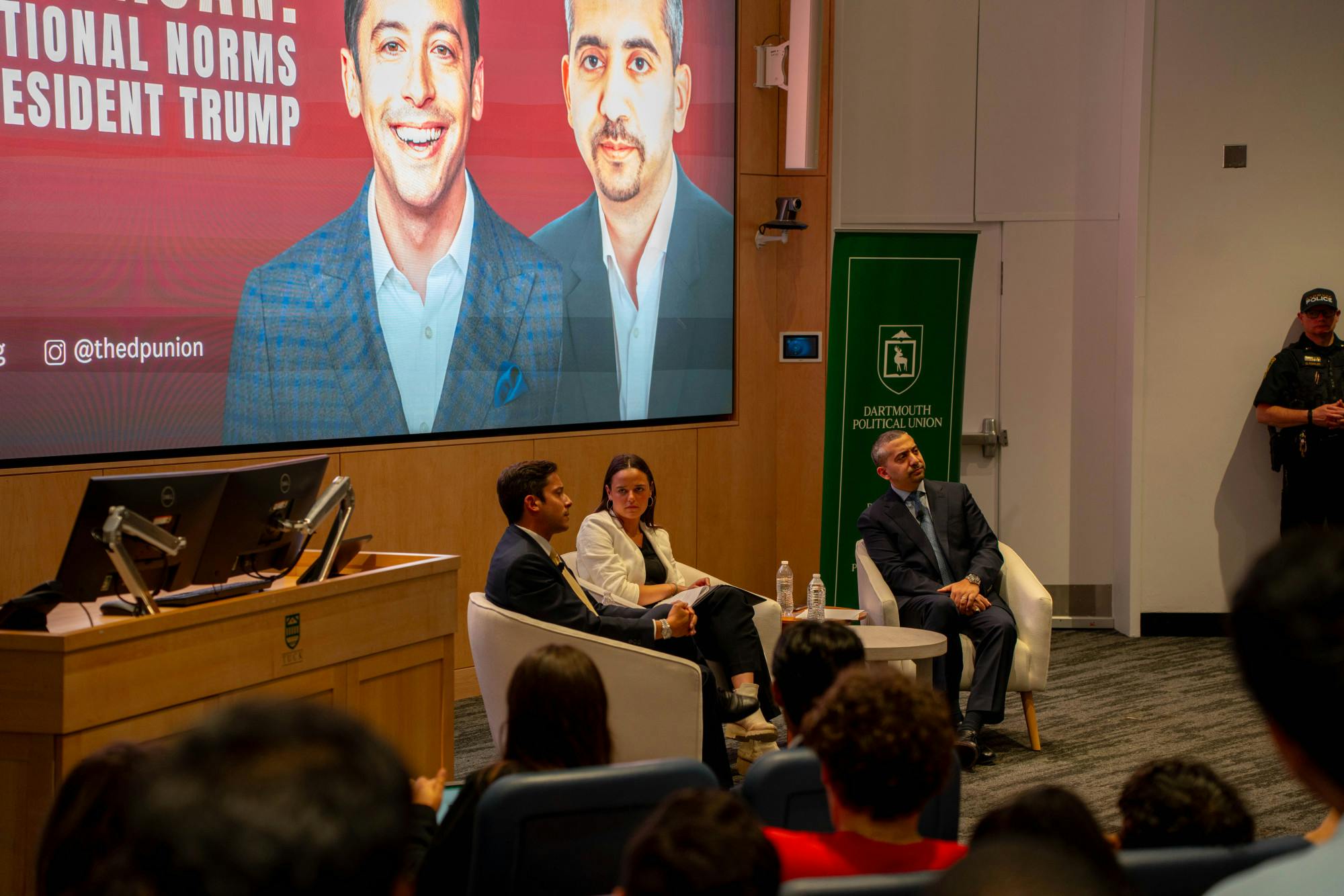
On May 5, former MS NOW anchor Mehdi Hasan and The Daily Wire host Michael Knowles debated whether President Donald Trump’s actions represent “deviance from or adherence” to the Constitution at a public event hosted by the Dartmouth Political Union.
The event — moderated by DPU ambassador Ella Klinsky ’26 — was the eighth installment of the DPU’s debate series, “Critical Discourse in the Age of Disagreement.” Approximately 300 people watched the debate in Cook Auditorium, with a recording of the event online receiving an additional 63,000 views as of May 6, according to DPU president Roger Friedlander ’27.
Hasan hosts debate program “Head to Head” on Al Jazeera English, founded and serves as editor-in-chief of new media company Zeteo and writes a column about U.S. politics for The Guardian. He hosted “The Mehdi Hasan Show” on MSNBC from 2021 to 2023.
Knowles has hosted “The Michael Knowles Show” on conservative news outlet The Daily Wire since 2017. He previously appeared in web series, films, podcasts and TV shows, including in a role as the cultural correspondent for conservative podcast “The Andrew Klavan Show.”
Klinsky began the debate by asking what it meant “in practical terms” for a president to “uphold or deviate from the Constitution.” Knowles answered that he believes upholding the Constitution does not entail “pedantic literalism that merely looks at the text of the Constitution.”
“If we were to use this … democratic literalist view of the Constitution, then we would have to disqualify virtually every single president we’ve ever had from upholding the Constitution,” Knowles said. “All the modern presidents who have surveilled en masse, all the great presidents who have violated habeas corpus, who have interred people.”
Hasan said that while other presidents have “certainly violated” clauses of the Constitution, no president has called for the “termination” of the Constitution until Trump.
“No president, certainly not in modern American history, has launched a multi-pronged, across-the-board open assault on the amendments and articles of our Constitution in the space of less than 18 months,” Hasan said.
In response to a question from Klinsky about the constitutionality of Trump’s second-term foreign policy, Hasan said he believes that the war against Iran is “undoubtedly unconstitutional” because Trump did not seek congressional approval before launching the attack.
“Donald Trump has admitted it — he said ‘If I call it a war, I’ll have to get approval,’” Hasan said. “And then he called it a war.”
Knowles said that while he was “skeptical” of the war in Iran, he believed that it was “within constitutional norms.”
“[The war in Iran] is in fact, much more restrained than anything his recent predecessors have done,” Knowles said. “Harry Truman … waged a war in Korea that went on for three years without congressional approval.”
After a question from Klinsky about the constitutionality of Trump’s second-term tariffs, Hasan said Trump used the International Emergency Economic Powers Act — which enables the executive branch to enact tariffs during declared emergencies — to “go after his enemies.”
“It’s an abuse of power,” Hasan said. “He uses the [IEEPA] completely illegally … to basically settle scores.”
Knowles noted that Trump accepted the Supreme Court’s February ruling striking down the administration’s IEEPA tariffs for lacking “clear congressional authorization.”
“The Supreme Court struck them down, … and the Trump White House complied,” Knowles said. “You could say [the tariffs are] bad economic policy, but there’s certainly nothing unconstitutional about it.”
The moderated debate was followed by a student Q&A. Following a question from a student about the constitutionality of Trump’s actions following his 2020 election loss, including his attempts to “influence [former Georgia secretary of state] Brad Raffensperger,” Knowles said he believes that there are reasons to be “a little skeptical” of the 2020 presidential election results.
“I think there was at least a reasonable person who might have some questions about the election,” Knowles said. “They changed all the voter rules, took away a lot of the safeguards and in some cases violated the state constitutions.”
In response to a question from a student about whether Trump may be elected for a third presidential term, Hasan said that Trump violating the 22nd amendment — which prohibits any individual from being elected president more than twice — is his “greatest fear.”
“This guy is a wannabe dictator,” Hasan said. “He wants to stay in power. He thinks he’s God’s gift.”
In an interview after the event, Trace Ribble ’29 said he believes that Hasan “absolutely won” the debate.
“I don’t think Michael Knowles really knows how to debate, and he doesn’t know how to stay on topic,” Ribble said.
Oz Trost ’29 said he found the event to be “kind of a farce” because it was framed as a “versus” event rather than as a “discussion.”
“I don’t think either person won,” Trost said. “The DPU is simultaneously trying to draw in a big crowd, which was very successful here, but also they’re sacrificing any attempt at having a dialogue.”


