
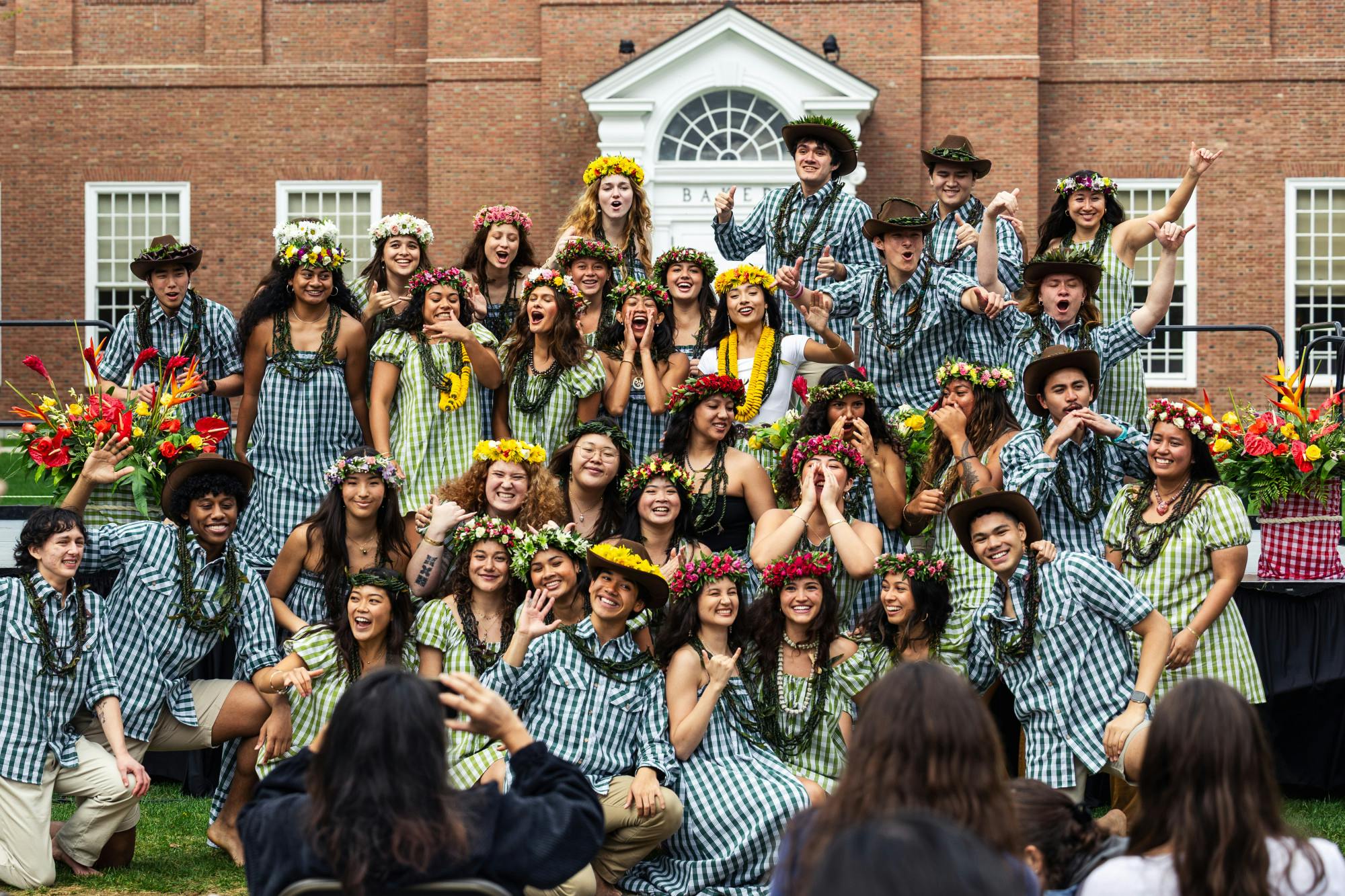
On May 10, Dartmouth’s Native Hawaiian and Pacific Islander heritage group Hōkūpa`a hosted their annual lū’au on the lawn of Baker-Berry Library. Around 1,000 students, faculty, family members and other community members attended to celebrate Pacific Islander culture with performances, lei-making and Hawaiian food, according to Hōkūpa`a co-president Chase Kamikawa ’26.
The day featured student song and dance performances and music from Hawaiian guest musicians, including Jonah Kahanuola Solatorio, twin brothers Dylan Nakahara and Devin Nakahara and Leimana Purdy.
The theme of the event was “Paniolo Country,” a reference to the Native Hawaiians — “paniolos,” or “Hawaiian cowboys” — who learned horseback riding, roping and cattle ranching when Mexican and Spanish cowboys first introduced cattle to the islands in 1793, emcee Pelehonuamea Harman explained at the beginning of the event.
“Over generations, paniolo culture took root across Hawaiʻi Island, Maui, Kauaʻi and Molokaʻi, becoming an enduring and beloved part of Hawaiian life and identity,” Harman said.
In an interview with The Dartmouth, Hōkūpa`a co-president Amedee Conley-Kapoi ’26 said the theme “pay[s] tribute” to a “unique part of Hawaiian culture.”
“New Hampshire is really country as well, so I feel like we’re kind of on-theme for Hanover,” Conley-Kapoi said.
She added that hosting the annual lu’au “facilitates [a] community” for Pacific Islander students who are “5,000 miles away from home” in Hanover.
“We’re the heartbeat of our people and our culture up here, so many miles away,” Conley-Kapoi said.

The event also spread awareness about super typhoon Sinlaku, which struck the Chuuk and Mariana Micronesian Islands on April 14 this year. The lū’au encouraged attendees to donate to the Micronesian Climate Change Alliance to support recovery projects, according to Kamikawa.
Kamikawa said planning for the lū’au begins a year in advance.
“We literally start the day after the previous lū’au ends,” Kamikawa said.
Throughout the year, Hōkūpa`a works with advisors to fundraise their budget, reach out to vendors for food and coordinate travel from Hawaii for presenters, musicians and caterers. This year, Hōkūpa`a raised $106,000 for their budget, according to Kamikawa. At the beginning of spring term, Hōkūpa`a members come together to learn hula dances and cultural songs for the lū’au.
Kamikawa said many Hōkūpa`a members first learn to hula while preparing for the lū’au.
“It’s pretty amazing because a lot of people who come to Dartmouth who have some sort of connection to Pacific identity or heritage don’t really know how to dance,” Kamikawa said. “It’s really beautiful watching [members] in their freshman year, not knowing what … the basic hula stuff is, and I’ve seen them in their senior year being able to dance out publicly for an audience of over 1,000 people.”
Hōkūpa`a member Cindy Taulava ’27 performed a Tongan hymn with the Dartmouth women’s rugby team. Taulava explained that, during the women’s rugby team training trip to Fiji over spring break, they were welcomed with a sevusevu — a traditional Fijian welcoming ceremony in which visitors present gifts to the village chief, who then grants them permission to “roam freely” on the island. After the ceremony, one teammate taught the team the hymn to perform for their hosts in Fiji, which they performed again for the audience at the lū’au.
Taulava said Hōkūpa`a “felt like a home away from home” because there are “only a handful of Polynesians” in Hanover compared to her hometown in the Bay Area.
Students who were on the anthropology foreign study program in New Zealand and the linguistics foreign study program in New Zealand and the Cook Islands during the winter term performed a waiata song to honor Enzo La Hoz Calassara ’27, who died in March while participating in the linguistics FSP, according to anthropology study abroad student Catherine Harnois ’27. Waiata are traditional Māori songs and dances used during welcome ceremonies.
Shannon Javillonar, caterer and owner of Island Style Grindz restaurant in Hawi, Hawaii, said he has traveled from Hawaii for the past four years to make macaroni salad, pulled pork, poke, coconut pudding and apples with plum powder and other food for the event.

The Pacific Islander community is a “family,” he said. “Everybody comes together, they enjoy what we prepare for them.”
After the performances, Harman acknowledged Native American and Indigenous studies professors Bruce Duthu and Meredith Fergeson and associate director of admissions Steven Abbott for their support for native and indigenous students. Harman described them as “centerpieces in our houses” who “hold everything up.”
“It’s not easy to go from tropical weather to this weather, but it makes it a lot easier when you have mentors and professors that take care of you in a way that we would back home,” Harman said.
Ann Marie Shell and Jonathan Shell traveled from Wooster, Ohio to visit their daughter, Neena Shell ’26, and said they “enjoyed” attending the lū’au, especially the food.
“This is delicious, I liked everything on [the plate], great flavors,” said Jonathan Shell.
Norwich resident Lucy Hampton brought her children to the event to introduce them to different cultures.
“It’s a great opportunity for children in the Upper Valley to learn about cultural diversity and be exposed to just the beautiful dancing and all the different activities and lei-making,” Hampton said.


