
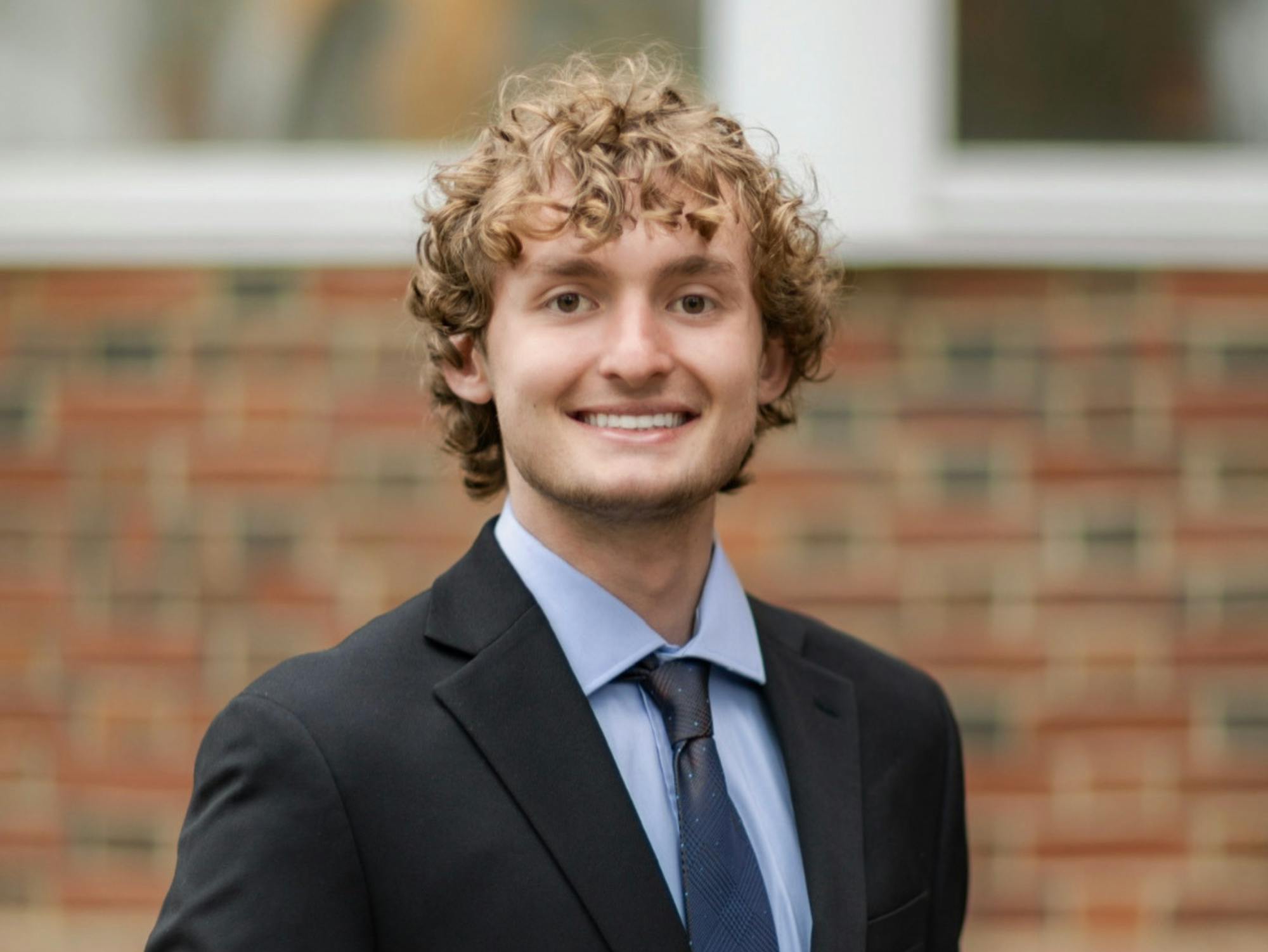
On April 15, Quinn Allred ’26 was named a John Robert Lewis Scholar by the Faith and Politics Institute, a non-profit organization that connects politicians to religious organizations.
The scholarship funds 20 undergraduate and graduate students from around the country to engage with the “philosophy of nonviolent social impact” advocated by former Congressman John Lewis, the scholarship’s namesake and civil rights leader, according to the Faith and Politics Institute. Allred and his cohort will visit Washington D.C. in July, and Selma, Ala. at a later date, to research civil rights and develop an oral history project, according to Dartmouth News.
At Dartmouth, Allred founded youth leadership non-profit Let Us Lead and served as president of the Dartmouth Democrats. The Dartmouth spoke to Allred about his accomplishments and plans for the future.
What does being selected as a John Lewis Scholar mean to you?
QA: I really appreciate that I get 12 more months where I can learn from people who clearly know much more than me about civil rights work, organizing social movements and talking to people that I might inherently disagree with, but still want to make change with. There are going to be times when I mess up, and more importantly there’s going to be someone right there to show me and to tell me that I messed up. My cohort has people who are about to get their J.D., people who just got their Master’s of Public Administration and other people who are just coming out of undergrad like me — everyone’s in a different spot, which makes for the best growth.
What makes you interested in change through nonviolent principles?
QA: I had a “break Quinn down, build him back up” moment when I got cancer during the COVID pandemic. I didn’t have very clear signs, so before my diagnosis it was chalked up to teenage hysteria. But I said, no, I really think something is structurally wrong with me.
When I finally found out I had cancer, it wasn’t this moment of everything falling away because I had been advocating for myself. No one could tell me anything after that — if I feel it in my bones, I feel it in my bones. When I finally got on the other side of that, getting here on campus and having that clean slate was incredibly important to me. That experience gave me such a strong sense of knowing myself, which was a powerful angle to approach change and commitment to change with.
Have you had any moments at Dartmouth that inspired you to pursue policy and justice?
QA: I was so excited to get on campus and hit the ground running. I came in as a Great Issue Scholar in Residence [a living learning community], which immediately exposed me to new perspectives. Then I joined the Center for Social Impact’s Foundations in Social Impact program, which was the first time that I saw a concrete path to dedicating my life towards making other people’s lives better. Through that, I got to go back to Raleigh, N.C., and work at an immediate housing assistance program. If the caseworkers did not perform that day, someone was not going to have a place to sleep. Witnessing that for that many weeks straight, every other problem felt immaterial.
What do you think makes for effective leadership in policy?
QA: A lot of us are trained on this broadcast model of leadership, where there’s one person with a mic and they’re talking to the masses. Everyone’s supposed to do this uniform thing. But when you are in a moment of crisis, there isn’t going to be a uniform response. Everyone has a different part to play in making a difference. Our whole model at Let Us Lead is built on leading shoulder-to-shoulder. We focus on how to make the 10-week fellowship scalable for those around you. If we all go through a program like this, we dedicate ourselves to making sure that a handful of people know that we care about something bigger.
If you appreciated what someone taught you about leadership, you have an opportunity to immediately turn around and give it to another person, or give it to five more people. That’s how we get a chain reaction. If you start now and you stick with it, you can change so many hundreds of lives.
What areas of law and public policy are you most concerned about? Why?
QA: If you do not have a house over your head, there is nothing else that you can focus on. I was part of the Policy Research Shop here at Dartmouth and we produced research on affordable housing in the Upper Valley region. When venture capital and private capital firms come into places like New Hampshire and buy up the housing stock, they’re pricing people out who actually work and live here. This causes massive displacement from people’s family homes and destroys the ability to engage with their communities.
What advice would you give to other Dartmouth students interested in pursuing justice through public policy?
QA: If you think you don’t have enough time to give, you’re wrong. If you feel like you’ve found your lane and your avenue to make a difference, try another one. I’ve learned more from the case studies that I failed in and had to adapt from than I have in any success that I’ve ever had. Start failing in many different ways, with a mentality of learning how to be better. That’s the best advice I can give you. If you still have time left at Dartmouth, join a program that you’re not yet a part of — especially anything that places you physically in front of somebody whose life you can make better.
This interview has been edited for clarity and length.
Max Hubbard '29 is a reporter from Boston, Mass., and is majoring in government and minoring in French. In his free time, he enjoys listening to music, running and watching movies.


