
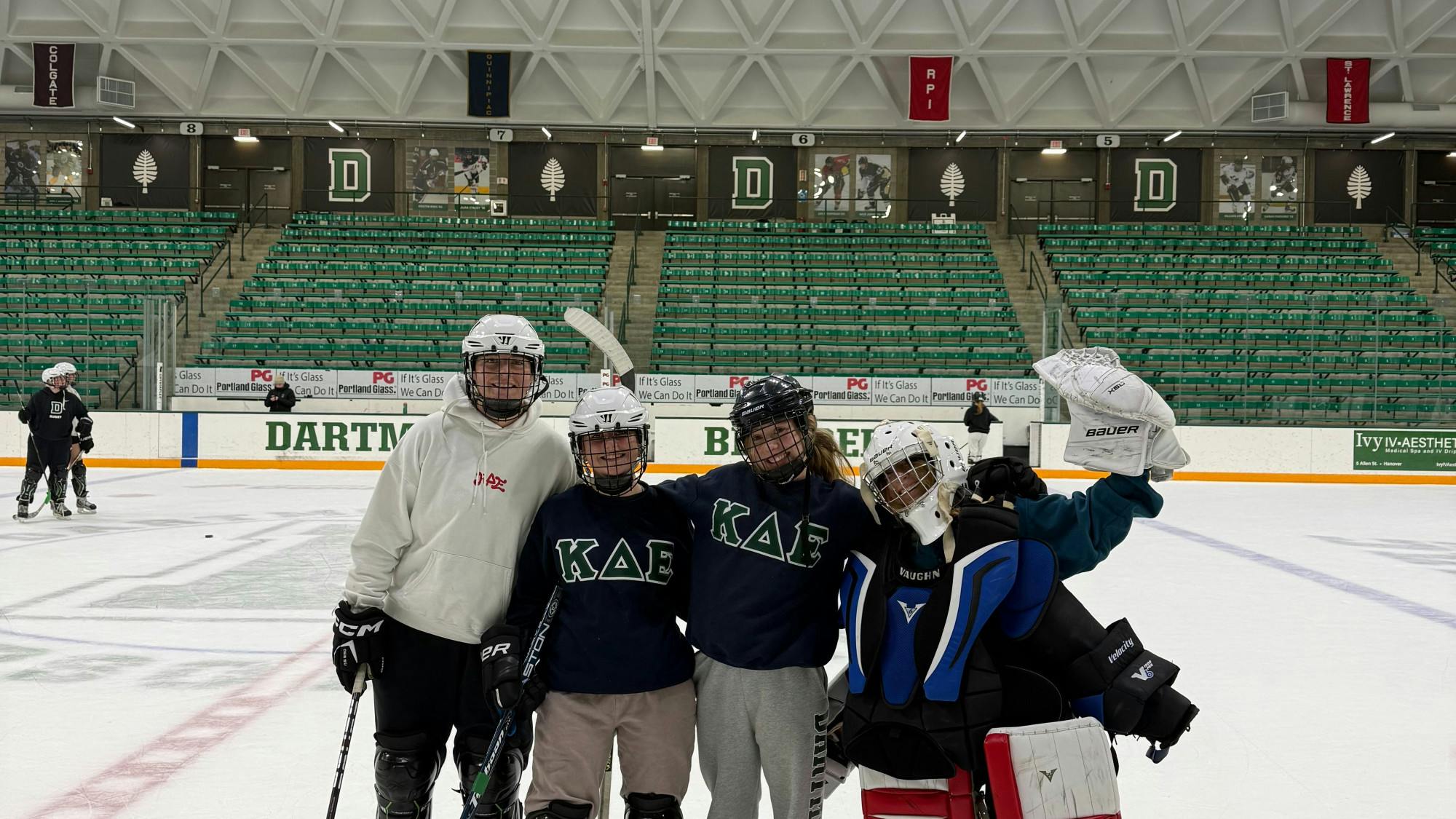
On winter weekends, Dartmouth’s ice rink fills with a mix of players: beginners gripping their sticks for balance, experienced skaters circling the ice and students and faculty unwinding after long academic weeks. Intramural hockey may look chaotic from the stands, but for those on the ice, it has become one of the most welcoming and community-driven activities on campus.
Unlike varsity athletics, IM Hockey teams are open to all members of campus. They form organically, whether within a friend group, a campus organization or an academic department. This allows members of the community, whether experienced or not, to participate.
Avery LaRusso ’29, who joined IM Hockey teams with the marching band and her housing community, explained that her friends encouraged her to join.
“I was pretty involved in the marching band in the fall, and when they said they were making a team, I thought it sounded fun,” LaRusso said. “I had never done ice hockey before, but I was intrigued.”
Others are drawn in through a shared love for hockey. Some teams, like the physics and astronomy department’s “Absolute Zeroes,” began as initiatives among students who shared an interest in the sport and wanted a way to spend time together outside the classroom.
Nathan Tolva GR, a student at the Frank J. Guarini Institute for International Education and the goalkeeper for the Absolute Zeroes, describes that his love for sports drew him to the team.
“I miss playing sports … I miss it even more now when I’m really not playing sports,” Tolva said. “So it’s kind of just fun to do something athletic [and] play a game with friends.”
For many newcomers, however, the excitement of joining is quickly followed by the realization that hockey is far more difficult than it looks. Players have to balance skating, stick handling and game awareness all at once, a combination that may feel overwhelming at first.
“It was definitely a very steep learning curve,” LaRusso said. “My dad taught me some basics over winter, but it was on roller blades … like [street] hockey.”
Some participants start with even less experience, stepping onto the ice without knowing how to skate at all. Still, they say the environment makes it easier to learn without feeling judged.
“I didn’t know how to skate at all before I started,” Tolva said. “That’s why I play goalie. I can skate now but when I started I just wanted to sit in the goal and our teammates would drag me out into the net so I could just sit there for the game.”
Compared to picking up sports as a child, learning as an adult can be more challenging. Benjamin Velguth GR, a first-year grad student at Guarini, joined the Absolute Zeroes without prior experience.
“Trying to learn how to make your legs and your arms and everything do what they’re supposed to as an adult is way harder than I remember it being as a kid,” Velguth said.
Rather than relying on formal coaching, most teams improve through informal practices and pickup sessions. Players often meet up to skate together, experimenting and learning techniques from one another.
“I’ve learned a lot of things just from going out with someone who’s better at skating than me and then being like, ‘Hey, man, just do this or try this thing,’” Velguth said.
Structured practices are rare, especially in lower divisions like the Green League, where teams tend to prioritize participation and fun over strict training routines.
“None of us were necessarily good enough to coach well,” LaRusso said. “There were a couple times where one or two of them would try to lead a more formal practice, but for the most part, it was just passing in a circle and then scrimmaging.”
That relaxed structure helps create a culture where beginners feel welcome to participate fully, regardless of skill level. Having been part of the Absolute Zeroes since the beginning, Physics and astronomy professor Ryan Hickox believes that welcoming atmosphere is central to the team’s culture.
“I think that’s one of the joys of the whole thing,” Hickox said. “Everybody can skate and gets the chance to skate as much as everybody else.”
Beyond athletic improvement, IM Hockey also provides a place for students and faculty alike to interact with people outside of their traditional social circles.
“It is a nice way to connect with people in a way that's completely independent of our you know, academic life,” Hickox said. “We all have a fairly intense intellectual life here … so it’s a really nice way of bridging across the different subfields.”
This sense of community extends beyond individual teams and games, shaping how players interact across campus.
“There’s this broader, sort of college [and] school-wide community that you can find in that,” Velguth said. “I've met a handful of people through that … it’s nice and it’s welcoming, and I think it’s a great way to meet people and just have a good time.”
For many participants, that sense of connection becomes a lasting part of the experience. The sport itself may be new, but the opportunity to try something unfamiliar is what stands out.
“I think it’s just another opportunity where Dartmouth gives you the chance to try a lot of things that you never would have done otherwise,” LaRusso said. “I had no plans in my life to play ice hockey, so this is super fun.”
Even memorable moments on the ice don’t always involve winning. Players say some of their favorite games are the ones that test teamwork the most.
“My favorite game of the season was … the game that we ended up losing, because it was a really close game,” Tolva said. “I felt like that was our best game playing as a team … I really love seeing everybody get better when we play together as a team.”
For many players, that sense of teamwork is exactly what makes hockey a memorable experience.
“It’s as fun as I thought it was going to be,” Velguth said. “I was just so excited to play intramural hockey, because I’ve never done it before, and it has just fulfilled all of my hopes and dreams. It’s just been a blast.”


