
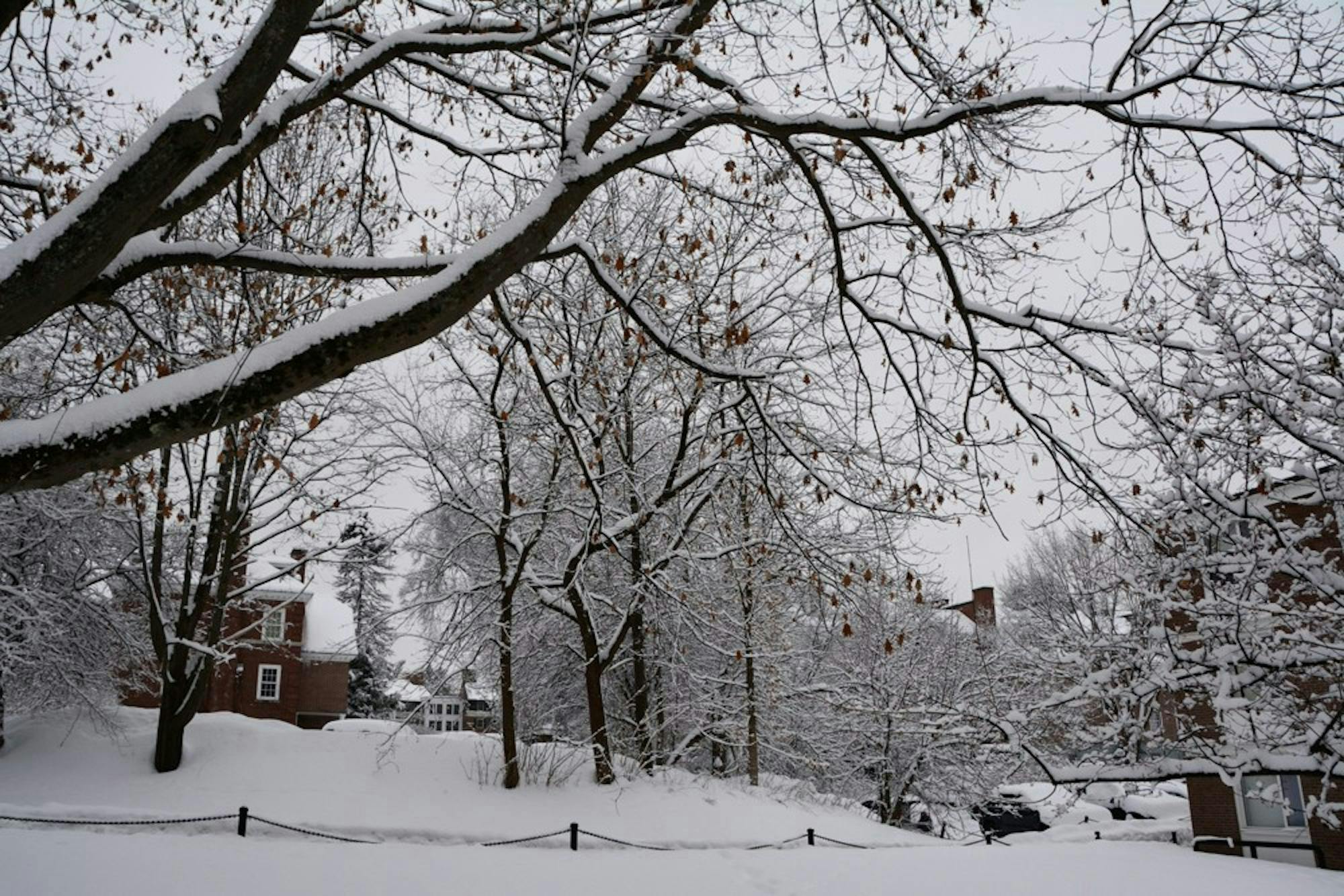
Throughout the finals period, students trickle out in waves; first, a few suitcases roll down dorm halls, then entire floors become enveloped in silence. Sidewalks that are typically filled with late-night conversations, hurried footsteps and constant movement become quiet, then empty.
This unmistakable shift stands as the harbinger of winterim, Dartmouth’s six-week period between academic terms that stretches from Thanksgiving to the start of the winter quarter. While most students return home for the break, a small number remain, navigating life in a campus transformed by the unusual absence of commotion.
Jonathan Ancrum ’29 was one such student. For him, the change was eerie and drastic.
“It was actually kind of spooky,” he said. “Just seeing the campus usually alive, with at least … 10 people out on the street when I first start walking down Tuck drive — it’s just become completely desolate.” Ancrum deliberately chose to stay on campus well in advance of winterim.
“I just wanted to experience a cold winter [for] Christmas,” he said.
According to Ancrum, seasonal changes were limited in his home state of Florida, where winters rarely brought more than a few colder days.
“I always wanted to have a white Christmas,” he added. He remained on campus for nearly the entire six-week period, only leaving briefly for a trip to the Bahamas from Dec. 15 to Dec. 20.
However, once finals ended and campus cleared out, the experience of staying behind began to look very different for some students.
Teddy Le ’29 originally planned to stay on campus throughout the interim period. However, after exams ended, she found her days narrowed to time spent almost entirely in her room.
“All my friends went back home, so I didn’t really have anyone to hang out with,” Le explained. “I just felt like it was too lonely and too quiet, so I couldn’t do it anymore. I just had to go somewhere else.”
After remaining on campus for the week following Thanksgiving, she traveled to Michigan, returned for a week, and then left again for Maryland for the remainder of the break.
Meanwhile, Angela Shang ’27 said she experienced the silence differently.
“I actually like it a lot,” she said. “I just really like the feeling of more space. It’s really nice to have friends and other students with you during the term, but sometimes, especially [during] the fall, I feel like it can feel sometimes a little bit claustrophobic.”
Shang stayed on campus for three weeks to work in the Nautiyal lab on a behavioral neuroscience research project, conducting daily experiments with mice.
“My research project timeline requires me to stay a little bit longer to finish up the things that I started last term,” she explained. “I was working with animals and running behavioral experiments. Those things are kind of finicky, because sometimes the animals don’t learn the task, and you need a little bit longer.”
Mazvita Nhidza ’28 also tried to keep busy to structure her winterim on campus. She worked multiple jobs: as a teaching assistant for a computational thinking workshop, at the International Student Office and at Ramekin Cafe. For Nhidza, who is from Harare, Zimbabwe, staying on campus was also an intentional choice she made early in her time at Dartmouth, having decided during her freshman year to return home once a year, in the summer.
“I’d already decided [during] freshman year that [I’d] always be on campus for winterim,” she explained. “In [my first year], … I didn’'t really know people, so it was hard. But this time has been easier.”
With the experience of past breaks spent on campus, Nhidza learned to stay busy with work during winterims on campus. However, during her first winterim, Nhidza said she struggled with the lack of structure.
“Last [winterim], I hadn’t started working on campus, so I had nothing to do,” she said. “I hadn’t really made a lot of friends … who would stay on campus as well.”
“Having a schedule so you’re not just stuck in your room” makes winterim far more manageable, she added.
Ancrum took advantage of the break to pursue new skills, spending two weeks participating in a computer science workshop.
“Even though I’m not a computer science major, I just found it interesting to do over break,” he said.
Nhizda similarly used the open schedule to immerse herself in experiences she normally couldn’t fit into a busy term.
“All the little farm visits that happen during the term, I don’t sign up for … because I don’t have the time,” she remarked.
Over the break, she visited an antique store in Vermont with friends and explored the alpaca farm in Quechee, Vt.
“It was nice going to the stuff I missed out on,” she said.
Shang also took advantage of the less crowded campus for her creative pursuits, practicing marimba, which is a percussion instrument shaped like a piano, at the Hopkins Center for the Arts, and attending dance classes in the studio, which is normally “pretty booked by various clubs and dance groups,” she said.
“Towards the end, I was basically going there every single night,” she said.
Ultimately, Accrum and Le said that choosing to stay on campus during winterim came down to their personal preference.
“I felt like I could [do] a lot more here than … what I would have done back home,” Accrum said.
Le shared a similar perspective.
“If you really love your private space, then do it,” she said. “But, otherwise, I don’t think it’s worth it.”
The quiet campus throughout winterim ultimately serves as a blank slate for students to explore new activities and skills, but also exposes the loneliness that may often come with staying behind while most return home. While it may not be for everyone, it offers a rare opportunity to experience campus life in an undoubtedly memorable way.


