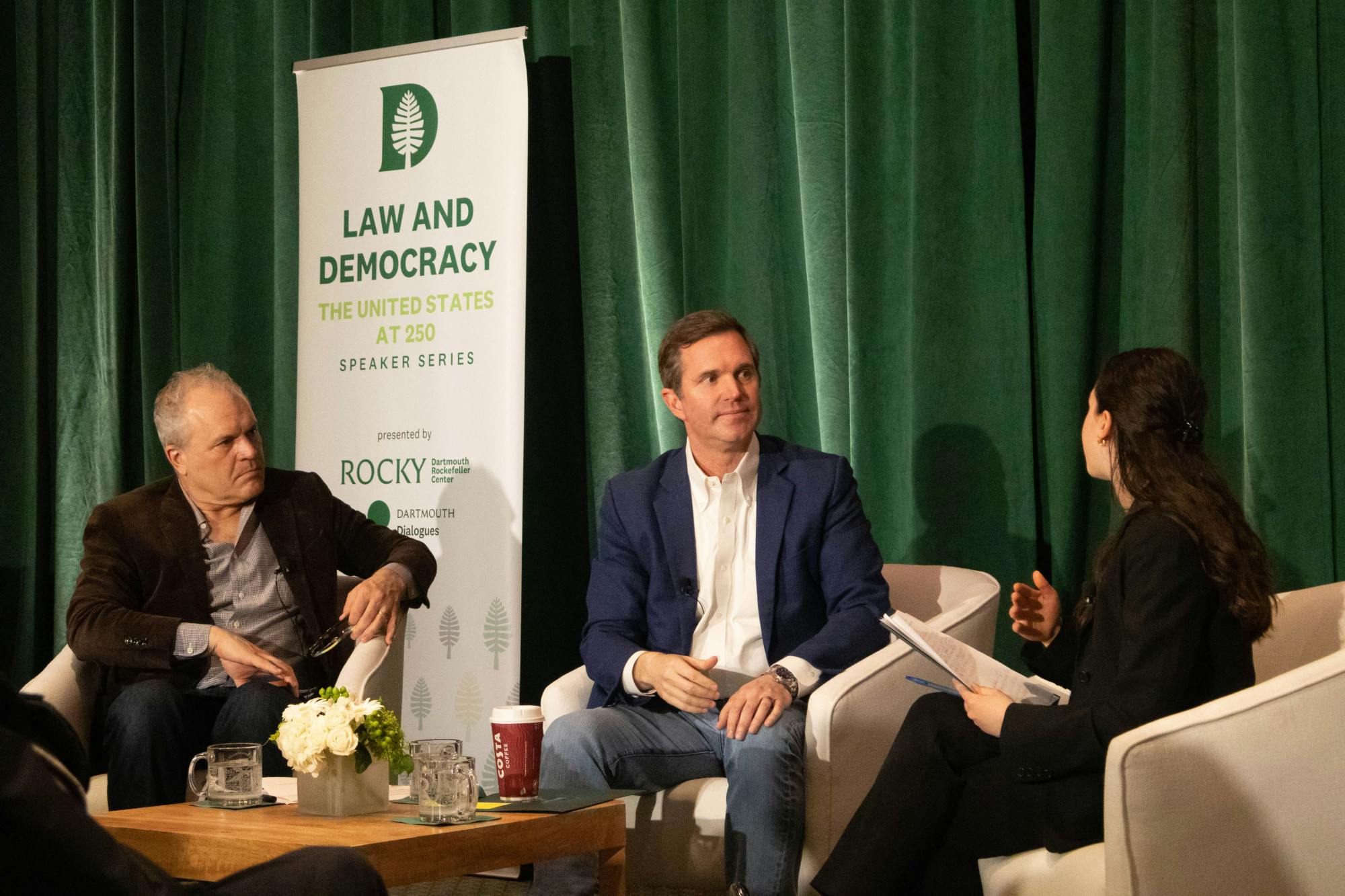
Kentucky Gov. Andy Beshear called for a “pragmatic” style of politics that focuses on results rather than inaction in a visit to Dartmouth on March 7. Beshear criticized the characterization of issues as “partisan” or “bipartisan,” instead calling on politicians to focus on “nonpartisan” issues, such as housing and healthcare.
Widely considered to be a potential Democratic presidential candidate in 2028, Beshear was visiting campus as part of a weekend he spent campaigning for local Democrats in New Hampshire, including at an AFL-CIO event.
The event — which was moderated by government professor Russell Muirhead and Dartmouth Democrats president Beatrice Reichman ’27 — was part of the Rockefeller Center for Public Policy’s “Law and Democracy: The United States at 250” speaker series. Approximately 250 people attended the event in Filene Auditorium, according to Rockefeller Center associate director for public programs and special events Dvora Greenberg Koelling.
Beshear, who served as Kentucky’s attorney general prior to winning the governorship in 2019, attributed his electoral success as a Democrat in a red state to his “convictions [and] values.” The state has voted Republican in every presidential election since 2000, and the Republican Party holds supermajorities in the Kentucky General Assembly.
“I believe we win by staying true ... to our values of compassion and empathy and always looking out for our neighbors,” Beshear said.
Although he is one of the few statewide-elected Democrats in Kentucky, Beshear said he does not focus on moving the politics of Kentucky to “the right or the left.”
“When most people wake up in the morning, they’re not thinking about the next election,” Beshear said. “They’re thinking about their job and whether they can support their family. …When I put effort and time and get results in those areas … everybody benefits.”
During the event, Beshear also offered his thoughts on what he sees as problems facing the Democratic Party. Party leaders risk “losing the emotional connection” to voters when they use “political science” language and do not explain the human impact behind policy, according to Beshear.
“We rarely talk about the why,” Beshear said. “Why are we for what we’re for? What I found is when you actually share your why, you can create grace and space to where many people can disagree.”
He added that he believes that Democrats have lacked the “urgency” to enact “immediate change … for people who are crying out.”
“If we can show people that we’ll get results, they’ll vote for the people who get results,” Beshear said.
Attendee Sebastian Rao ’28 said that he found “Beshear to be very inspiring” because of the “way he talks about an 80%, 20% split,” in which Beshear stated that he spends 80% of his time on issues that matter to everyone.
In an interview with The Dartmouth after the event, attendee William Parocai ’27 said he thought that Beshear made it “clear he’s interested” in running for president.
Olivia Sapper ’29 is a reporter from Darien, Conn., and is majoring in Government.