
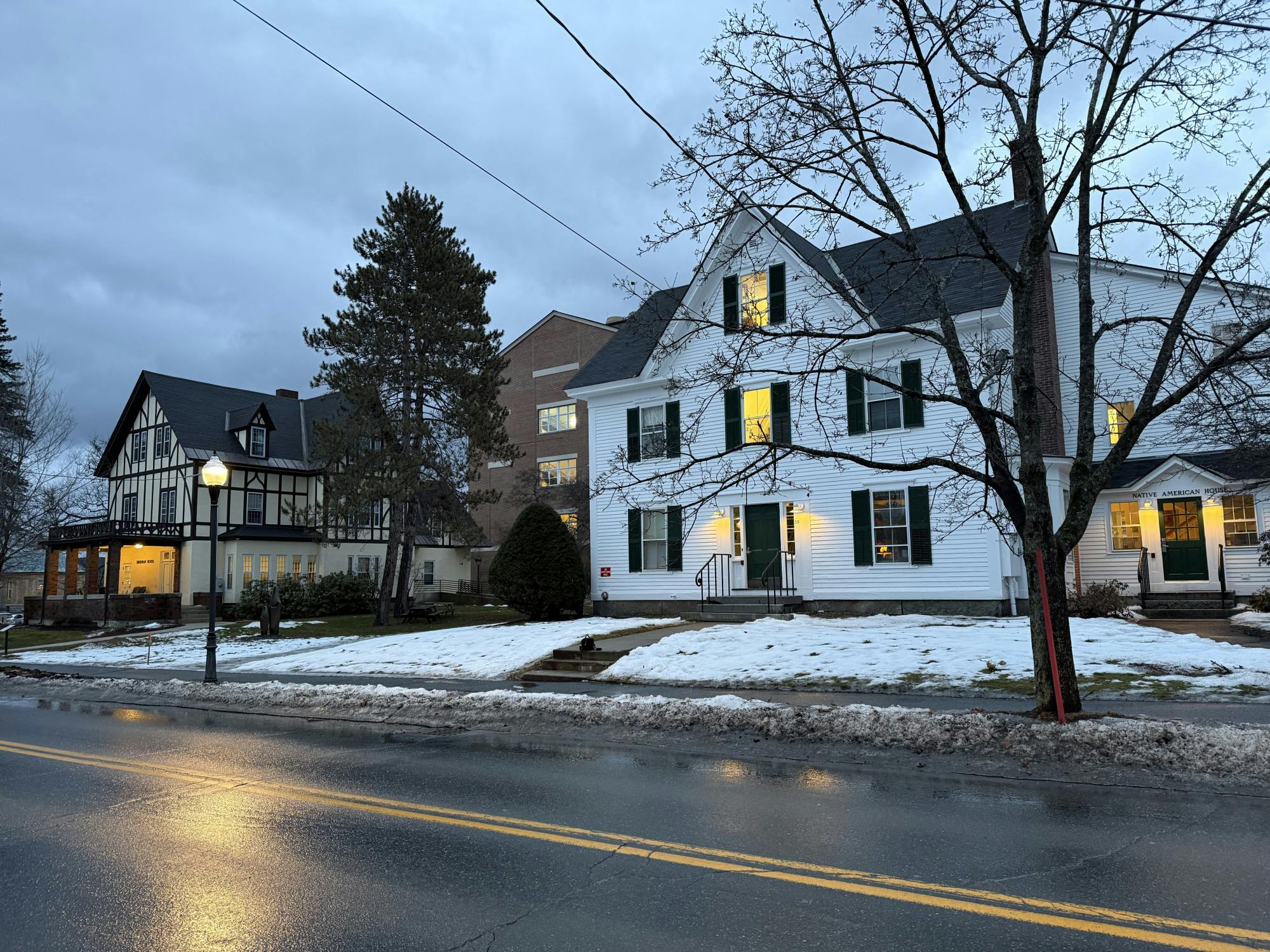
The Native American House will close for renovations from Commencement this year until next summer, according to Native American Program director Adria Brown ’15. Renovations will expand the house and add additional bedrooms and bathrooms, according to Brown.
The Native American House provides “cultural, social and educational enrichment for Native, Indigenous and other interested students,” according to the Native American Program website.
While the NAH is closed, upperclassmen will have access to a living learning community in the North Park Apartments, and incoming first-year students will be able to apply to a living learning community within the East Wheelock House Community, according to the Native American Program website.
The current location of the Native American House at 35 North Main Street has housed the living learning community since 1995, according to Brown.
Current Native American House undergraduate advisor Rosa Lopez ’26 said renovations “would be good for the house.”
“It’ll just mean that there’ll be [fewer] community events there for the time being,” Lopez said.
Gabrielle George-Frank ’26, who has lived in the house almost every term since her first year, said she was “really sad” about the closure.
“We’ll have a class now, the ’30s that arrive, [who] won’t be able to live in the NAH,” George-Frank said. “That’s going to be really weird because a lot of the pre-orientation stuff for Native Americans at Dartmouth takes place at the NAH.”
Sonja Talwani ’29 said the Native American House is “especially important” for first-year students in NAD to find a sense of community.
“When we were introduced to campus, they told us ‘this is your home, you can spend whatever amount of time here, this space is yours to exist in and relax in,’” Talwani said. “I feel like some random apartment in North Park will not have that same effect for people.”
George-Frank added that living at the Native American House as a first-year student helped her develop “really close friendships” that she might not have made otherwise.
The NAH “kind of feels like a second home,” George-Frank said. “It’s just given me a really good sense of community. I became really close with [my best friend] because we both lived at the NAH and we did the Sunday dinner programs together.”
Alternatives for event organizing include working with East Wheelock House Community to host larger NAP events and using “existing spaces” such as the Collis Center for Student Involvement, according to Brown.
“We’ve been working with student leaders to figure out where we can host some of our long-standing events and still be able to have that for next year,” Brown added. “We have a library that’s going to be moved over into Collis.”
According to the Native American Program website, the renovated Native American House will include “new vibrant spaces that will continue to support the community for new generations to come.”
Brown said the renovations will allow for an “expansion” of the Native American House.
“There will be expanded gathering space, additional residential beds [and] bathrooms and an administrative space for the Tribal Sovereignty Institute,” Brown said.
Lopez added that the current lack of space in the Native American House “fractures the community” and is especially visible during the Indigenous Fly-In program.
“When we have everyone together, we always do a bingo night,” Lopez said. “We start out in the kitchen, but then we start overflowing, and so then people have to move into the basement or into the living room … It’s something that we’ve just laughed off.”
George-Frank said she hoped the renovations would also result in better air conditioning in the Native American House.
“There only is [air conditioning] in the shared spaces in the living room and the kitchen because they installed it on the wall, but there’s no [air conditioning] in the rooms,” George-Frank said.
Native Americans at Dartmouth co-president Perciliana Moquino ’26 said there will be an “inventory and feedback session” in the spring term, and that “the current infrastructure” of the Native American House “hasn’t been able to hold as many people.”
“I’m excited that we’ll finally be able to house everybody, host events and be able to have a center space like that on campus,” Moquino said.
Kay Alvito ’29 is a news reporter from Rio de Janeiro, Brazil studying comparative literature and creative writing. On campus, she is very involved with the arts as a member of the Rude Mechanicals classical theatre company and the dance group Street Soul.
Sahil Gandhi ’29 is a reporter from Staten Island, N.Y., and is majoring in environmental studies and government modified with philosophy and economics. He loves word searches and falling down internet and Wikipedia rabbit holes.


