
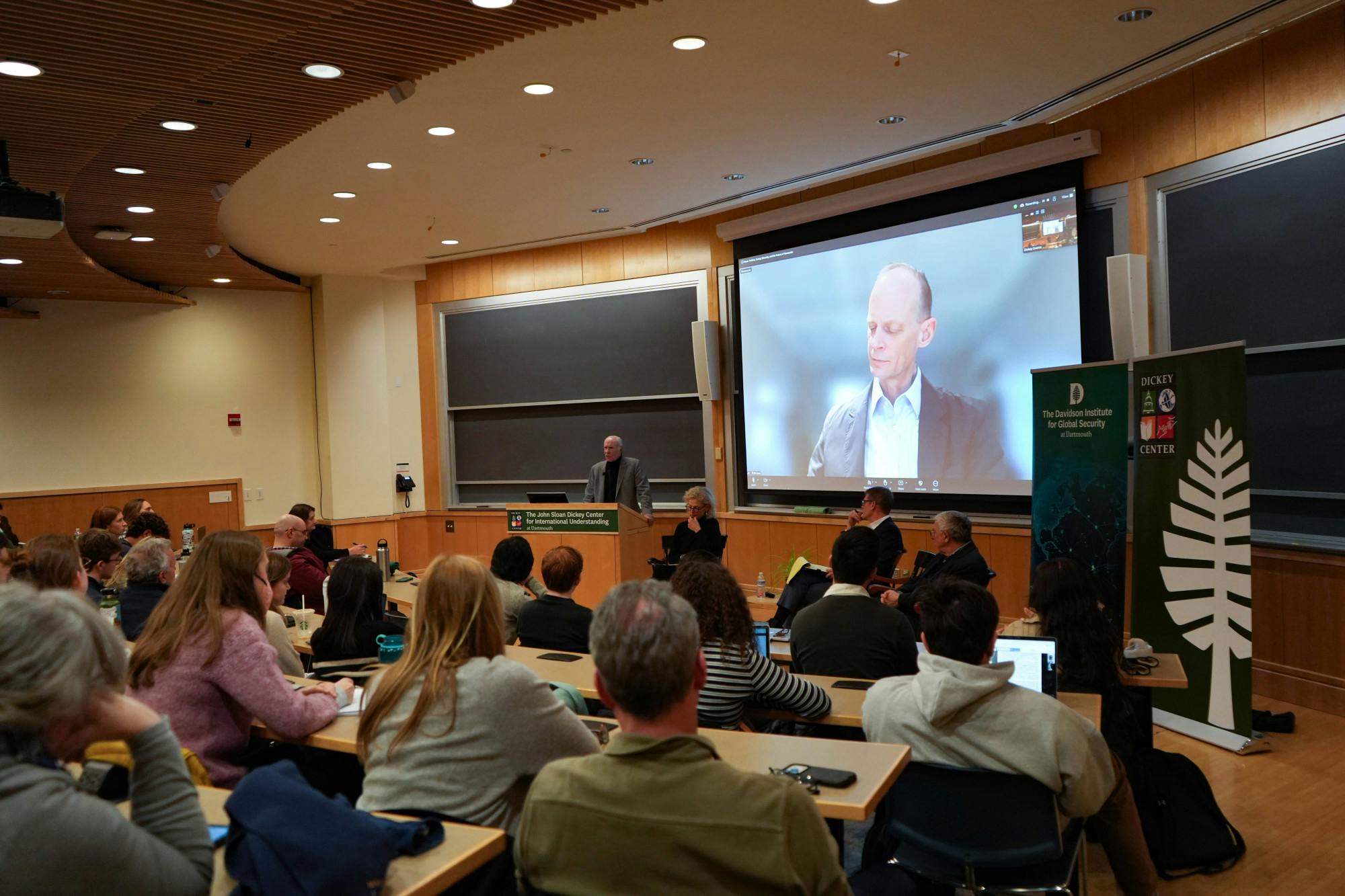
On Jan. 20, following an American military operation that captured Venezuelan president Nicolás Maduro, the Dickey Center for International Understanding hosted a talk on energy security and the “future of Venezuela.”
Approximately 60 people attended the panel in Haldeman Hall, which featured former ExxonMobil India CEO Bill Davis, Davidson Institute faculty director Daryl Press, Harris Program visiting professor Klaus-Dieter Barbknecht and Latin American, Latino and Caribbean studies professor Peter DeShazo ’69.
Earlier this month, United States special forces captured Maduro following months of bombing alleged drug transportation boats. Maduro was brought to New York City on narco-terrorism charges. In a press conference, President Donald Trump cited the Monroe Doctrine — named after the fifth president — to justify the intervention.
Press began the event by explaining how the Monroe Doctrine — a 19th-century U.S. foreign policy position asserting American hegemony over the Western hemisphere — has been a “foundation of U.S. strategic thought” throughout the country’s history.
“Thinking about the proxy wars that the United States fought against pro-communist or pro-Soviet guerrillas. [The Venezuela operation] was all about trying to preserve U.S. sanctuary in the Western Hemisphere,” Press said.
Aside from geopolitics, Davis said that another reason for the intervention was that Venezuela has the “world’s largest oil reserves,” which he said influenced American companies to see if there is “opportunity” for them in that market.
“The ultimate rationale for this intervention has been a shifting one, but one consistent theme coming out of Washington has been an insistence on something called ‘energy security,’” Davis said.
Davis noted that Venezuela holds over 300 million barrels of oil reserves. He added, however, that companies investing in Venezuela faced both financial and political risks.
“A lot of capital investments need to continue to be made in this business, [and] it just hasn't happened,” Davis said. “And then there’s the idea of rule of law … Venezuela has not been set up to host international companies in a big way for a long time.”
DeShazo agreed, adding that it is “unclear” whether American companies’ efforts to invest in Venezuela’s energy sector will be successful.
“The United States has important leverage, but the [Venezuelan] regime is still in power,” DeShazo said. “It remains to be seen how the United States is going to somehow manage [Venezuela’s] oil sector.”
Press said that the intervention in Venezuela reflects a broader shift in U.S. foreign policy.
“I hate to say it, but my prediction is that that attitude of the United States will survive this current administration,” Press said. “It will play a powerful role in American foreign policy in future Democrat or Republican administrations.”
Charlotte Henes ’29, who said she attended the event because she is taking GOVT 5: “International Politics,” with Press, said the event was “really interesting.”
“We’ve been learning about theoretical concepts in class, and we’ve discussed a little bit about how they can apply to current events,” Henes said. “I was definitely making a lot of connections in my head.”
Henes added that it was “really interesting” to “hear directly about current events” and make “connections” with class material.
Kathryn Chou ’29, who is also taking GOVT 5 with Press, said the event was “super interesting.”
“I enjoyed it and learned a lot,” Chou said.
Madeline Kahn Ehrlich '29 is a reporter from upstate New York. She is considering studying English and Public Policy. She enjoys creative writing, art and reading historical fiction.


