
Three Evergreen study participants were granted anonymity to speak candidly about their experiences. They have been given the pseudonyms Evan, James and Matt.
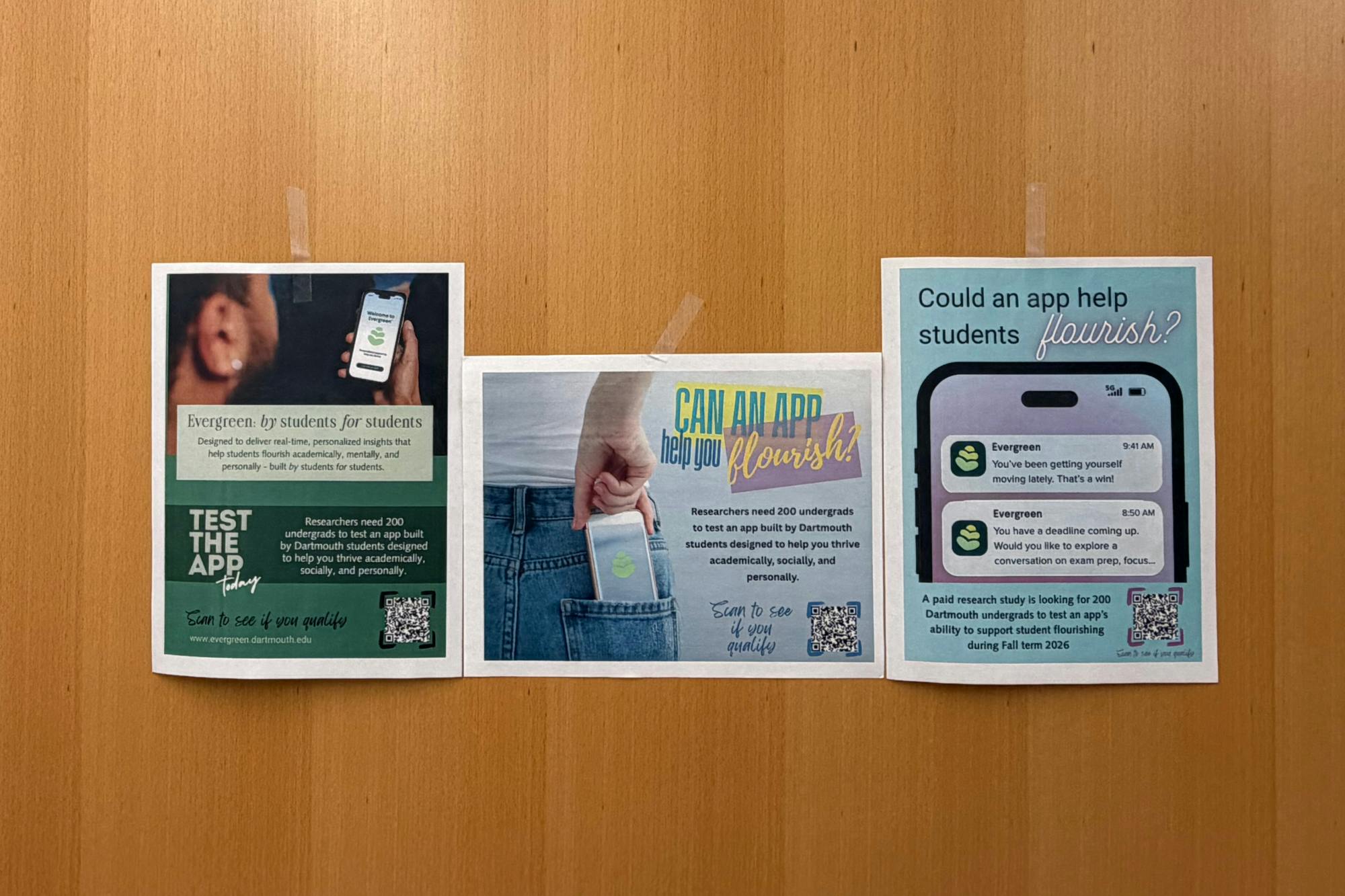
Evergreen, the campus wellness artificial intelligence project developed by Dartmouth professors and students, has recruited 200 undergraduate students for a fall term research study, according to an email statement to The Dartmouth from Geisel School of Medicine psychiatry professor and Evergreen founding director and project lead Lisa Marsch. The study aims to “understand the usability, reliability and engagement of the Evergreen app,” according to a copy of the study’s participant consent form obtained and reviewed by The Dartmouth.
Evergreen, first announced in October 2025 by Dartmouth News, is a “personalized digital platform for student flourishing,” built on “student-built generative AI,” according to its website.
The Evergreen app, which student participants are testing, uses a “structured chatbot” with “pre-written” messages, according to Marsch. The Evergreen staff plans to initiate a separate trial in 2027 for a version of the app that includes an “in-house generative AI-based interface” for students to interact with, she added. Evergreen will not use a “commercial AI product like Claude” to operate the chatbot, so the Evergreen team will have “control” over the system’s behavior, what it learns and what it is optimized for.
Participants are paid $300 over the course of the study, which lasts through fall term, in three installments. They receive $75 after onboarding, $50 after completing midpoint surveys and $125 following an interview and post-study survey, according to the participant consent form. Midpoint surveys will be sent out to participants “halfway to finals and then another around/after finals,” according to an email sent to participants obtained and reviewed by The Dartmouth. Participants may receive “a small additional incentive,” in the form of a raffle drawing, for referring friends to the study, according to the consent form.
Evergreen’s website lists a fundraising goal of $16.5 million to “fully implement” Evergreen at Dartmouth: $7.5 million to fund the “two-year initial launch period,” planned for 2025 to 2027, and an additional $9 million to finish the app and to “disseminate beyond Dartmouth.” The project has raised $5 million as of November 2025 entirely from private donors.
This trial, which is expected to finish by the end of the fall term, follows a “usability study” with around 10 to 15 participants conducted in summer 2026 which “indicated that Evergreen provided valuable assistance in areas such as disrupting unwanted doomscrolling, making real-world social connections and time management,” according to Marsch.
The fall study compares an experimental group’s and a control group’s “flourishing,” which the consent form defines as a “holistic state of well-being where a student thrives across multiple dimensions of life.”
The experimental “intervention group” uses the Evergreen app and a smartwatch, such as the Apple Watch SE 3, provided by Evergreen for the duration of the study. Together these track and provide notifications about Canvas assignments, Dartmouth Dining entry and purchases, sleep patterns, location, physical activity, phone calls and text messages, light exposure, heart rate, calendar and DartHub data.

Providing Dartmouth-specific and biometric data are optional for participants. If a participant opts out, “the app can function, though perhaps less well” without the data, according to the consent form.
Participants’ data is not and will not be shared with the College administration or to third parties at any time, Marsch wrote. The consent form states that any participants’ data will be “stripped of personal identifiers” and “may be used for future research.”
“Any information or data you turn on or use in Evergreen will remain with Evergreen to help developers build the next version,” the consent form explains.
The use of the data for possible future research will be reviewed by the College’s Committee for the Protection of Human Subjects to determine if the use of the data may “properly” be done without permission from the participants, according to the consent form.
The “control group,” which does not use the Evergreen app or an Apple Watch, instead receives a self-paced “flourishing guide” to be read and used on the participant’s own schedule. Marsch declined to provide the flourishing guide or other study materials to The Dartmouth to “ensure the trial’s integrity.” The control group self-reports levels of “flourishing” based on their experience with the guide.
All of the student participants interviewed for this article were members of the “intervention” group. Evan, who has already downloaded and familiarized himself with the Evergreen app, said his obligations as a participant are “pretty chill.”
“If it sends me a notification, I’ll look at whatever it is,” he said. “Because I’m part of the study, I’ll try to do it once a day. If I do, it’s only like a couple minutes.”
Though Evan has the Evergreen app, he said he is “not sure” how to use it, adding that the Evergreen student employee who onboarded him “didn’t really tell me that much about what I was supposed to do.”
“I have the app, and sometimes I look at it … and there’s some stuff that’s kind of interesting,” he said. “And sometimes it sends notifications, but it’s not that frequent.”
The notifications that the Evergreen app sends Evan vary. The day of his interview with The Dartmouth, he had gotten a notification about a panel hosted by the Dartmouth Undergraduate Research Association about student experiences doing off-term research. He said that the recommendations he has received from the app seemed to be “slightly tailored” to the interests he selected when he began using the app.
Though this version of the app does not allow study participants to input their own unique interests, there are pre-set options that they can choose from, including research. The future AI interface will “allow for more personalization,” according to Marsch.
“I told it I was interested in research in the start,” Evan said. “I feel like that might have impacted it, because it hasn’t told me about any other events.”

Evan has also received notifications from the app that he thinks may be related to his Canvas data. He said when he turned in an assignment late, he received a notification asking if he “wanted to talk about missing deadlines.” The app also sent Evan a notification with a video about how to set goals in response to him taking four courses this term, which he said he did not find “that helpful.”
According to Evan, some videos on the Evergreen app, including the one about his course load, are filmed on campus and feature students wearing Dartmouth-branded clothing.
“It’s Dartmouth students walking around Dartmouth and talking about certain stuff, so that’s kind of cool,” Evan said.
Marsch wrote that Evergreen’s designers, including 300 Dartmouth undergraduates working alongside Evergreen’s “experts in technology” have built a platform that “provides highly personalized support to help Dartmouth students make the most of college, from building healthier habits to finding campus events that match their interests.”
Evan’s impression of the study so far has been “fairly positive,” adding that he finds the app to be “quite well-made” and said it could be a useful way to manage College events once it is fully functional.
“There’s a lot of stuff going on,” he said. “It’s another way to get things tailored towards you.”
Noah Landefeld ’30 said he declined to participate in the study after the Evergreen team approached him in the lobby of the Class of 1953 Commons.
“I’m not really into using AI and I don’t feel like I would ever use AI for therapy topics,” Landefeld said. “I much prefer in-person communication.”
James, another participant who was interviewed by The Dartmouth, onboarded for the study the day of his interview. He said he had not been able to access the app yet because of difficulties with his device. However, he said he thought “the idea behind” the app was “good.”
James shared that while he was comfortable participating in the study, he understood that concerns about “privacy” could be a reason others chose not to participate.
“It does collect a good amount of information,” he said. “It knows what classes you’re taking, where they’re being held … maybe stuff you wouldn’t want some random people knowing.”
Matt said his experience with the app has been “surprisingly positive” and that becoming further
“connected” to the program and what Evergreen “is trying to achieve” through participation in the study has made him “feel more positive about it.”
“It seems that the people in charge of the program really care, and I think that the mission of the app is pretty valuable,” he said.


