
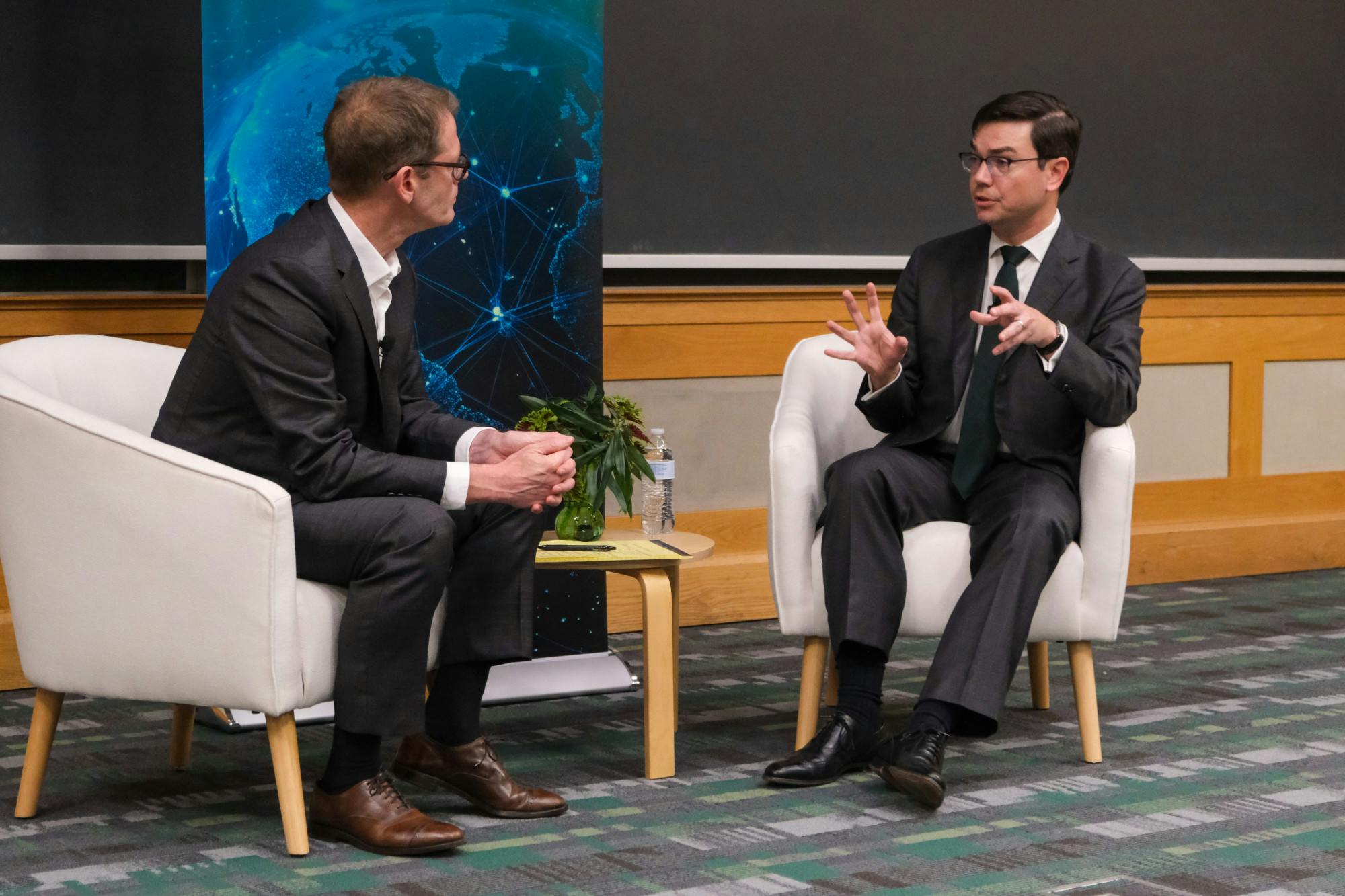
On Oct. 13, the Davidson Institute for Global Security hosted CIA deputy director Michael Ellis ’06 to discuss current intelligence issues and the impacts of artificial intelligence on global security.
Approximately 160 people attended the event, which was moderated by government professor and Davidson Institute faculty director Daryl Press.
President Donald Trump appointed Ellis to deputy director in February 2025. He previously served as general counsel for the National Security Agency from November 2020 to January 2021, before being placed on administrative leave when former President Joe Biden was inaugurated in January 2021. Ellis also served as senior director for intelligence programs at the National Security Council from March 2020 to January 2021 and in the White House Counsel’s Office during the first Trump administration, where he provided legal advice on national security and foreign relations, according to the CIA website.
Press opened the event by asking Ellis his opinion on current relations between the U.S. and China. Ellis reflected on former President George W. Bush’s goal of “enabling the peaceful rise of China,” which he said was “fundamentally misplaced.”
“It was born of good intentions, that as China grew economically, that it would also liberalize politically,” Ellis said. “It turned out that that was not the case. That was a misreading of the Chinese system to the detriment of the United States.”
Since the first Trump administration, Trump has changed the “language” that the Bush administration used by instead referring to China in a “competitive or adversarial way.”
“No one is under an illusion that China is going to become a member of a rules-based international order and is going to liberalize politically as a program,” Ellis said.
However, Ellis said that while there “might not be a cooperative arrangement” between the U.S. and China, the U.S. can “at the very least” ensure that “we have clear lines of communication and strategic stability” in emerging technologies such as artificial intelligence.
Press noted that the Trump administration has a less “dogmatic view” of the countries the U.S. does business with, observing that this administration has not set political liberalization as the “principal bar” for the U.S. to “be willing to work” with a foreign nation.
Ellis said Trump’s foreign policy differs from previous administrations because he realized that China was “fundamentally uninterested in political liberalization.”
“If China is going to abuse the rules of the international system, if China is going to engage in unfair trade practices, we need to stop being the only party that will play by the rules,” Ellis said.

Ellis also discussed AI’s impact on the geopolitical landscape of international conflict, highlighting the tool’s power to “automate things that would have been previously done manually” as a reason to consider it “super intelligence.”
“Tasks that would have taken people months or years to achieve could now be done in hours or days,” Ellis said. “But also [AI] achieves tasks that would have been impossible for any human to do, no matter how much time allotted to a team of humans. So that’s one of the reasons I think the term ‘super intelligence’ is more apt.”
Ellis added that many AI models are “very capable” of completing work that is normally done by cyber operators in the CIA. In April, Ellis announced the CIA’s publication of their first intelligence report entirely generated by AI.
“The same way law firm partners manage teams and associates, so too our intelligence officers are managing teams of superintelligent agents to do their work,” Ellis said. “Whether it’s planning out a clandestine operation, forming analysis or solving a hard engineering problem.”
However, the rise of AI can also create potential security risks, Ellis said.
“It requires us to more rapidly innovate, protect our own networks and work with the private sector to help defend private sector networks,” Ellis said.
During the event, attendee Dylan Unruh ’28 asked Ellis if the CIA is “concerned” about the tendencies of AI to be “sycophantic” or if CIA employees “under-index how much they allocate their reasoning to AI.”
AI at the CIA “supplements or enhances our work, it does not replace it,” Ellis replied. “The exact shape that will take will change over time, as these tools improve and as we find different ways to integrate them into our work.”
In an interview after the event, Unruh said he found Ellis’s response “pretty optimistic and a little naive” about the potential effects of using AI, “especially talking about how it is supplementary, that might not be true.”
Attendee Dhruv Gupta ’30 said he was “fascinated” to learn how the CIA conducts their operations from an “insider perspective.”
“I’d love to learn more about how the CIA plans to deal with certain criticisms or plans to deal with challenges in terms of AI,” Gupta said. “But I really liked his answer about how the CIA’s main goal is to discern those intentions and discern those goals that determine how states behave with each other.”
Kailyn Holty ’29 is a news reporter from Redwood City, Calif., and is majoring in economics and quantitative social science.


