
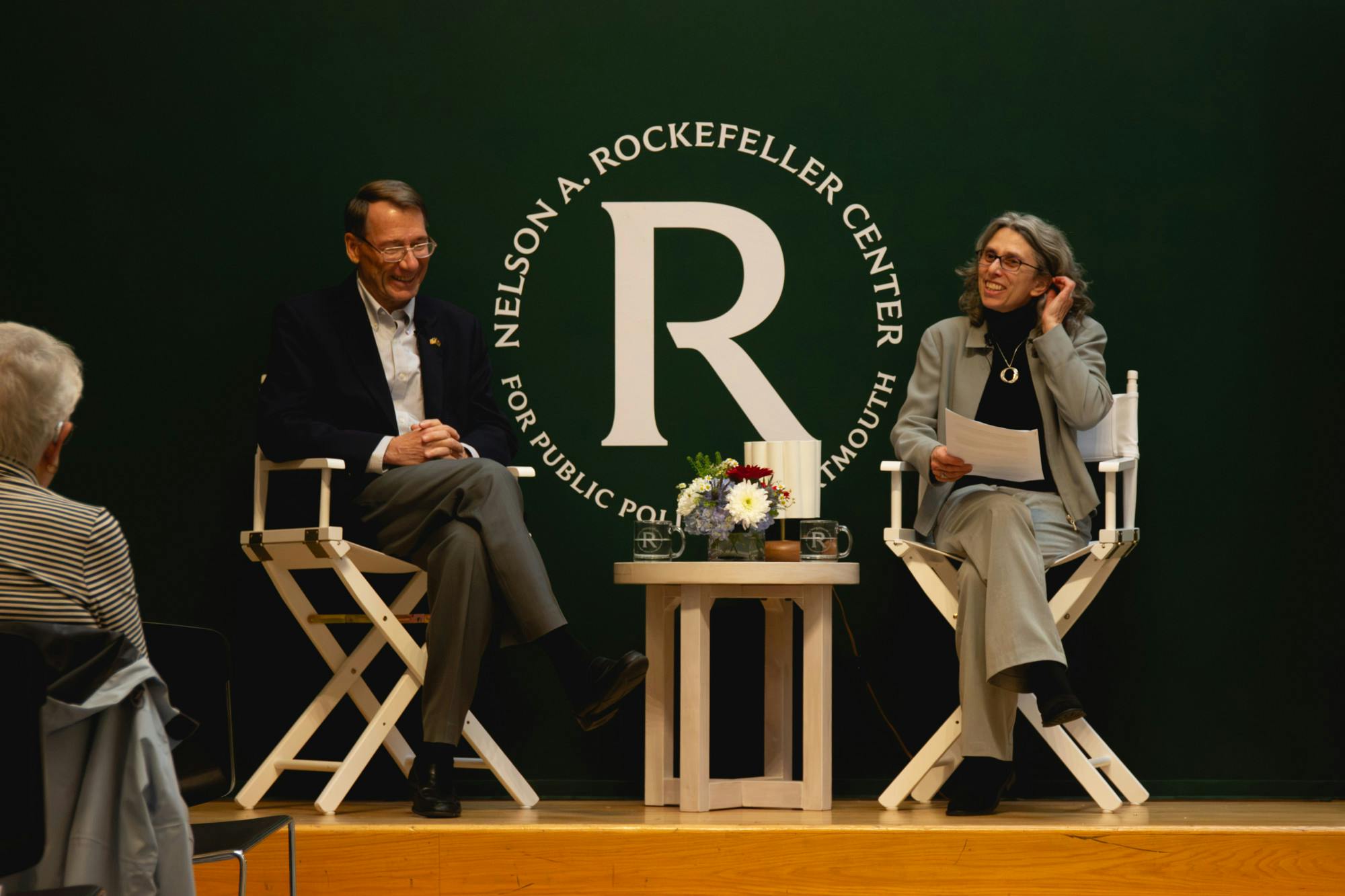
On Oct. 13, former New Hampshire Supreme Court justice James Bassett ’78 reflected on his career and hopes for the state’s judiciary at an event hosted by the Rockefeller Center for Public Policy.
Approximately 80 people attended the event in Hinman Forum and 23 watched a livestream recording, according to Rockefeller Center public officer for events and special programs Meg Hamilton. Policy Research Shop director and sociology professor Kristin Smith moderated the talk.
Bassett, who studied government at the College, worked for 27 years as a trial lawyer for Concord-based firm Orr & Reno before he was nominated to the New Hampshire Supreme Court in 2012.
As a trial lawyer, he represented WMUR in a 2002 case that won media companies the right to film in New Hampshire courtrooms. He went on to co-chair the N.H. Supreme Court’s Judiciary and the Media committee established in 2002 after his case, which now serves as an intermediary between the media and the judiciary to set policies guiding how the media interacts with New Hampshire courts.
During the event, Bassett said he “hopes” federal court reverses the White House ban on news media because the White House is a “public forum” where there “shouldn’t be viewpoint discrimination.” On Sept. 18, President Donald Trump banned CNN, MS NOW and Politico from the White House for coverage he found unfavorable.
A few hours after Bassett’s talk, a federal judge issued a preliminary injunction stating that the White House must allow the media companies.
On the state Supreme Court, Bassett ruled on major education funding cases. In July 2025, Bassett wrote for majority opinion in Contoocook Valley School District v. New Hampshire, ruling that the current amount of funding allocated to public schools was “unconstitutionally low.” The Court mandated that the state legislature raise and appropriate the “conservative minimum threshold” to $7,356 per student. It previously appropriated $4,266 per student in 2025.
In 2025, Bassett worked with students to evaluate New Hampshire’s Guardians ad litem pilot program, which appointed volunteers to advocate for a child’s best interest in legal proceedings through the Policy Research Shop, a Dartmouth program where Dartmouth students conduct research for Vermont and New Hampshire courts and legislators. Bassett presented their report to the legislature to fund the program.
“It’s been an enjoyable and mutually beneficial relationship” between the court and the Policy Research Shop, he said.
In 2016, Bassett began hiring Dartmouth students during their off-terms informally partially inspiring the Rockefeller Center Judicial Fellowship program. The program pairs undergraduates with Dartmouth alumni in the judiciary officially and began in 2025.
“I went to my colleagues at the court and said, ‘I’d like to have an undergraduate with me,’” he said. “They thought I was crazy. I didn’t know whether it would work or not, but I said, ‘Well, let me try,’ and it was a great experience.”
In response to gender “disparities” in lawyers arguing cases in front of his court, Bassett collected data from 2013 to 2025 for a report he is currently writing about the differences in the number of male and female attorneys arguing cases before the New Hampshire Supreme Court.
“There are things that I think courts and law firms and clients can do to encourage more participation by a more diverse set of lawyers, including more women,” he said. “It seemed important to start the dialogue since I had that information.”
Bassett retired at 69, one year before the state Supreme Court’s mandatory retirement age of 70. He said he thinks the limit needs “more flexibility” and that the “ability to have judges stay on” would be good for his trial court.
“There are issues related to the isolation of a position and being there for too long,” he said. “But I think trial judges are in a different place, and the advantages of having an experienced trial judge outweigh any negatives."
He said the “current political pressures to appoint people who are younger and younger” are “troubling” because it “results in this disconnect between the popular sentiments” and “who is on the court,” he added.
Daniel Mann ’30 said he attended the talk because he is “fascinated by” the Judicial Fellows program. He said he appreciated Bassett’s emphasis on the program’s “reciprocity — not only how much undergraduates could take away, but how much they could contribute to the Court.”
“It was inspiring to hear that not just law students, but Dartmouth students, like ourselves, can impact the state judiciary or the judiciary process in meaningful ways,” he said.
Elizabeth Ray ’27 is a news executive editor of The Dartmouth and a former Rockefeller Center judicial fellow.


