
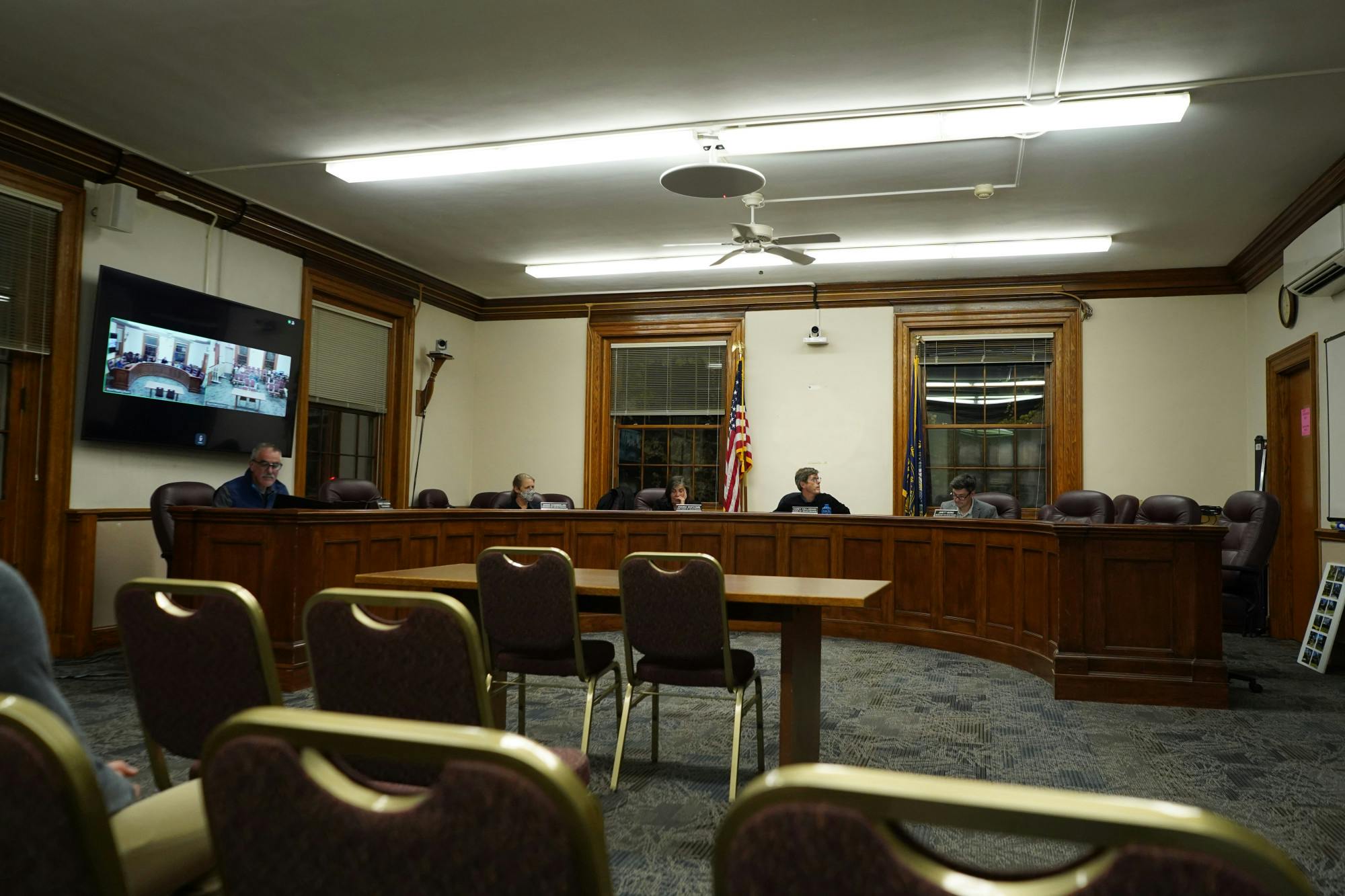
At the Hanover Selectboard’s Sept. 28 meeting, Hanover Department of Public Works director Peter Kulbacki gave a presentation on the department’s plans to modernize the town water treatment and wastewater network. The Selectboard also discussed the need for improvements to the town website to facilitate better communication between Dartmouth and the town.
The Department of Public Works began its Water Distribution Improvement Project on April 28, 2025, Kulbacki said in his presentation. The project aims to repair and replace aging water mains — the underground pipes which transport Hanover’s water — across 11 project areas, five of which are nearly completed, Kulbacki wrote in a follow-up email to The Dartmouth on Sept. 30.
Replacing old pipes will lead to a “more reliable” system, fewer pipe breaks, improved water quality and more “predictable” water utility rates for residents, Kulbakci wrote.
In June, when aging water main feed lines were repaired on East Wheelock Street, the Department of Public Works shut off the street’s water due to the age of the original pipe.
“You can’t just cross a 130-year-old pipe,” Kulbacki said in an interview with The Dartmouth, referring to the process of installing pipes that intersect water main lines. “You can’t support it because it has old, broken lead joints.”
The department also plans to upgrade Hanover’s water reclamation facility on Pine Knoll Drive, which treats wastewater. DPW signed a contract with Penta Corporation this summer to construct an additional aeration tank and upgrade the facility’s electrical and HVAC systems. Facility improvements are scheduled to be completed by Aug. 2, 2027, according to Kulbacki.
Kulbacki also recommended the Selectboard appropriate funds to replace the Cold Regions Research Center water pump station — which is managed by the town to move water from the Research Center south to the town’s water reclamation facility — in the fiscal year 2028 budget, which the town will vote on at the Town Business Meeting in May 2027. Kulbacki wrote to The Dartmouth that the latest estimate for the cost of the new pump and construction is $1.6 million.
During his presentation, Kulbacki warned the Selectboard that if water treatment capacity is not expanded, Hanover will need to find a way to reduce the amount of water in treatment systems. For optimal water safety and infrastructure durability, it is important to keep average daily water flow below 80% of treatment capacity — 1.8 million gallons-per-day — he explained. In 2024, Hanover’s daily water flow was approximately 54% of treatment capacity, Kulbacki said.
However, Kulbacki warned that water usage is likely to exceed 80% capacity by 2042, requiring the town to either limit water usage or build a new water treatment facility, which Kulbacki estimated would cost between $75 and $100 million. Hanover could also end its intermunicipal deal with Lebanon, N.H., that allows Lebanon to borrow 600,000 gallons-per-day or 25% of Hanover’s wastewater capacity. The agreement was reapproved for five years in June 2025, Kulbacki added.
Selectboard chair Carey Callaghan ’83 said ending this agreement would leave the neighboring city “in a precarious position,” forcing Lebanon to invest in new water mains and a large pump system to transfer the water to its treatment facility.
Kulbacki outlined multiple factors that will likely significantly increase Hanover’s water consumption by 2042, including 7% projected population growth in Hanover and College expansions such as potential redevelopment of the parcel of land north of Occom Pond, formerly known as the Hanover Country Club, and new undergraduate dorms.
College spokesperson Jana Barnello wrote in an email statement to The Dartmouth that there are “no active plans or projects underway to redevelop” the former golf course. Barnello added that the land is included in the 2020 campus masterplan, a “public, long-range planning document” developed by then-College President Phil Hanlon in collaboration with the town, which refers to Dewey Parking Lot and the golf course as the College’s “single largest opportunity for contiguous academic expansion.”
The College is “not in a position” to comment on Kulbacki’s projection that the former golf course redevelopment has a 70% likelihood of occurring by 2042, Barnello wrote.
In an email statement, Kulbacki wrote that his projection was “based on zoning, not any specific plans.”
“In 2022 there was a preliminary plan submitted to the [Hanover] Planning Board for a dorm near the intersection of Reservoir and Lyme Road, indicating there was at least a possibility that some redevelopment [of the golf course] could occur,” he wrote.
After Kulbacki’s presentation, the Selectboard discussed the importance of improving town communication systems. Selectboard member Jennie Chamberlain raised the issue during a discussion of the 2026-2027 Town of Hanover Selectboard Objectives & Key Results, a planning document which organizes the Selectboard’s priorities.
“We get a lot of complaints that it’s difficult to find information” on the website, Chamberlain said.
“I think the website is horrible,” Selectboard vice-chair Joanna Whitcomb added.
Callaghan also shared concerns about the website’s navigation features and overall efficacy, calling it a “work in progress” during the meeting.
The website redesign lacks a clear timeline, Chamberlain added. She and Callaghan suggested it could be a priority for the new assistant town manager position, which the Selectboard proposed creating at their meeting on Sept. 14, and the Selectboard tabled the issue for their meeting on Oct. 5.
In an interview with The Dartmouth after the meeting, Callaghan said while there are “a lot of points of contact” between Dartmouth and Hanover, there is “still room for more dialogue” about town governance. More effective online communication and outreach could allow members of the Dartmouth community to better engage with town government, Callaghan said.
The Selectboard meets every other Monday at 7 p.m. in Hanover Town Hall at 41 South Main Street. Meetings are open to the public.


