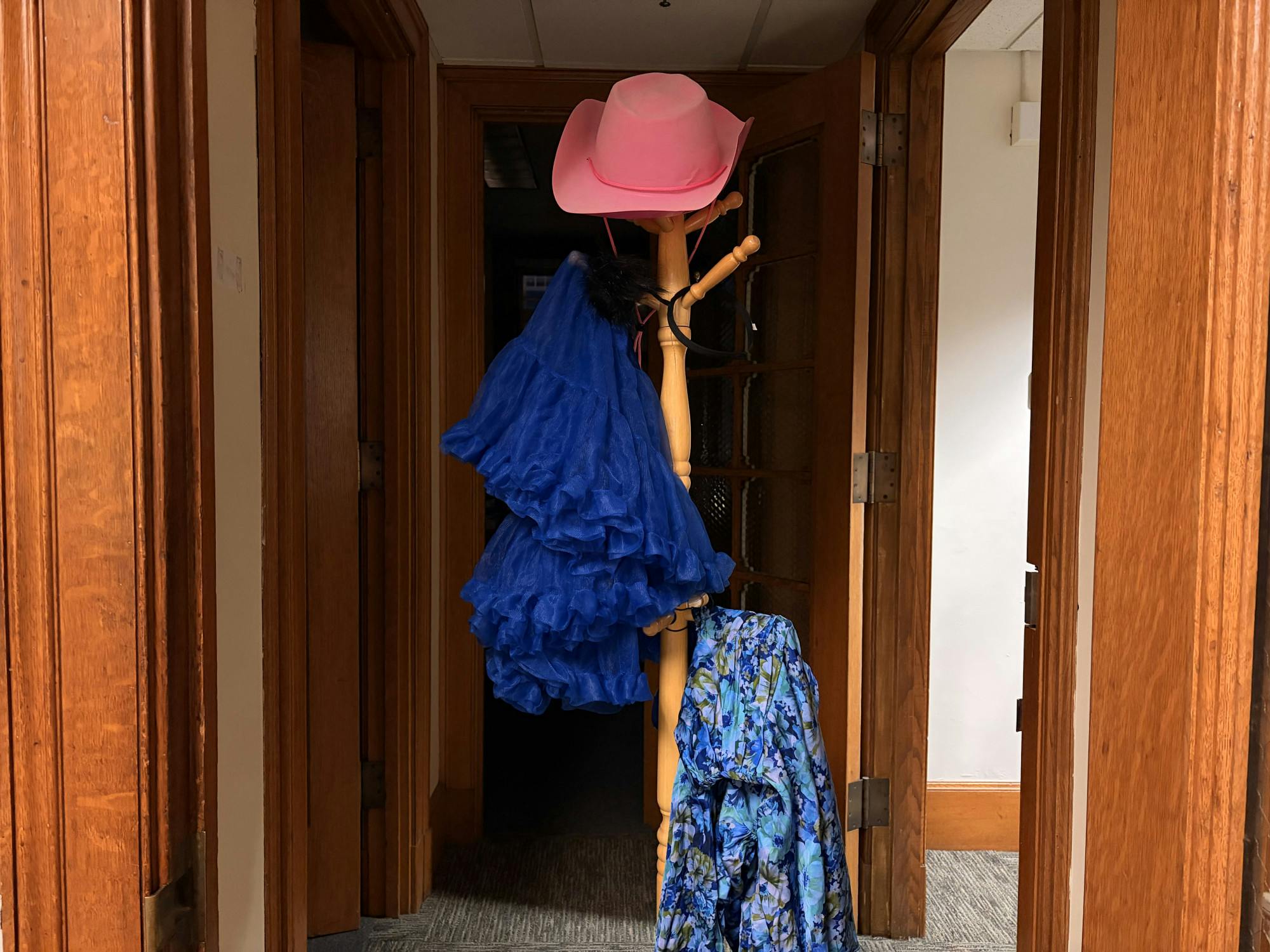
Wandering through Dartmouth, you may see a student in a bright pink tutu, a full-body raccoon onesie, retro ’80s jackets, overlapping patterns of stripes, polka dots and leopard prints, or any number of other “unusual” outfits.
Flair is not just a hallmark of the Dartmouth experience, but an embodiment of it. Dartmouth’s soul lives in the neon pants or Dr. Seuss hat that any number of students may enthusiastically pull from their wardrobe on any given day. And even before it was called “flair,” these silly outfits had been a Dartmouth tradition that students embraced wholeheartedly.
Dartmouth students have been wearing flair since at least the 1970s, when it first became a fixture in Greek houses and clubs, according to Rauner Library Edward Connery Latham ’51 Special Collections fellow Sonia Meytin ’26.
“The earliest thing that one would consider nowadays as flair that I could find was in the 1977 composite of Alpha Theta, a gender inclusive Greek house, in which the social chair wears a kind of 1950s straw boater and silly bow tie outfit,” Meytin said, who looked through Rauner’s archives for the history of flair for The Dartmouth.
Pointing to house composites and yearbook photos, they explained that “a couple years after” the initial alpha theta photos, members of Bones Gate fraternity were photographed wearing a cow onesie and alien outfits.
However, the phrase “flair” wasn’t officially used at Dartmouth until the 1999 release of the film “Office Space.” In the movie, waitress Joanna (Jennifer Aniston) is required by her boss to wear a vest covered in pins and buttons — what he calls “the flair” — as part of her work uniform.
Meytin compared the film’s popularity to that of “Mean Girls” today.
“So the same way people reference Gretchen from ‘Mean Girls’ by calling things ‘fetch,’ people would reference that scene in the movie by calling silly clothing ‘flair,’” they said.
Dartmouth’s isolated and rural location uniquely facilitates the popularization of slang vocabulary, they explained. Flair was “just another manifestation of that.”
The tradition of flair is perhaps nowhere more visible than on First-Year Trips. Brian Kunz ’00, who oversaw First-Year Trips from the fall of 2000 to the fall of 2018, recalled that flair was first incorporated into trips by the Lodge Croo, which is based at Moosilauke Ravine Lodge, during the late 80s or 90s. By dressing up in crazy outfits, the Lodge Croo hoped to show new students that they did not need to worry about how they were perceived by their peers because the upperclassmen were wearing such silly outfits, Kunz explained.
Then, in the 1990s, members of Hanover Croo — often abbreviated as H-Croo — decided they would wear flair as well to join in the “dramatics” and “fun” of dressing up, Kunz said. And when Vox Croo was created in 2005 to help trippees that may be sick or injured on trips, members also began wearing flair, even when delivering sick trippees to clinics or hospitals.
Hair dye was, and continues to be, a prominent part of flair, Kunz said.
“Everybody wanted to change their hair color, and they wanted everybody to do it at once,” he said.
Over time, the tradition has shifted to accommodate people who did not want to dye their hair. Practices such as donning colorful wigs instead created an inclusive alternative.
Nowadays, both options are still large parts of Dartmouth flair culture. Outdoor Programs Office director Katie Colleran said the Outdoor Programming team has “a box of wigs … and whatever the heck else they’re trying to put together for their outfits” for Trips and buys hair dye for students who want it.
Not all Trips customs have stayed, though.
A former tradition, practiced until 2004, embodied the complete opposite of wearing flair — in fact, it consisted of wearing nothing at all. Instead of wearing as many crazy accessories and outfits as you can, students used to wear no clothes at points, incorporating “a lot of nudity” into Trips, according to Kunz.
As biking trips approached the Lodge, for example, trip leaders would “convince everybody to take their clothes off and bike that last bit,” Kunz said.
The tradition ended because professionals across campus brought up the possibility of being pressured into nudity, triggering students with a history of sexual abuse, Kunz said. Popularizing flair promoted an alternative and more inclusive way of teaching newcomers to embrace the uniqueness of Dartmouth, he explained.
Today, flair can be seen all over campus during Orientation week. As first-year and transfer students unpack and prepare to sent off on hikes, mountain biking or a range of other trips, there is never an absence of upperclassmen in flair wandering around to greet and guide them.
“Once directorate week starts, which is like the week-ish before trips, you literally don’t see anyone ever not wearing flair,” Jaya Miller ’28, who was the outdoor logistics coordinator for First-Year Trips this year, said.
Wearing flair creates a “really nice vibe” so that the freshmen know that “we are here to have fun,” she added.
Besides Trips, flair has come up more in her Dartmouth experience than she expected, Miller said. “People use any excuse to wear it” during the year, like when welcoming new members to clubs or during performances.
This year’s Sunapee Croo captain Nathan Hill ’27 said he enjoys the tradition of passing down flair from graduating seniors to underclassmen.
“I think that kind of helps create a culture that’s passed down by making people excited about certain things,” he said. “I think it’s a big part of the culture that makes people feel more okay being expressive.”
Kappa Delta Epsilon alumni chair Avery Kalafatas ’27 said flair has existed in KDE since the sorority was founded in 1993, when house members began to hold “Tackiez meetings,” dressing up in “sort of funky, flair-like outfits that they thought were tacky. And then, as the sorority got bigger and time went on, [flair-wearing] eventually sort of seeped into other events.”
Most notably, flair is the dress code for KDE’s termly Tackiez event, which is a party where the KDE hosts and attendees dress up in flair.
“It’s a good way for people to bond if they’re wearing funny things, and I don’t know, just have a little more fun than they do in their typical day to day,” Kalafatas said.
Madeline Kahn Ehrlich '29 is a reporter from upstate New York. She is considering studying English and Public Policy. She enjoys creative writing, art and reading historical fiction.