
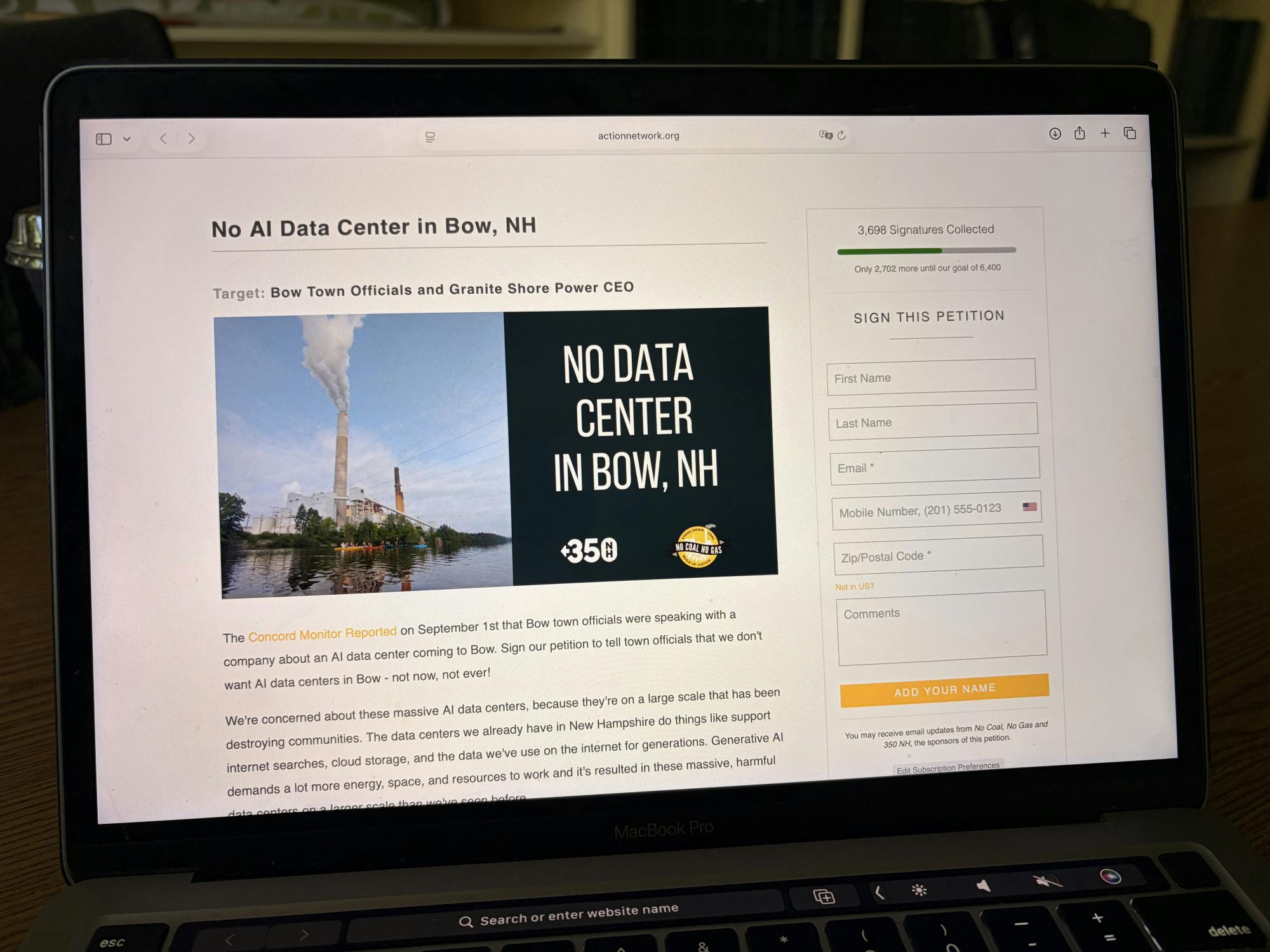
Early-stage plans to build a hyperscale data center in Bow, N.H. have drawn opposition from residents and intensified debate among state politicians over how to handle the costs of artificial intelligence.
Over 100 people gathered outside of a selectboard meeting in Bow, N.H., on Sept. 22 to rally against the plans to build an artificial intelligence data center at Merrimack Station, a former coal plant, according to Kendra Ford, an organizer of the protest with the climate justice campaign No Coal No Gas. In May, a separate application for the approval to construct a data center in Nottingham, N.H., was withdrawn due to backlash.
State senate president Sharon Carson, R-Londonderry, and Gov. Kelly Ayotte announced in the past month that Republicans would pursue moratoriums on data center construction.
On Aug. 20, during a meeting at the Rotary Club of Portsmouth, Ayotte said New Hampshire is “not the appropriate location” for a data center. The position marks a sharp turn from her position in August 2025, when she signed off on a bill deregulating energy providers who do not use the public power grid, allowing them to develop energy projects without New Hampshire Public Utilities oversight.
“It does not make sense at all to site a data center in New Hampshire,” she said at the meeting. “We don’t have the energy for it.”
Ayotte’s office did not respond to multiple requests for comment on a timeline for the moratorium.
In a Sept. 17 press release, Carson wrote that state Senate Republicans “agree with Gov. Ayotte” on banning data center construction.
“Senate Republicans will pursue legislation to protect New Hampshire taxpayers from shouldering the costly demands of data center development and ensure our communities are not left to pay the price,” the press release read. Carson did not provide a timeline for legislative action in the press release.
Seven Republican senators and representatives did not respond to multiple requests for comment; two declined to comment. Another two were absent for scheduled interviews and declined to follow up at a later date.
Residents first raised concerns about a large-scale data center in Bow after New Hampshire consumer advocate Don Kreis posted on X on Aug. 31 that during a meeting with Eversource — New England’s largest energy delivery company — one of the company’s officials mentioned conversations with a developer about a potential 200-megawatt data center in Bow.
New Hampshire currently has no hyperscale data centers. Instead, the state has 24 small operational data centers that total 14.5-megawatts in power, according to the U.S. Data Center Map.
Hyperscale data centers can “stress” local power grids, according to Thayer School of Engineering professor Anthony Rizzo.
“If you’re not building more power plants … then you’re going to be siphoning power that would go elsewhere, and that can cause problems,” he said. “Part of the problem with building data centers is then also building power plants to power them.”
In April, Granite Shore Power, which owns Merrimack Station, filed a request with the U.S. Federal Energy Regulatory Commission to begin preliminary studies with Eversource on the possibility of connecting to the power grid to construct a hyperscale, 350-megawatt project.
Bow Selectboard chair Kip McDaniel said at the board’s Sept. 29 meeting that Bow has not since communicated with Granite Shore Power on the subject, or received a project application.
Bow resident Kevin McManus, who attended the Sept. 22 protest and said he lives less than a mile from Merrimack Station, said he is “concerned” about a center causing noise pollution, consuming utilities and harming the riverfront.
“Assuming they [the town] taxed them for the full value of this thing, it would be a huge decrease in our tax bills,” he said. “But I don’t care.”
No Coal No Gas, which is run by climate justice and renewable energy movement 350 New Hampshire, coordinated the Sept. 22 rally to demonstrate to local officials that “the people don’t want it,” Ford explained in an interview with The Dartmouth.
“We will make sure that there are several people from Bow and folks from other towns at every planning board and zoning board meeting for the foreseeable future until we hear that there is not going to be a data center,” she said.
She added that the residents are concerned about a potential data center’s noise pollution and damage to the nearby river.
An Eversource spokesperson wrote in a statement to The Dartmouth that the company is “obligated” to answer proposals from developers and evaluate whether projects would be able to connect to their grid.
“We have no role in determining whether potential projects are allowed to interconnect to our system if developers are willing to incur specific associated costs — including for studies, assessments and necessary infrastructure upgrades — and if those projects receive required local, state and federal approvals in the future,” they wrote.
Some economics and energy experts said the costs of the project would depend heavily on how it is structured.
Kreis said in an interview with The Dartmouth that data center development “could be a win-win” financially for “all electric customers in the state” by lowering rates.
“I think it is at least theoretically possible to design rates and terms of service that would make data centers a net benefit to all of the state’s electric customers,” he said. “If we put a data center online and require it to curtail its use of electricity from the grid at certain peak hours, and basically manage consumption, that could reduce costs for everybody, because the data center would pay a big share of the utility’s [Eversource] fixed costs.”
Thayer School of Engineering associate professor Junbo Zhao, who researches energy grids, said data centers “could” provide economic growth opportunities for the state.
“This will be billions of dollars of investment to the local community,” he said. “Good for the state, good for the community, in terms of economic benefits … If they are still trying to squeeze any power from the existing systems, that will increase our electricity bill. That’s something we don’t want to see.”
State representative Hope Damon, D-Sullivan, said Republicans went “180 degrees” in proposing a moratorium on data centers.
Earlier this year, Damon and state senator Debra Altschiller, D-Stratham, co-sponsored S.B. 439 to give local authorities “control” and permission to regulate data center development, Damon said. The bill did not make it out of the legislative session.
Before the bill was tabled, Carson voted for an amendment to the bill that classified data centers as “permitted uses by right” in commercial or industrial zones, meaning they would be subject to the same ordinances, regulations and requirements as other construction projects.
Altschiller added that she believes the data center issue has “become much more bipartisan” for voters since Kreis’ announcement on X.
“It doesn’t matter if you’re a Republican or a Democrat when your water cable runs dry because you’ve allowed for the unfettered development of AI data centers,” she said. “You’re still thirsty and you still have no water.”
Though Damon agreed a moratorium would be “great,” she emphasized that it’s “not action,” and is instead a “concept.”
“Other than public protest, there is nothing to stop the data center being built in New Hampshire,” she said. “If the governor truly values a moratorium on data centers, she should be doing an executive order right now.”
Seacoast Anti-Pollution League executive director Doug Bogen expressed similar sentiments.
Ayotte issuing an executive order “is what ought to be done if they really care about it,” Bogen said. “It takes a long time to get things through the legislature and enacted … whereas they [Ayotte] could do an executive order now.”
Government professor Brendan Nyhan said data centers “might be an uncomfortable issue” for Republicans across the country in the upcoming midterm election.
“Republicans typically have been less supportive of government regulations, so allowing private businesses to build facilities that would promote economic growth is a standard Republican position,” he explained. “The opposition to data centers cuts against that awkwardly. It may just be that those kinds of cross pressures are uncomfortable for politicians.”
When asked why politicians may have changed their views on the issue, Kreis said that data centers and AI are “salient” political issues.
“Candidates across a political spectrum, and both major political parties are, reasonably enough, thinking about what the political implications of these issues are, because they know they’re on voters’ minds as they go to the polling place,” he explained.
Nyhan added that politicians across the country? have been “scrambling to change their views” as the issue has gained prominence.
“It’s getting the attention of politicians in a way that’s quite unexpected,” he said. “I don’t think anyone thought a local permitting issue would have this kind of salience to voters, but so far, at least, it seems to.”
Rizzo expressed similar skepticism towards possible development.
“The question needs to be: do we really need all of these data centers?” Rizzo asked. “What is it actually going to be doing for society?”
McDaniel declined to respond to request for comment. Granite Shore Power Station did not respond to request for comment.
Kay Alvito ’29 is a news reporter from Rio de Janeiro, Brazil studying comparative literature and creative writing. On campus, she is very involved with the arts as a member of the Rude Mechanicals classical theatre company and the dance group Street Soul.


