This article is featured in the 2026 Freshman Special Issue.
The Twilight Ceremony is a beloved first-year tradition that marks the end of Orientation Week and welcomes the incoming class to Dartmouth. Many look back fondly at their own candle-lighting experience — passing a flame around to their newfound classmates before proceeding to the Bema for a final ceremony. The night concludes with the singing of “Dear Old Dartmouth,” the alma mater, and as students file away, there’s a sense of anticipation for what life at Dartmouth is about to become.
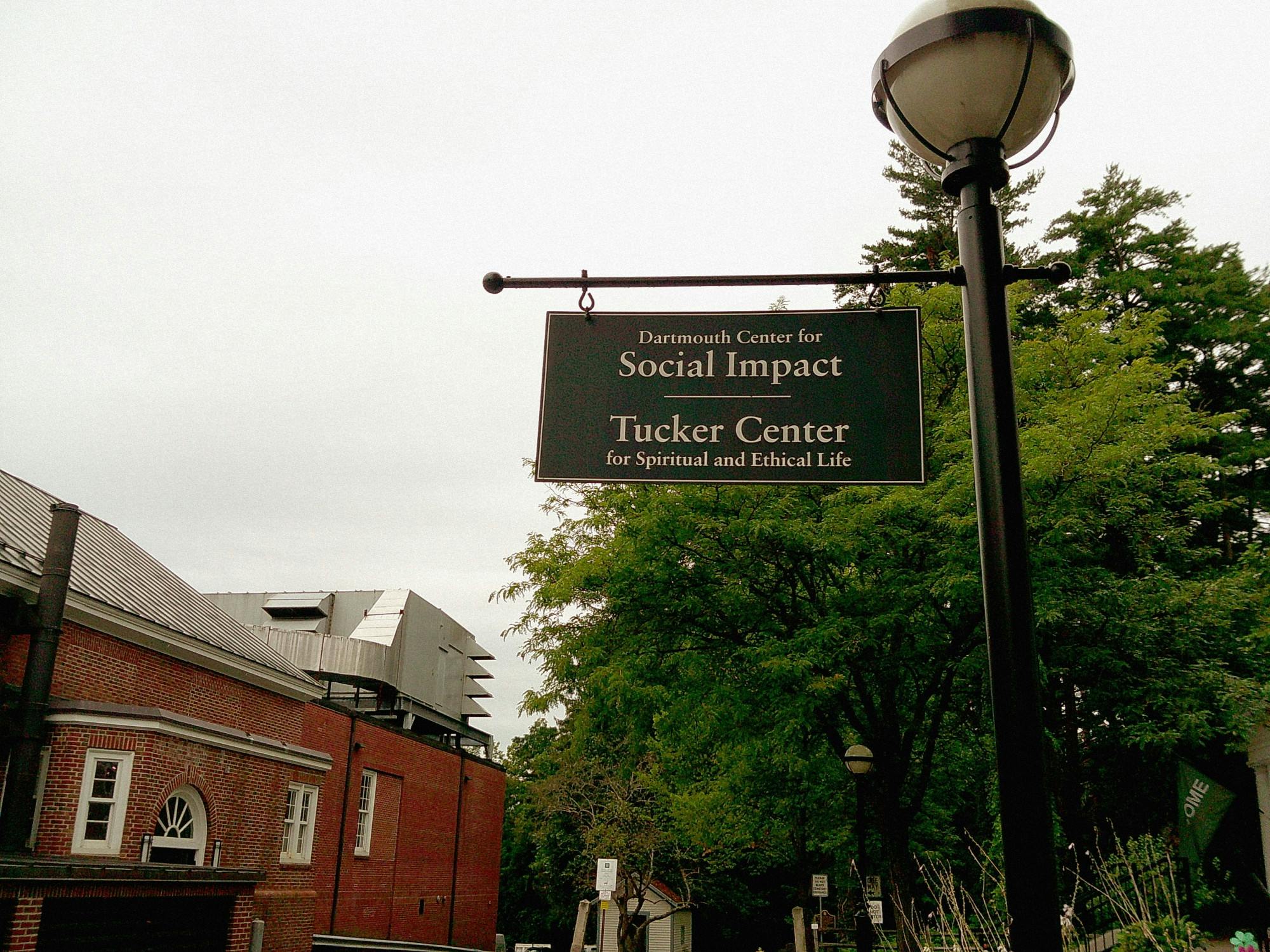
What many don’t realize is that this beloved tradition is led by the William Jewett Tucker Center, Dartmouth’s spiritual and religious hub. The gathering doubles as a first introduction to the center’s mission: uniting the community in reflection.
The Twilight Ceremony is just one small piece of what the Tucker Center offers. It also supports and recognizes 20 student religious groups: a Buddhist group, a Hindu group, a Sikh group, a Muslim group, two Jewish groups and 14 Christian groups, according to Reverend Nancy Vogele ’85.
Vogele, who serves as the center’s director and College chaplain, oversees religious life and student groups on campus and provides pastoral counseling as a private resource for Dartmouth community members.
Vogele described the role of the Tucker Center on campus as tied to a “great” quote by William Jewett Tucker, the center’s namesake and the ninth president of Dartmouth, in which he said, “Do not expect that you will make any lasting or strong impression on the world through intellectual power without the use of an equal amount of conscience and heart.” This quote has been the guiding principle for the Tucker Center, Vogele said.
“We try to help people develop that conscience in heart,” she explained. “For many students, it’s religious application, but for more and more students, they’re just looking for meaning and purpose.”
Vogele added that the center provides programming that “allows students to show up as their authentic selves.”
“You can’t do anything deep if you can’t show up as yourself, and that’s not an easy thing on this campus sometimes,” she said.
Tucker Center interfaith advisor Ryan Jenkins further echoed the importance of Tucker’s quote, which inspired the center to emphasize the center’s Conscience and Heart programming in 2022 to help “students take a pause, take a moment of reflection and one of connection,” Jenkins said.
Part of this programming includes Tune-In Tuesday, during which members of the Center hand out hot chocolate or lemonade outside Collis while asking passersby to reflect on a question of the week. On Finished the Week Fridays, Tucker Center staff members help community members celebrate finishing the week with a “giant sheet cake” on Friday afternoons.
Vogele said she “loves” Finished the Week Fridays because it is such a “low-barrier” activity to get involved with the Center.
“All we ask is that you try to show up as much as your authentic self as you can that day,” she said. “It’s a great way to end the week where you can just be you and find joy in other people being them.”
The Edgerton House Episcopal Campus Ministry prides itself on a similar sentiment of inclusion. Episcopal chaplain Reverend Guy Collins wrote in an email statement to The Dartmouth that their space is “open to all students: of all faiths and none.”
“We are an inclusive, welcoming community that prides itself on treating strangers as if they were Christ himself,” he added.
Nate Wayne ’28, a Tucker Center mission and strategy student fellow and active member of Hillel at Dartmouth — one of the College’s Jewish students’ organizations, based at the Roth Center for Jewish Life — said he works closely with Vogele to think about how the Tucker Center “positions itself and communicates its message to the campus community, which includes the Conscience and Heart programming.”
“This is all programming that we’ve developed recently and really is starting to make a path on campus in terms of how people are thinking about their life and where they fit in,” Wayne said.
Rabbi and executive director of Hillel at Dartmouth Seth Linfield wrote about the organization as a space “where Dartmouth's Jewish students come home and include their non-Jewish friends.”
Wayne first became involved with faith on campus as a freshman when he lived in the Interfaith Living Learning Community, a program organized by the Tucker Center.
“The LLC is designed for people of all different faiths to live together and engage with programming that involves their different identities,” Wayne said. “I had a lot of conversations about how identities intersect with faith and how faith plays a role in our lives.”
This exploration of faith and the presence of the Tucker Center can be especially important for first-year students. For many, it’s their first time being away from family and any religious traditions their parents were involved with. It can be students’ first time saying, “now I”m owning my faith. I’m making sense of it myself, and I'm figuring out how it’s meaningful in my life,” Vogele explained
Ashley Giron ’28, a member of Aquinas House, home to Dartmouth’s Catholic students’ organization, said campus religious groups, in her experience, allow students to “explore and take initiative in their own religious journey and faith.”
Aquinas House director and Catholic priest Timothy Danaher noted how the organization, inspired by Mother Teresa’s motto “Do something beautiful for God,” aims to create a space for students to come together.
“We try to be that for students, as a place to pray, cook or meet authentic friends,” he wrote in an email statement to The Dartmouth.
Jenkins added that individual autonomy is part of what makes the college experience of religion and spirituality so “unique.”
“All of a sudden, you start to develop your own ‘what do I want from religion and/or spirituality, if anything?’” Jenkins said. “I think that’s where the Tucker Center is such an important resource because as you’re asking these questions, the Tucker Center has no particular agenda to send you in any particular direction.”
Wayne echoed this sentiment.
“The Tucker Center is not trying to evangelize or pull you in closer to a faith because we are not an explicitly related organization,” Wayne said. “We are here to help others cultivate a deeper sense of meaning and purpose in their lives. If that’s religious, that’s great, but if it’s ethical or spiritual, that’s all wonderful too.”
Ultimately, the Tucker Center offers myriad possibilities to tap into your religious or spiritual side, in whichever way you choose, be it through Tucker programming or Tucker recognized student groups.
Vogele said many of these spaces become where students feel “seen, comforted, challenged and cherished.”
“I can’t tell you how many times students who were involved in any of these groups say ‘this was my home away from home,’” Vogele said.
Isabela Pierry '29 is a reporter from New York and is majoring in comparative literature and government.