Dartmouth reports on its Global Dartmouth website that over half of students participate in a study abroad program at least once during their undergraduate education, a figure that represents a point of institutional pride. But where does that number come from, and for how long has this claim circulated throughout these halls?
The assertion is not new, tracing as far back as a 1979 Dartmouth News Service release, which reported for the first time that nearly 60% of the graduating Class of 1980, composed of roughly 1,000 students, had studied abroad as a part of their academic studies at Dartmouth. The paper trail behind that number, and the decades of institutional change it represents, lies scattered across the boxes and files in the Rauner Special Collections Library.
The earliest mention of an organized study abroad program at Dartmouth appears in a May 1946 edition of The Dartmouth, which describes an already-ongoing “Foreign Study Plan” administered by the University of Delaware and open to students from other colleges in the East. Through this program, Dartmouth juniors were allowed to study abroad at a French school in Geneva, Switzerland. According to the article, Dartmouth had been participating in this plan for “a number of years.”
In 1958, Dartmouth established its Foreign Study Program to provide language majors with linguistic and cultural experience abroad, according to a 1967 edition of Dartmouth Alumni Magazine looking back on study abroads. The program was launched in partnership with the Experiment in International Living, a nonprofit organization dedicated to sending American students abroad, making Dartmouth the first Ivy League university to establish a foreign study plan of its own, according to a September 1982 edition of Dartmouth Alumni Magazine.
A 1959 brochure aimed at juniors majoring in French, German or Spanish described the structure of the experience for that fall: “After many years of experience with plans for an entire year’s residence abroad, Dartmouth has a distinct preference for the briefer but deeper experience it first provided in 1958,” the brochure explained, adding that towns were chosen for their “good educational facilities” and their distance from the capital cities where American students tended to cluster. Students able to do so were strongly encouraged to spend the preceding summer abroad as well.
According to Frank J. Guarini Institute for International Education executive director Megan Wood, “off-campus programs really took flight in the 1950s” under then-College President John Sloan Dickey.
That early momentum followed the College’s shift to a trimester system and accelerated further in the 1970s, when coeducation forced Dartmouth to grow its class size “without decreasing the number of men admitted,” a problem the College answered by instituting the year-round “D-Plan,” Wood added.
By the mid-1960s, the program began to change shape again, according to a feature in the September 1982 edition of Dartmouth Alumni Magazine. In 1978, oversight of foreign study programs was passed to former French and Italian professor John Rassias, who taught at Dartmouth from 1965 until he died in 2015. In the following year, Rassias and his colleagues built an introductory track for language programs called the Language Study Abroad, which paired a term of intensive “drill” work in Hanover with a term of linguistic immersion overseas. Whereas the FSP required advanced coursework and tended to draw juniors and seniors, the LSA opened the door to studying abroad to first- and second-year students.
Offering both LSAs and FSPs proved to be a major success. By the 1982-83 academic year, nearly a fifth of the undergraduate student body — 789 students — would spend some part of that year abroad. Over four hundred of those participated in an LSA.
Jim Citron ’86, now a faculty member in the Department of Spanish and Portuguese, encountered early iterations of Dartmouth’s study abroad model as an undergraduate himself.
“My first week on campus, I went to the open house, and one of the professors started talking to me about the study abroad experiences in Spain … and that hooked me,” he explained. “By my sophomore fall, I was in Salamanca on the Dartmouth FSP, and when I came back, I decided I wanted to be a psychology modified with Spanish major.”
Following his FSP experience, Citron soon realized that he could complete the rest of his language coursework by going abroad again, this time in Mexico. He spent his junior winter on the FSP in Puebla. That spring, the professor leading the LSA in “a different part of Mexico” called Citron’s professor with whom he studied abroad in Puebla asking for a recommendation for a teaching assistant, which led to Citron staying in Mexico for another term.
“I did three terms over my four [undergraduate] years in other countries, while I was a student,” Citron recalled. “From there, I was just very interested in study abroads in general.”
That interest eventually became a career. Citron went on to lead study abroad programs of his own “mostly in Mexico” for high school students studying Spanish, along with summer programs for the Experiment in International Living, before pursuing a doctorate in educational linguistics. His dissertation would challenge one of the field’s oldest assumptions about whether immersion was being achieved by study abroad programs in foreign countries, or if they were having an experience too shaped by their program peers to actually learn the new culture.
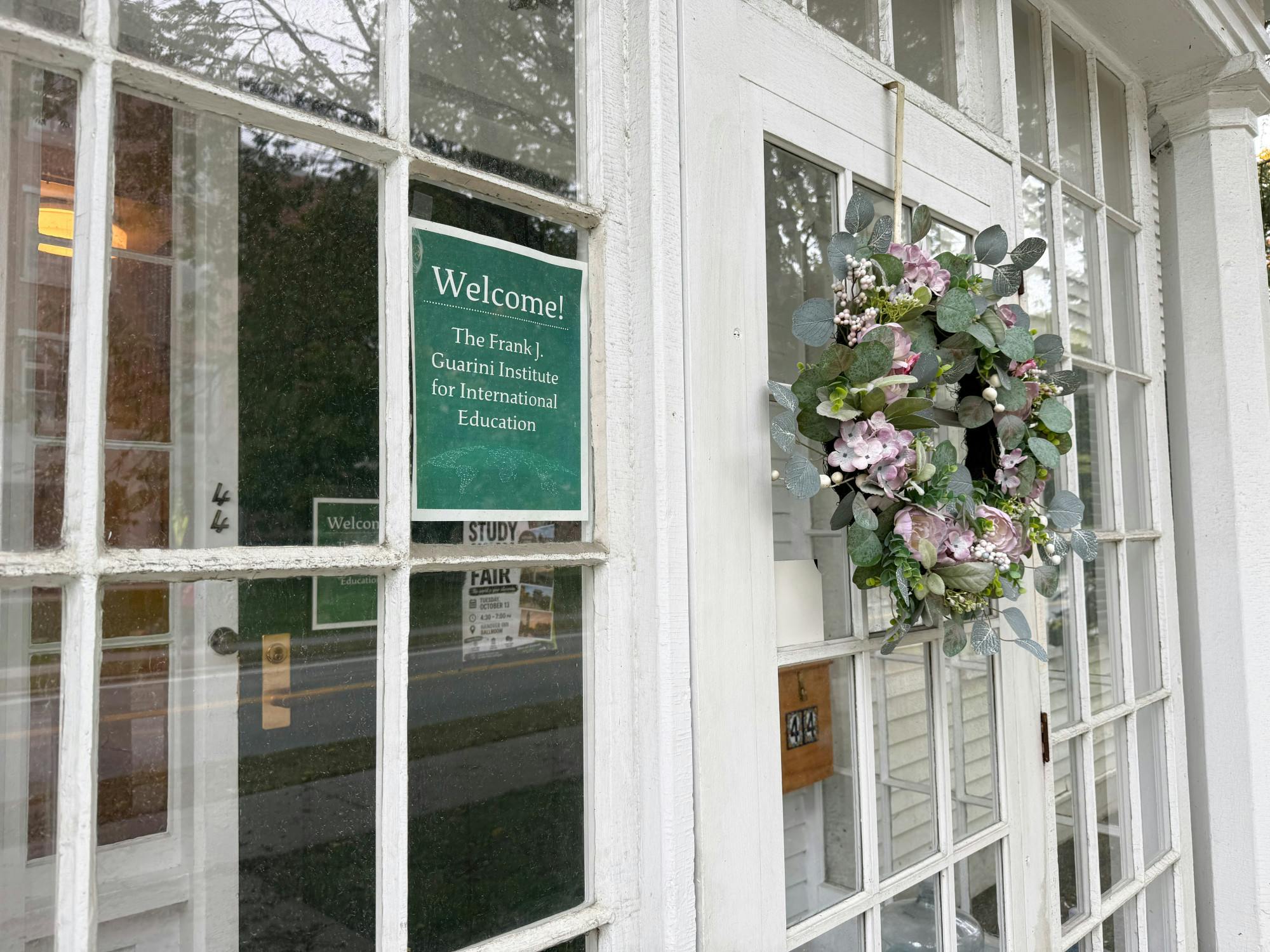
Meanwhile, Dartmouth’s own approach to supporting study abroad experiences was also evolving, largely due to a $10 million gift from Frank Joseph Guarini in 2013, according to Wood. The office overseeing off-campus programs took on Guarini’s name and a new scale, giving the institute the opportunity to “expand [their] reach,” as well as offer more direction over how programs incorporated cultural learning and, crucially, more staff to support the faculty designing them.
According to Citron, the College has pushed toward making intercultural learning “more intentional and more structured,” giving faculty the “tools” to better guide students’ educational experiences through pre-study abroad course COCO 26: “So, You Want to Save the Planet, Be a Global Citizen? What’s in Your Toolbox?,” which helps familiarize students with tools for self-reflection during global travel, and post-study abroad course COCO 21: “What’s in Your Shoebox? Unpacking Your Study Abroad Experience,” which helps them process the experience upon return.
These changes to programming work to actively respond to gaps that Citron has noticed in his own research.
“Without someone helping students process that experience, I think we were losing opportunities for real learning,” Citron said.
Similarly, Matthew Ritger ’10, a professor in the English department who will lead the department’s London FSP in fall 2027, said he sees studying abroad as an experience whose value extends well beyond a single course or term.
Studying abroad “seems like something every student should almost be required to do,” he said, highlighting the value of “[getting] out of the Hanover [and] … Dartmouth bubble to go see the world and experience other cultures and other places.”
Ritger pointed to the kind of “life-changing” work that can only happen abroad in the first place.
“There are things you can only study in person, in certain places,” he said. “You don’t know what you’ll find, and that’s the point.”
In response to “the need of students who want more options,” Wood said she and the Guarini Institute are developing six “Fall Term Plus” programs, which are three-week programs offered during winterim that offer one course credit. Additionally, the institute is developing new programs in “locations that haven’t been offered before” and in “disciplines that haven’t had as much representation in off-campus programs.”
In addition to launching two Fall Term Plus programs in the 2027-28 academic year, the College is also reintroducing six term-length programs that “have existed before, but may have been offered either on an alternate basis or a different term.”
Ultimately, while Dartmouth’s study abroad opportunities differ in structure and content, they converge on a common goal: to impact both the educational and personal experiences of Dartmouth students in a lasting fashion. For Citron, that potential is precisely what makes intercultural education so meaningful.
“When cross-cultural or intercultural education happens in a deliberate, intentional, well-planned out way, it can really change people’s lives,” he said. “It’s certainly changed my life.”
His sentiment is not so different from that of a Dartmouth student decades earlier. In a letter to home that was featured in Dartmouth Alumni Magazine in 1967, one anonymous student described an independent research project abroad as the turning point in his academic career.
“I can safely say that this term (the FSP term abroad) was the most enlightening of my career as a Dartmouth student,” he wrote.