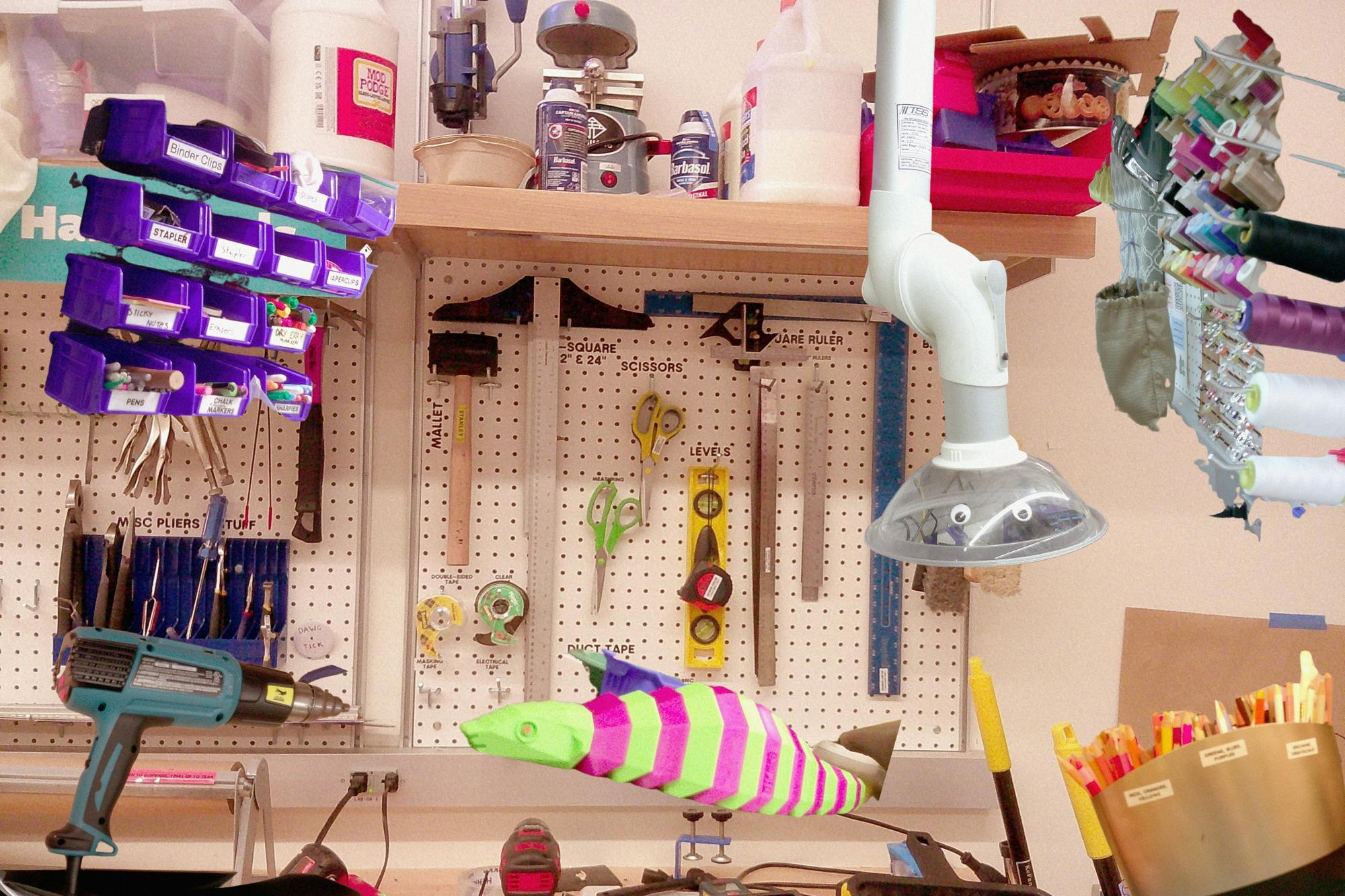
Inside the Harold Edward Cable Makerspace, ideas rarely stay on paper for long. A 3D printer hums as it builds a plastic figure layer by layer, while a laser cutter traces precise lines through a sheet of material. Around the room, students experiment with tools and materials, turning designs into tangible creations.
Located on the ground floor of the Class of 1982 Engineering and Computer Science Center, the makerspace gives Dartmouth students and faculty access to a variety of specialized machinery — such as sewing machines, laser cutters, a milling machine and 3D printers — and materials — such as free fabric, wood and other basic materials — for building projects.
According to a 2023 Dartmouth Alumni Magazine feature, the space was established in 2022 by a donation from Scott Sandell ’86 and his family in honor of his daughter, Anna Sandell ’23, an engineering student who suffered a critical injury from a snowmobile accident. It is named after her grandfather, Ed Cable, a mechanical engineer and inventor.
Although the makerspace’s offerings include specialized equipment, it is designed to be accessible to anyone interested in utilizing its resources. Computer science lecturer Kate Salesin, who co-teaches a Digital Applied Learning and Innovation Lab-led digital fabrication lab that utilizes the makerspace to build projects, noted that students can get involved with the makerspace without making an extensive time commitment.
“It’s nice that it is so open-ended and that [students] can just explore whatever is most interesting to them,” Salesin said. “People can just wander in and ask to be trained on whatever machines are in there. You don’t have to sit through even a week-long course. You can just go in for a couple hours when it’s convenient for you and use the machines.”
Makerspace assistant manager Nina Kieserman ’28 said she hopes to foster a space where students feel comfortable walking in and trying something new, regardless of their experience level.
“People come in here a lot, asking whether or not they’re allowed in here, whether or not they need to do trainings before getting in here and whether or not they’re allowed to use anything in here,” Kieserman said. “I wish people were more aware of the fact that you can just walk in and use a machine. You can walk in and ask the TAs for help learning how to use a machine. You can sign up for a training and just show up.”
For students who do want guidance, they can look to the makerspace’s teaching assistants for help using the equipment safely. Arthur Trindade ’29, an engineer at the DALI Lab, first started using the makerspace before he had any formal experience with machines like the 3D printer and credits much of his learning to the makerspace staff.
“The TAs in the makerspace are super nice and super dedicated to teaching very thoroughly,” Trindade said. “Most of my knowledge did come from asking the TAs for help and doing the safety trainings.”
Makerspace event facilitator Violet Cueva ’28, who leads trainings for the laser cutter machines and other educational programming, said she tries to make the learning process as approachable as possible.
“I try to make my trainings very friendly, so [the other students and I] are able to joke around while staying professional,” Cueva said. “Because of that, the students are a lot less stressed.”
However, there are still learning curves associated with the training process. Due to the complex nature of the laser cutter, one wrong setting can delay a simple cut or even break the machine in the process.
“Sometimes there’s settings that they forget,” Cueva said. “So I give them a couple [of] different ways to make sure that what they are doing is correct before it gets to the test cut.”
That combination of guidance and independence means that students can use the space for projects ranging from formal assignments to those purely inspired by personal interest.
For Trindade, one memorable project was creating a circular synthesizer, inspired by taking COSC 89.29/MUS 14.05: “Music and Artificial Intelligence” that term.
“I [used] a bunch of aluminum tape, which they had at the makerspace, with [a] capacitive touch sensor to make the keys of the keyboard detect when you touch them and play the sounds,” Trindade said. “Then I made an interactive screen in the middle and I think it’s one of the coolest projects I’ve done.”
Not all materials come from the makerspace or personal supplies, however — upcycling is a common trend in student projects. For a class project for SART 027: “Printmaking 1,” Cueva turned to old materials to build a large light-up carousel.
“I decided to create this light-up revolving carousel [that] was about three feet tall,” Cueva said. “I wound up using the laser cutter to create stamps that I would print things out with. I also took a lot of upcycled materials like chopsticks, my friend’s old umbrella, an old lazy susan, and I created this giant carousel.”
For Kieserman, the makerspace has provided the tools to create something a little more personal. She used the space to build an inkle loom, which can be used to make belts, shoelaces and other woven materials.
“I [used it to make] a couple headbands for my grandma,” Kieserman said. “It’s why I made [them] in the first place. A couple years ago, I found an inkle loom at camp and I made her a headband, and every year since then, she’s asked me for another one.”
In addition to supporting students’ individual projects, the makerspace also played a vital role in allowing designers to combine textiles, electronics and programming for the 2026 Entangled Ecologies Fashion x Tech Runway show, according to Salesin, who codirected the show. In preparation for the show, students and faculty worked on a variety of dresses with features ranging from laser cut fabric to LEDs.
“I made a piece that featured a bunch of 3D printed embroidery,” Salesin said. “We had two different pieces that incorporated liquids being pumped, so that was controlled by a microcontroller on the dress.”
The makerspace isn’t only for students working toward a specific project or deadline: It also hosts events for those who just want to try out the amenities of the space. Usually held every three weeks on Thursday from 4 p.m. to 6 p.m., these events give students the opportunity to work on projects without needing prior training.
“Over spring term, I held a couple [wire jewelry] workshops with one of my coworkers at the time, so we created things like wire flowers, wire cats, and a bunch of students created different things,” Cueva said. “This term we are leaning more towards other crafts that … involve less TA intervention [so] students are free to come in and they don’t have to be scheduled — they could just come in during a big two [to] three hour block.”
Beyond these events, students say the makerspace fosters community in more everyday ways.
“It is a place where you can find like-minded people who do the same types of crafts and the same types of activities that you do,” Kierserman said. “You can help each other to work on better and bigger projects together.”
Trindade echoed this sentiment, adding that the value of the makerspace comes from bringing people together in a way that digital work sometimes cannot.
“Working on something physical has this really special property of connecting to people in a more real sense, where [you’re] actually building something with them and sharing ideas in real time,” Trindade said.